Longitudinal associations between amyloid and symptoms of depression and anxiety in subjective cognitive decline: the impact of personality characteristics
Calvin Trieu, Mardou S. S. A. van Leeuwenstijn, Lisa-Marie Schlüter, Jarith L. Ebenau, Inge M. W. Verberk, Sietske A. M. Sikkes, Sander C. J. Verfaillie, Elsmarieke van de Giessen, Charlotte E. Teunissen, Wiesje M. van der Flier, Argonde C. van Harten

TL;DR
This study found that amyloid positivity in people with subjective cognitive decline is linked to increased depressive symptoms over time, but only in those with low neuroticism or somatization.
Contribution
The study identifies a preclinical Alzheimer’s-related depressive phenotype modulated by personality traits.
Findings
Amyloid status was not directly associated with depression or anxiety symptoms.
Neuroticism modified the link between amyloid positivity and increased GDS scores.
Somatization modified the link between amyloid positivity and increased CES-D scores.
Abstract
Depressive/anxiety symptoms are common in subjective cognitive decline (SCD) and may relate to Alzheimer’s pathology, potentially modulated by personality characteristics. Depressive/anxiety symptoms were assessed over 4 ± 2 years in 329 SCD (88 amyloid-positive/241 amyloid-negative) using Geriatric Depression Scale-15 (GDS), Center for Epidemiological Studies-Depression (CES-D), and Hospital Anxiety and Depression Scale-Anxiety (HADS-A). Mixed-effects models assessed associations between amyloid status and these symptoms, with neuroticism and somatization as effect-modifiers. Amyloid status was not directly associated with GDS, CES-D or HADS-A. However, neuroticism modified the association between amyloid status and GDS (p<0.05). In lower neuroticism, amyloid positivity was associated with GDS increase (β:0.10 ± 0.08), but not in higher neuroticism (β:-0.04 ± 0.12). Somatization…
Genes, proteins, chemicals, diseases, species, mutations and cell lines named across the full text — each resolved to its canonical identifier and authoritative record.
Click any figure to enlarge with its caption.
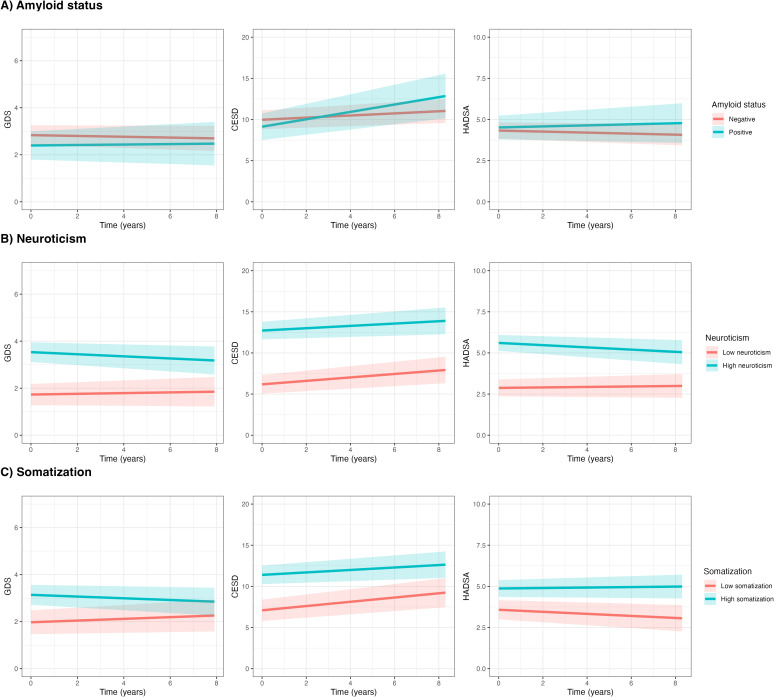 Figure 1
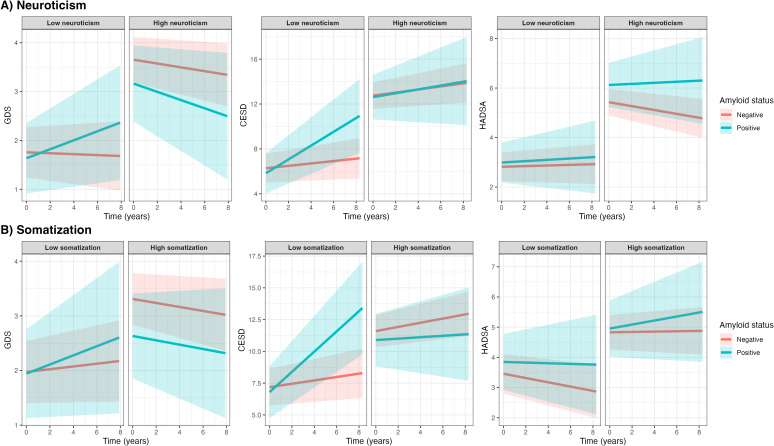 Figure 2
Peer Reviews
No public reviews on file for this paper yet. If you reviewed it on a platform where reviews are public (OpenReview, ICLR, NeurIPS, ICML), you can paste yours below so the community can read it here.
Videos
No videos yet. Explain this paper in a talk, walkthrough, or lecture? Add one.
Taxonomy
TopicsDementia and Cognitive Impairment Research · Mental Health Research Topics · Schizophrenia research and treatment