Between support and scepticism: Health professionals’ perceptions of a nutrition education program promoting low-carbohydrate, high-fat diets in under-resourced South African communities
Georgina Pujol-Busquets, Kate Larmuth, Christopher C. Webster, James Smith, Ahtisham Younas, Sergi Fàbregues, Anna Bach-Faig, Mickael Essouma, Mickael Essouma, Mickael Essouma

TL;DR
Health professionals in South Africa have mixed views on a program promoting low-carb, high-fat diets, with concerns about affordability and sustainability.
Contribution
The study provides new insights into healthcare professionals' perceptions of implementing low-carbohydrate, high-fat dietary interventions in under-resourced communities.
Findings
Healthcare professionals lacked confidence in their nutritional knowledge and had varied opinions on the sustainability of LCHF diets.
Concerns were raised about the high fat content and affordability of LCHF foods for disadvantaged communities.
Professionals acknowledged the value of group support but expressed reservations about the strong emphasis on LCHF diets in the EBSA program.
Abstract
The burden of non-communicable diseases (NCDs) continues to rise, emphasizing the need for effective dietary interventions. Programs such as Eat Better South Africa (EBSA) advocate for low-carbohydrate high-fat (LCHF) dietary choices, especially in disadvantaged communities. However, the adoption of such approaches among healthcare professionals remains contentious. This qualitative study explores healthcare professionals’ perspectives on nutrition and the EBSA program, drawing on 16 in-depth individual interviews with physicians, nurses, and dietitians from False Bay Hospital, Groote Schuur Hospital, and a primary health clinic in Hout Bay, Western Cape, South Africa. Thematic analysis of the interviews revealed four main findings. Healthcare professionals lacked confidence in their nutritional knowledge, and while many were familiar with the LCHF diet, opinions varied regarding its…
Genes, proteins, chemicals, diseases, species, mutations and cell lines named across the full text — each resolved to its canonical identifier and authoritative record.
Click any figure to enlarge with its caption.
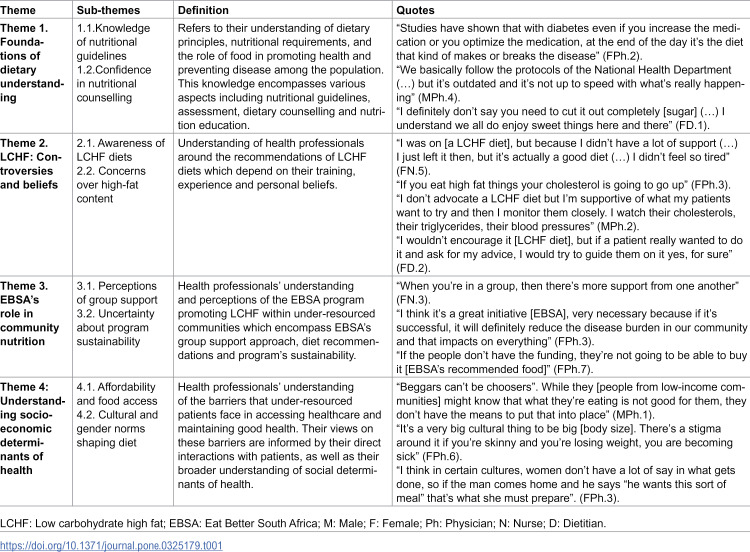 Figure 1
Peer Reviews
No public reviews on file for this paper yet. If you reviewed it on a platform where reviews are public (OpenReview, ICLR, NeurIPS, ICML), you can paste yours below so the community can read it here.
Videos
No videos yet. Explain this paper in a talk, walkthrough, or lecture? Add one.
Taxonomy
TopicsDiet and metabolism studies · Obesity and Health Practices · Obesity, Physical Activity, Diet