An overview of the treatment interventions and assessment of fear-avoidance for chronic musculoskeletal pain in adults: A scoping review protocol
Sam Tan, Anju Jaggi, Alex Tasker, Catherine Borra, Fraje Watson, André Pontes-Silva, André Pontes-Silva, André Pontes-Silva, André Pontes-Silva

TL;DR
This paper outlines a scoping review protocol to explore treatment interventions for fear-avoidance in chronic musculoskeletal pain, considering all relevant components and synonyms.
Contribution
The study introduces a comprehensive approach to assess interventions targeting all fear-avoidance components and their synonyms.
Findings
Current reviews focus mainly on kinesiophobia, neglecting other fear-avoidance components.
The review will include diverse study designs and outcome measures to provide a broader overview of interventions.
Patient and Public Involvement will be used to develop and reflect on the findings.
Abstract
The Fear-Avoidance (FA) model aims to explain how an acute pain experience can develop into a persistent state. The FA model considers five core components: kinesiophobia, pain-related fear, catastrophisation, victimisation, and interpersonal social environment. Amongst these, kinesiophobia, tends to dominate the literature on chronic musculoskeletal pain. As a result, current reviews have not considered the other core components of the FA model when exploring its interventions. Moreover, several synonyms of the term kinesiophobia is not reflected in their search strategies. Coupled with the preference of particular study designs and outcome measures, this scoping review aims to provide and characterise an overview of treatment interventions that consider all study designs, relevant outcome measures, FA components, and FA component synonyms. Eligible studies will be in English or with…
Genes, proteins, chemicals, diseases, species, mutations and cell lines named across the full text — each resolved to its canonical identifier and authoritative record.
Click any figure to enlarge with its caption.
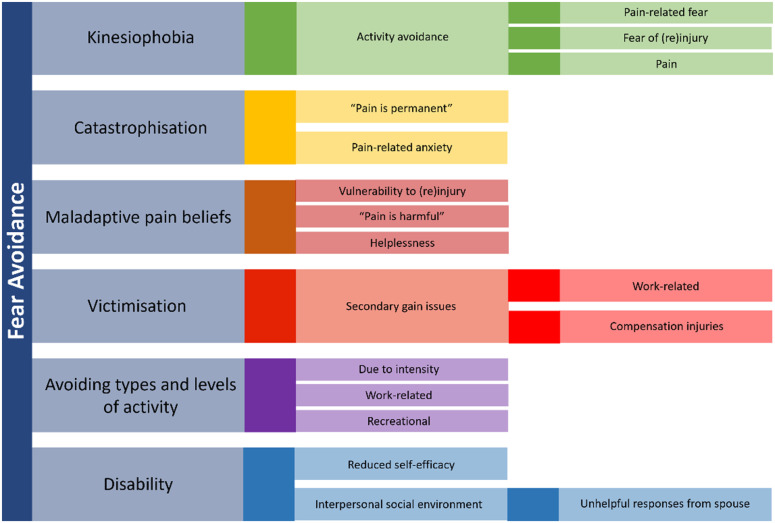 Figure 1
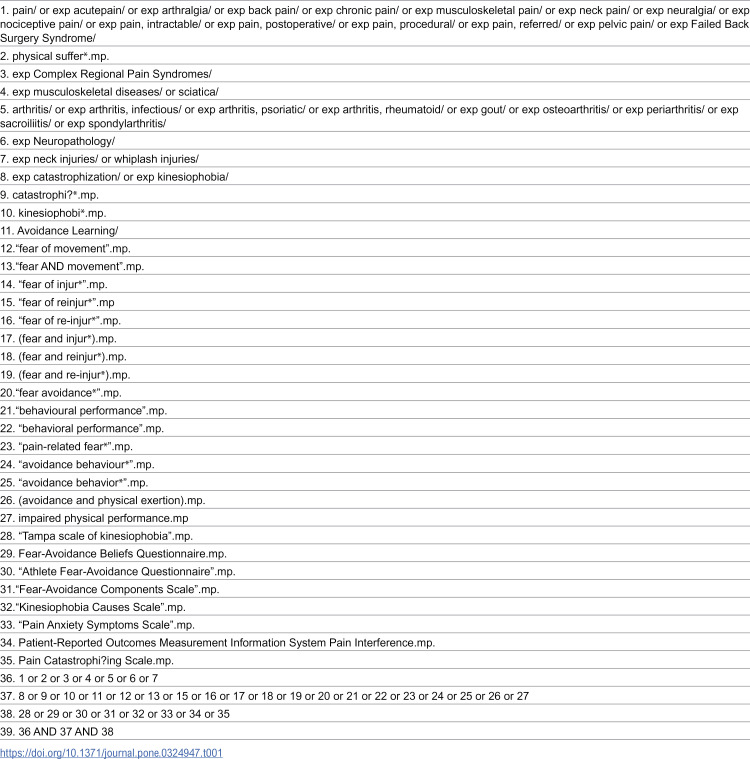 Figure 2
Peer Reviews
No public reviews on file for this paper yet. If you reviewed it on a platform where reviews are public (OpenReview, ICLR, NeurIPS, ICML), you can paste yours below so the community can read it here.
Videos
No videos yet. Explain this paper in a talk, walkthrough, or lecture? Add one.
Taxonomy
TopicsMusculoskeletal pain and rehabilitation · Fibromyalgia and Chronic Fatigue Syndrome Research · Pain Management and Placebo Effect