Feasibility and acceptability of remote APOE-genotyping among research volunteers of an online recruitment registry (The Dutch Brain Research Registry)
L. Waterink, S.J. van der Lee, D. Nijland, F.I. van der Zee, L.N.C. Visser, Y.A.L. Pijnenburg, S.A.M. Sikkes, W.M. van der Flier, M.D. Zwan

TL;DR
This study shows that at-home APOE-genotyping is feasible and well accepted by volunteers in an online registry for Alzheimer's prevention research.
Contribution
The study demonstrates the practicality of remote APOE-genotyping and introduces a prescreening strategy to improve recruitment efficiency.
Findings
High feasibility with 89% participation, 90% swab return, and 99% genotyping success rates.
27% of participants were APOE-ε4 heterozygotes and 2% homozygotes.
Prescreening with family history reduced the number of invitations needed to identify APOE-ε4 carriers by a third.
Abstract
Participant recruitment for preclinical Alzheimer's disease (AD) prevention studies is challenging. Online registries facilitate large scale prescreening of individuals at risk for AD to accelerate recruitment. APOE-prescreening has the potential to better identify at-risk individuals. This study investigated the feasibility and acceptability of at-home APOE-genotyping in cognitively-normal registrants of an online registry. We invited 9,287 cognitively-normal registrants of Dutch Brain Research Registry (DBRR) aged 50 to 75 for at-home APOE-genotype testing, without receiving the results. Feasibility was measured by participation ratio (participation/interested), swab-return ratio (returned-swabs/participation), and genotyping-success ratio (analyzed swabs/returned swabs). Acceptability was measured with online questions about information provision and project scope. We explored…
Genes, proteins, chemicals, diseases, species, mutations and cell lines named across the full text — each resolved to its canonical identifier and authoritative record.
Click any figure to enlarge with its caption.
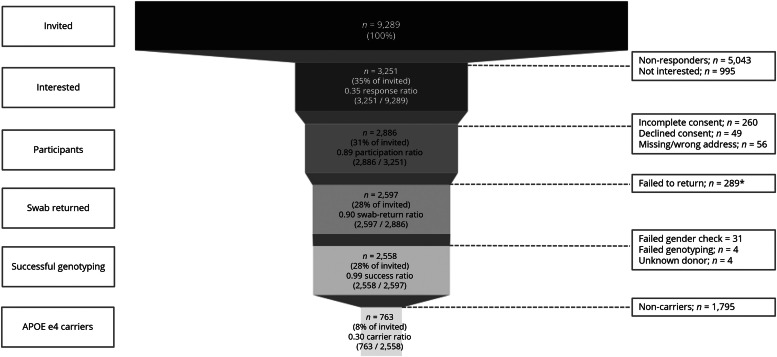 Figure 1
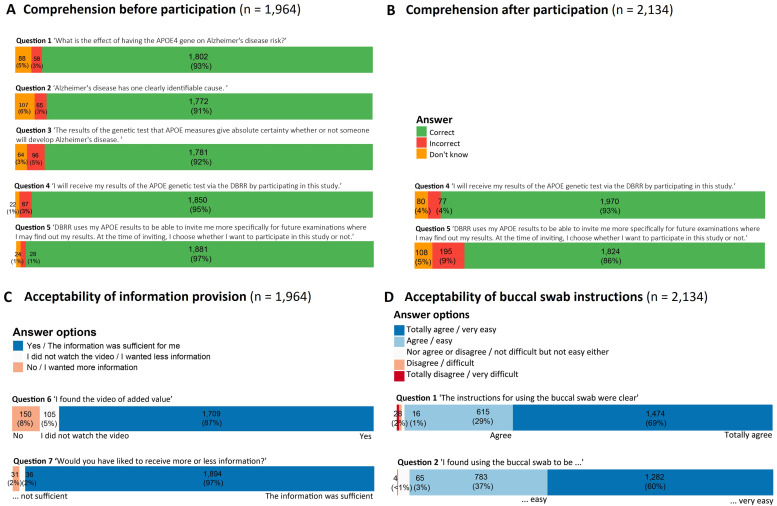 Figure 2
Peer Reviews
No public reviews on file for this paper yet. If you reviewed it on a platform where reviews are public (OpenReview, ICLR, NeurIPS, ICML), you can paste yours below so the community can read it here.
Videos
No videos yet. Explain this paper in a talk, walkthrough, or lecture? Add one.
Taxonomy
TopicsHealth, Environment, Cognitive Aging · Functional Brain Connectivity Studies · Dementia and Cognitive Impairment Research