Tuberculosis Under Biotherapy in Patients with Spondyloarthritis: Data from the Moroccan Biotherapy Registry (RBSMR) during 3 Years of Follow Up
Salma Zemrani, Bouchra Amine, Imane Elbinoune, Chaimae Charoui, Samira Rostom, Ihsane Hmamouchi, Redouane Abouqal, Ahmed Bezza, Fadoua Allali, Imane El Bouchti, Abdellah El Maghraoui, Imad Ghozlani, Hasna Hassikou, Taoufik Harzy, Linda Ichchou, Ouafae Mkinsi, Redouane Niamane

TL;DR
This study finds that patients with spondyloarthritis on biotherapy, especially TNF-inhibitors, have a higher risk of active tuberculosis, highlighting the need for careful monitoring.
Contribution
The study provides new incidence data on tuberculosis in Moroccan spondyloarthritis patients on biotherapy and evaluates LTBI reactivation rates.
Findings
The incidence of active tuberculosis was 17/1000 patient-years in patients on TNF-inhibitors.
Diabetes and prior use of multiple TNF-inhibitors were significantly associated with active tuberculosis.
Only 4.5% of patients with prior latent tuberculosis infection developed active tuberculosis after chemoprophylaxis.
Abstract
Biologics agents may lead to a significant risk of infection, including tuberculosis, particularly in endemic countries. This study aims to determine the incidence and characteristics of active tuberculosis in spondyloarthritis patients undergoing biotherapies and estimate the rate of reactivation of latent tuberculosis infection (LTBI). A prospective multicentre study was conducted based on 3-year data from the Moroccan Register of Biotherapies (RBSMR). We determined the incidence rate of tuberculosis during follow-up and performed a comparison with patients in whom tuberculosis was not detected. Screening for LTBI prior to the initiation of biotherapy was analysed, and the reactivation rate was determined at the 3-year follow-up. 194 patients with SpA were included. 98.8% of the patients received TNF-inhibitors, and 6.6% had a history of treated tuberculosis infection. After 3 years…
Genes, proteins, chemicals, diseases, species, mutations and cell lines named across the full text — each resolved to its canonical identifier and authoritative record.
Click any figure to enlarge with its caption.
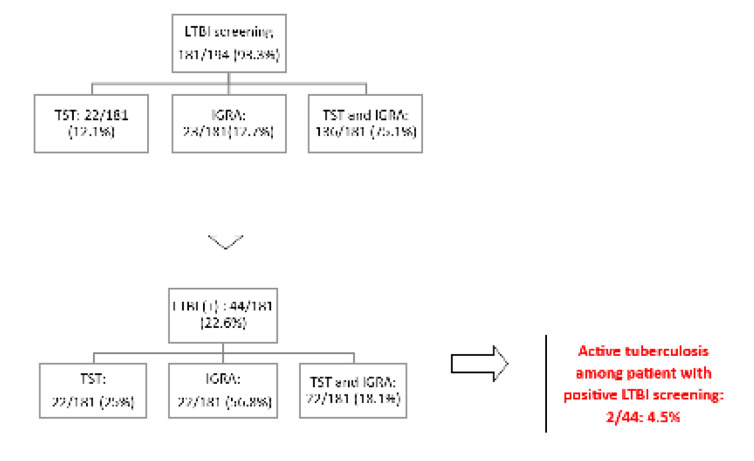 Figure 1
Peer Reviews
No public reviews on file for this paper yet. If you reviewed it on a platform where reviews are public (OpenReview, ICLR, NeurIPS, ICML), you can paste yours below so the community can read it here.
Videos
No videos yet. Explain this paper in a talk, walkthrough, or lecture? Add one.
Taxonomy
TopicsTuberculosis Research and Epidemiology · Infectious Diseases and Tuberculosis · Leprosy Research and Treatment