Longitudinal study of body mass index in relation to Alzheimer's disease pathology and symptomatology in Down syndrome
Victoria L. Fleming, Brian C. Helsel, Lauren T. Ptomey, Benjamin L. Handen, Sharon J. Krinsky‐McHale, Christy L. Hom, Matthew Zammit, Davneet Minhas, Weiquan Luo, Charles Laymon, Joseph H. Lee, Ira Lott, Annie Cohen, Beau M. Ances, Adam M. Brickman, Margaret Pulsifer

TL;DR
This study shows that adults with Down syndrome experience BMI decline in their 40s, which is linked to Alzheimer's disease pathology and cognitive decline.
Contribution
The study links longitudinal BMI decline to AD biomarkers and cognitive decline in adults with Down syndrome.
Findings
BMI decline in adults with Down syndrome is associated with amyloid beta deposition and cognitive decline.
BMI decline begins in the early 40s and is linked to memory and cognitive functioning decline.
BMI decline is an important clinical indicator for Down syndrome-associated Alzheimer's disease.
Abstract
Weight loss has been linked to early Alzheimer's disease (AD) pathology, possibly through metabolic dysregulation. We examined changes in body mass index (BMI) in relation to AD biomarkers (amyloid beta [Aβ] and tau) and cognitive decline in adults with Down syndrome (DS). We hypothesized that BMI decline would track with early AD pathology and cognitive decline. Adults with DS (N = 467; Mage = 43.67 ± 10.06) completed one to four data cycles (≈16 months apart). Linear mixed models examined BMI change over time by age, positron emission tomography (PET) Aβ and tau, and changes in memory and dementia symptoms. BMI declined with age‐by‐time (β = −0.014, p = 0.002) and baseline PET Aβ‐by‐time (β = −0.005, p = 0.002). On average, BMI decline began in the early 40s and was related to decline in memory and overall cognitive functioning. Weight loss is associated with the presence of Aβ…
Genes, proteins, chemicals, diseases, species, mutations and cell lines named across the full text — each resolved to its canonical identifier and authoritative record.
Click any figure to enlarge with its caption.
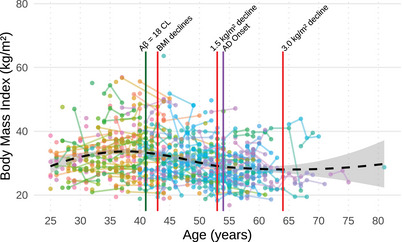 Figure 1
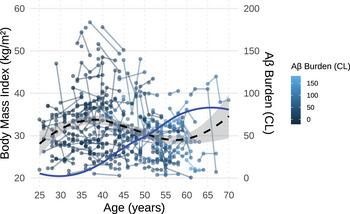 Figure 2
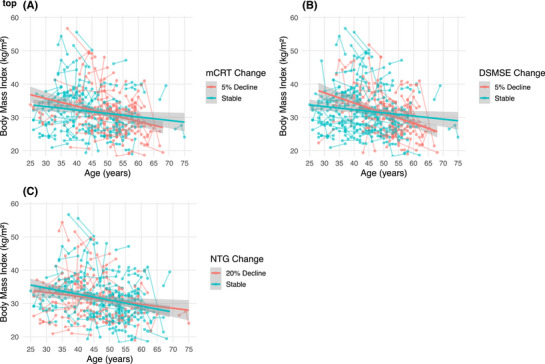 Figure 3
Peer Reviews
No public reviews on file for this paper yet. If you reviewed it on a platform where reviews are public (OpenReview, ICLR, NeurIPS, ICML), you can paste yours below so the community can read it here.
Videos
No videos yet. Explain this paper in a talk, walkthrough, or lecture? Add one.
Taxonomy
TopicsDown syndrome and intellectual disability research · Frailty in Older Adults · Dementia and Cognitive Impairment Research