Evolutionary insights into toxins diversity in Ceriantharia (Cnidaria; Anthozoa)
Celine S.S. Lopes, Rafael E. Iwama, Thainá Cortez, Sónia C.S. Andrade, Anna M.L. Klompen, Jorge A. Audino, Jason Macrander, Adam M. Reitzel, Renato M. Nagata, Emilio Lanna, Lucas D. Martinez, Barbara M. Chagas, Sérgio N. Stampar

TL;DR
This study explores toxin diversity in Ceriantharia, finding that larvae and polyps have different toxin profiles, possibly due to environmental and developmental factors.
Contribution
The study provides new insights into the evolutionary dynamics of toxin-like proteins in Ceriantharia through transcriptomic and phylogenetic analyses.
Findings
The larva of Arachnanthus errans expresses 70 more toxin-like genes than the polyp.
Phylogenetic analyses suggest duplication events in ShK-like and Kunitz-type toxins in Ceriantharia.
Genes related to stress response, metamorphosis, reproduction, and immunity were identified in A. errans.
Abstract
Ceriantharians synthesize and inoculate the toxins found in their stinging cells spread throughout the body. For most cnidarians the putative toxins profile can vary widely depending on the tissue function and the environmental conditions faced by these marine invertebrates. Extensive gene duplications events have impacted the diversity of the toxins system of cnidarians and could explain the rapid emergence of novel toxins. On the other hand, it seems for Ceriantharia, the putative toxins profile does not exhibit major variation, despite occupying different ecological niches. Some species of ceriantharians have a planktonic stage that is highly dispersive, while the benthic phase is characterized by semi-sessile polyp. However, the polyp builds a tube involving the entire column that can play an additional function by protecting against predators and competitors, which could decrease…
Genes, proteins, chemicals, diseases, species, mutations and cell lines named across the full text — each resolved to its canonical identifier and authoritative record.
Click any figure to enlarge with its caption.
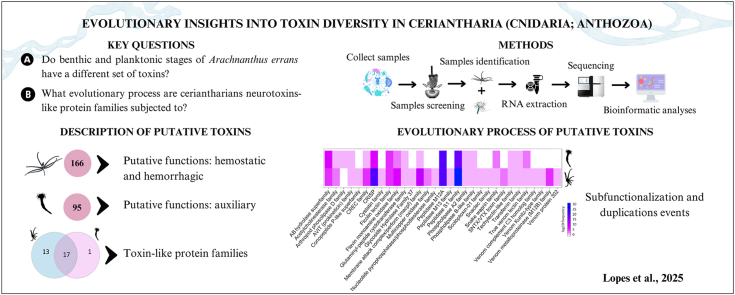 Figure 1
 Figure 2
 Figure 3
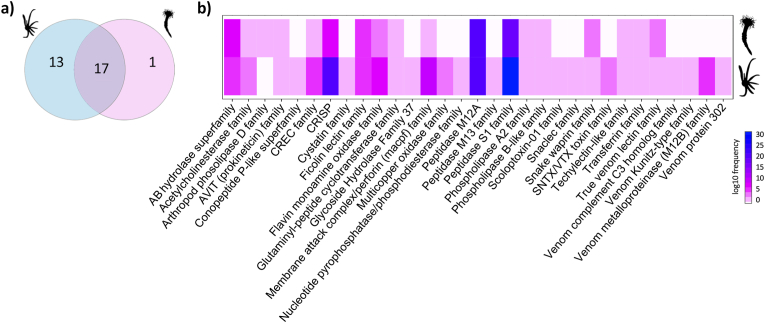 Figure 4
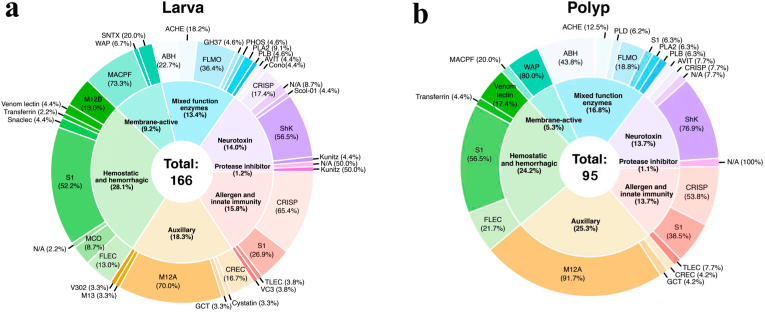 Figure 5
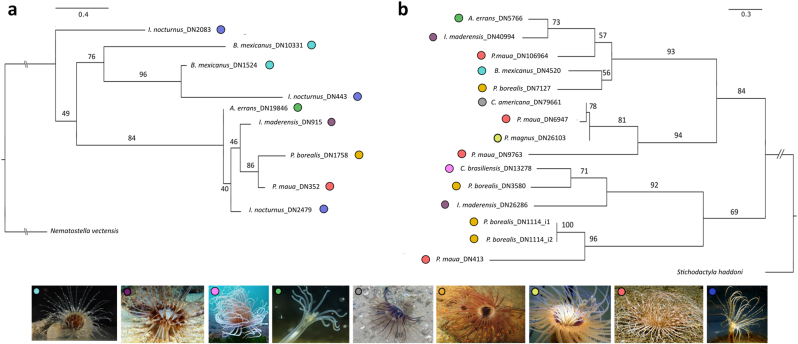 Figure 6
Peer Reviews
No public reviews on file for this paper yet. If you reviewed it on a platform where reviews are public (OpenReview, ICLR, NeurIPS, ICML), you can paste yours below so the community can read it here.
Videos
No videos yet. Explain this paper in a talk, walkthrough, or lecture? Add one.
Taxonomy
TopicsMarine Invertebrate Physiology and Ecology · Coral and Marine Ecosystems Studies · Vibrio bacteria research studies