Psoriasiform Dermatitis: A Peculiar Presentation in the Setting of Staphylococcus aureus Bacteremia and Hepatitis C
Noor Ul Ain Shahid, Noman Saleem, Syeda Juveria, Musab Zubair

TL;DR
A 64-year-old woman with hepatitis C and staph infection developed a severe rash resembling psoriasis, which improved with treatment.
Contribution
This case highlights a rare presentation of psoriasiform dermatitis in the context of Staphylococcus aureus bacteremia and untreated hepatitis C.
Findings
The patient's rash was confirmed as psoriasis via skin biopsy despite initial suspicion of other conditions.
Treatment with topical betamethasone led to significant improvement in the rash and skin lesions.
Low complement levels and elevated ESR were observed, but cryoglobulinemia and ANA were negative.
Abstract
Psoriasis is a multifactorial, immune-mediated dermatitis and chronic papulosquamous disease with considerable geographic and ethnic variation. Psoriasiform dermatitis encompasses a wide spectrum of inflammatory conditions, with several major forms represented by psoriasis. This case report presents an unusual case of psoriasis in a patient with Staphylococcus aureus bacteremia and untreated hepatitis C. A 64-year-old female with untreated chronic active hepatitis C presented with a one-and-a-half-month history of a spreading, pruritic, and painful erythematous rash, initially on her feet and extending to her inner thighs. Examination showed skin breakdown from scratching. Methicillin-sensitive Staphylococcus aureus (MSSA) bacteremia was identified, and nafcillin was started. Initial differential diagnoses included cryoglobulinemia, leukocytoclastic vasculitis, and allergic drug…
Genes, proteins, chemicals, diseases, species, mutations and cell lines named across the full text — each resolved to its canonical identifier and authoritative record.
Click any figure to enlarge with its caption.
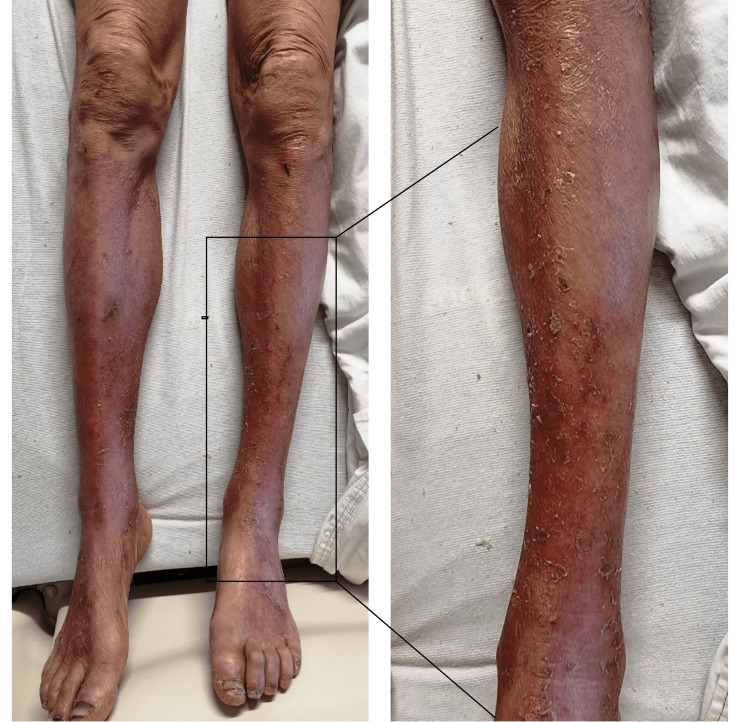 Figure 1
| Test | Result | Units | Reference Range |
| Lactic acid | 2.2 | mMol/L | 0.5 - 2.2 |
| Lipase | 31 | Units/Liter | 0 - 60 |
| Magnesium | 1.4 | mg/dL | 1.7 - 2.2 |
| WBC | 8.3 | K/CUMM | 4.0 - 11.0 |
| RBC | 2.68 | M/CUMM | 4.7 - 6.1 |
| Hemoglobin | 9.4 | g/dL | 13.5 - 17.5 |
| Hematocrit | 30 | % | 38.8 - 50.0 |
| MCV | 111.9 | fL | 80 - 100 |
| MCH | 35.1 | pg | 27 - 33 |
| Platelets | 189 | K/CUMM | 150 - 450 |
| Glucose by meter | 539 | mg/dL | 70 - 140 |
| AST | 139 | U/L | 10 - 40 |
| ALT | 88 | U/L | 7 - 56 |
| ALP | 219 | U/L | 44 - 147 |
Peer Reviews
No public reviews on file for this paper yet. If you reviewed it on a platform where reviews are public (OpenReview, ICLR, NeurIPS, ICML), you can paste yours below so the community can read it here.
Videos
No videos yet. Explain this paper in a talk, walkthrough, or lecture? Add one.
Taxonomy
TopicsDermatology and Skin Diseases · Psoriasis: Treatment and Pathogenesis · Autoimmune Bullous Skin Diseases
Introduction
Psoriasis affects approximately 3% of adults in the United States, and prevalence has remained nearly the same for almost two decades [1]. This multifactorial, immune-mediated chronic papulosquamous dermatitis exhibits considerable geographic and ethnic variation [2]. Psoriasiform dermatitis encompasses a broad spectrum of inflammatory skin conditions, with psoriasis representing several major forms. Immunological, environmental, and genetic predispositions play a major role in the development. This case is presented due to its unusual features, which could be easily overlooked by healthcare providers. We considered and ruled out several differential diagnoses, discussed a detailed treatment plan, and have included relevant clinical images. A rapidly progressing rash in a patient with methicillin-sensitive Staphylococcus aureus(MSSA) bacteremia and untreated hepatitis C virus (HCV) presents a complex diagnostic challenge. Differentiating the rash's etiology necessitates a thorough workup to consider drug reactions, infectious exanthems, HCV-related skin manifestations, and sepsis-related findings.
Case presentation
A 64-year-old African American female with a history of untreated chronic active HCV and alcohol use disorder presented to the emergency department with a chief complaint of a rash involving her lower extremities for over 45 days. Initially appearing as dark patches on both feet, the rash was pruritic and erythematous, gradually extending to the inner thighs as a painful, diffuse erythematous rash (Figure 1).
Diffuse erythematous rash below the knee bilaterally
Physical examination revealed multiple areas of skin breakdown secondary to severe scratching, in addition to the previously described lesions. Initial laboratory evaluation showed alanine aminotransferase (ALT) of 88 U/L, aspartate aminotransferase (AST) of 139 U/L, alkaline phosphatase of 219 U/L, hemoglobin of 9.4 g/dL, mean corpuscular volume (MCV) of 111.9 fL, and an ethanol level of 146 mg/dL, indicating hepatocellular injury secondary to alcohol abuse and HC (Table 1).
Although afebrile, her blood cultures were positive for MSSA. She was treated with intravenous (IV) fluids, acetaminophen, and IV nafcillin for the MSSA bacteremia, which was likely secondary to infected skin lesions. As the rash progressed to involve the proximal thighs and trunk as a macular rash, nafcillin was switched to IV vancomycin. Given her untreated HCV, cryoglobulinemia, leukocytoclastic vasculitis, or an allergic drug reaction were initially considered as plausible differentials for the rapidly spreading rash. Serological workup revealed a negative antinuclear antibody (ANA) test, C3 of 104 mg/dL, C4 of 17 mg/dL, CH50 of 31 U/mL, erythrocyte sedimentation rate (ESR) of 100 mm/hr, and negative cryoglobulins. For pruritus, permethrin cream and malathion lotion were initiated, providing significant relief, along with topical betamethasone ointment. A skin biopsy was then deemed necessary. The surgery and pathology departments were consulted. Skin punch biopsy specimens were taken by the surgical team under sterile conditions using topical anesthesia from the left mid-thigh (lesion center and border) and medial knee (lesion center and border). Microscopic examination revealed epidermal acanthosis with a somewhat psoriasiform pattern and overlying parakeratosis. Neutrophil exocytosis was not observed. A sparse perivascular lymphocytic infiltrate was observed in the dermis. Microscopic findings suggested psoriasiform dermatitis. Contact and nummular dermatitis were less likely. A gastroenterology consult was recommended for outpatient treatment of HCV.
Discussion
Psoriasis is a common, chronic, multifactorial immune-mediated inflammatory skin disorder that can be triggered by various factors, including infections, alcohol consumption, medications, trauma, and endocrine disorders [3]. Psoriasis has diverse clinical manifestations. The five major types of psoriasis include plaque, inverse, guttate, pustular, and erythrodermic. Typical lesions are chronic, recurring, scaly papules and plaques. Pustular eruptions and erythroderma can also occur. Psoriasiform dermatitis represents a wide spectrum of inflammatory skin conditions, with the majority presented by psoriasis. Others include Reiter’s syndrome and lichen simplex chronicus. Pathogens appear to contribute to the pathogenesis of psoriasis through exotoxin production. Pathogens such as Staphylococcus aureus and HCV can trigger or exacerbate psoriasis, potentially through superantigen activation of skin-homing T cells and upregulation of tumor necrosis factor [4,5,6]. There were around 389 common genes related to both psoriasis and HC [4]. These genes play a crucial role in the pathogenesis of both diseases and can take part in a variety of biological pathways. In individuals genetically predisposed to psoriasis, HCV and Staphylococcus *aureus *bacteremia could dysregulate the immune system, inflammation, and cell growth that lead to unusually severe and rapidly progressive psoriatic eruption. This case presents a pruritic, erythematous rash on both feet, rapidly spreading proximally to the trunk and lower extremities, in a patient with chronic, untreated HCV and Staphylococcus aureus bacteremia. Representing an atypical presentation posed diagnostic challenges. Diagnosis required histopathological analysis, which helped rule out other psoriasisiform dermatitides. Corticosteroids are essential in reducing the extent of skin lesions. Steroid-sparing agents, such as vitamin D analogs, tazarotene, and calcineurin inhibitors, alone or in combination with steroids, can also be used for treatment. The combination of these agents provides a more sustainable treatment strategy, minimizing the reliance on high-potency corticosteroids and their associated risks.
Conclusions
Psoriasis can be triggered by various factors, including infections, alcohol consumption, medications, trauma, and endocrine disorders. Pathogens such as *Staphylococcus aureus *and HCV can trigger or exacerbate psoriasis, potentially through superantigen activation of skin-homing T cells and upregulation of tumor necrosis factor-α. This case highlights an unusual presentation of psoriasis with a widespread, erythematous, pruritic rash resembling vasculitis. Prompt diagnosis requires appropriate laboratory testing and skin biopsy. Appropriate treatment is crucial to minimize the extent of skin lesions and associated complications.
The reference list from the paper itself. Each links out to its DOI / PubMed record.
- 1Psoriasis prevalence in adults in the United States JAMA Dermatol Armstrong AW Mehta MD Schupp CW Gondo GC Bell SJ Griffiths CE 94094615720213419095710.1001/jamadermatol.2021.2007 PMC 8246333 · doi ↗ · pubmed ↗
- 2Genetic epidemiology of psoriasis Curr Dermatol Rep Gupta R Debbaneh MG Liao W 6178320142558037310.1007/s 13671-013-0066-6PMC 4285384 · doi ↗ · pubmed ↗
- 3Psoriasis 2025 https://www.mayoclinic.org/diseases-conditions/psoriasis/symptoms-causes/syc-20355840
- 4Is there a relationship between psoriasis and hepatitis C? A meta-analysis and bioinformatics investigation Virol J Liu Y Cui SN Duan MY 1351820213421526010.1186/s 12985-021-01606-z PMC 8252322 · doi ↗ · pubmed ↗
- 5Infection-provoked psoriasis: induced or aggravated (Review)Exp Ther Med Teng Y Xie W Tao X 5672120213385053910.3892/etm.2021.9999 PMC 8027725 · doi ↗ · pubmed ↗
- 6Hepatitis C may enhance key amplifiers of psoriasis J Eur Acad Dermatol Venereol Chun K Afshar M Audish D Kabigting F Paik A Gallo R Hata T 6726783120172718418510.1111/jdv.13578 · doi ↗ · pubmed ↗