Author Correction: Antinociceptive effect of intermittent fasting via the orexin pathway on formalin-induced acute pain in mice
Hyunjin Shin, Jaehyuk Kim, Sheu-Ran Choi, Dong-Wook Kang, Ji-Young Moon, Dae-Hyun Roh, Miok Bae, Jungmo Hwang, Hyun-Woo Kim

Abstract
Genes, proteins, chemicals, diseases, species, mutations and cell lines named across the full text — each resolved to its canonical identifier and authoritative record.
Click any figure to enlarge with its caption.
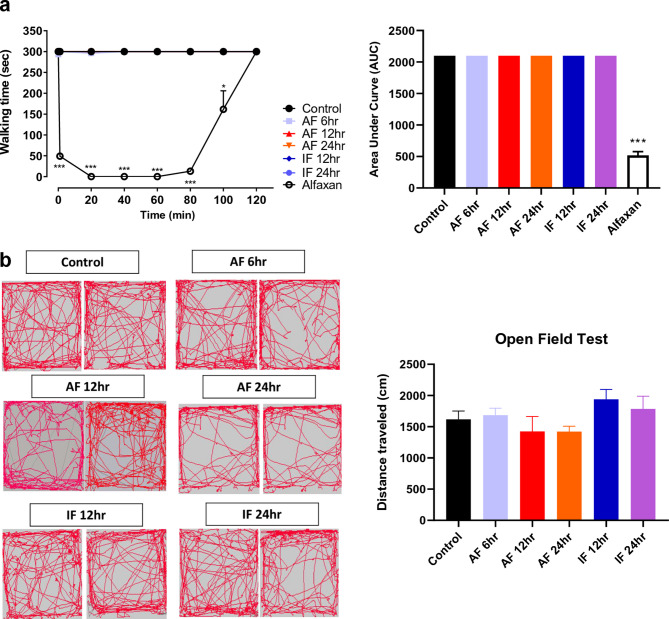 Figure 2
Peer Reviews
No public reviews on file for this paper yet. If you reviewed it on a platform where reviews are public (OpenReview, ICLR, NeurIPS, ICML), you can paste yours below so the community can read it here.
Videos
No videos yet. Explain this paper in a talk, walkthrough, or lecture? Add one.
Taxonomy
TopicsSleep and Wakefulness Research · Dietary Effects on Health
Correction to: Scientific reports 10.1038/s41598-023-47278-3, published online 20 November 2023
The original version of this Article contained an error in Figure 2, panel b, where two identical images were used in the open field trace data of “AF 24hr”. The original Figure 2 and accompanying legend appear below.Fig. 2. Effects of acute and intermittent fasting on motor function. (a) Rota-rod test was performed after 6 h acute fasting (AF 6 h), 12 h acute fasting (AF 12 h), 24 h acute fasting (AF 24 h), 12 h intermittent fasting (IF 12 h), 24 h intermittent fasting (IF 24 h), and alfaxan administration (positive control). Area under curve (AUC) was analyzed in control, fasting, and alfaxan-treated groups. (b) Open field test was performed in control and fasting groups and the distance traveled for 5 min was analyzed and plotted in a graph. Data were expressed as the mean ± SEM. *p < 0.05 and ***p < 0.0001 vs. Control. n = 5 mice/group.
The original Article has been corrected.