PDF Entity Annotation Tool (PEAT)
Christopher G. Stahl, Kristan J. Markey, Brian C. Jewell, Dahnish Shams, Michele M. Taylor, A. Amina Wilkins, Sean Watford, Andy Shapiro, Michelle Angrish

TL;DR
PEAT is a new tool that allows researchers to annotate PDF documents directly without converting them to plain text, making the process more accurate and easier for creating machine-readable datasets.
Contribution
PEAT introduces a novel approach to annotate PDFs while preserving their original structure, enabling domain-specific schema creation for machine learning.
Findings
Annotations can be made directly on the original PDF layout without losing structural information.
The tool supports the creation of domain-specific schemas for diverse knowledge domains.
PEAT improves accuracy and ease of annotation compared to traditional methods.
Abstract
While different text mining approaches – including the use of Artificial Intelligence (AI) and other machine based methods - continue to expand at a rapid pace, the tools used by researchers to create the labeled datasets required for training, modeling, and evaluation remain rudimentary. Labeled datasets contain the target attributes the machine is going to learn; for example, training an algorithm to delineate between images of a car or truck would generally require a set of images with a quantitative description of the underlying features of each vehicle type. Development of labeled textual data that can be used to build natural language machine learning models for scientific literature is not currently integrated into existing manual workflows used by domain experts. Published literature is rich with important information, such as different types of embedded text, plots, and tables…
Genes, proteins, chemicals, diseases, species, mutations and cell lines named across the full text — each resolved to its canonical identifier and authoritative record.
Click any figure to enlarge with its caption.
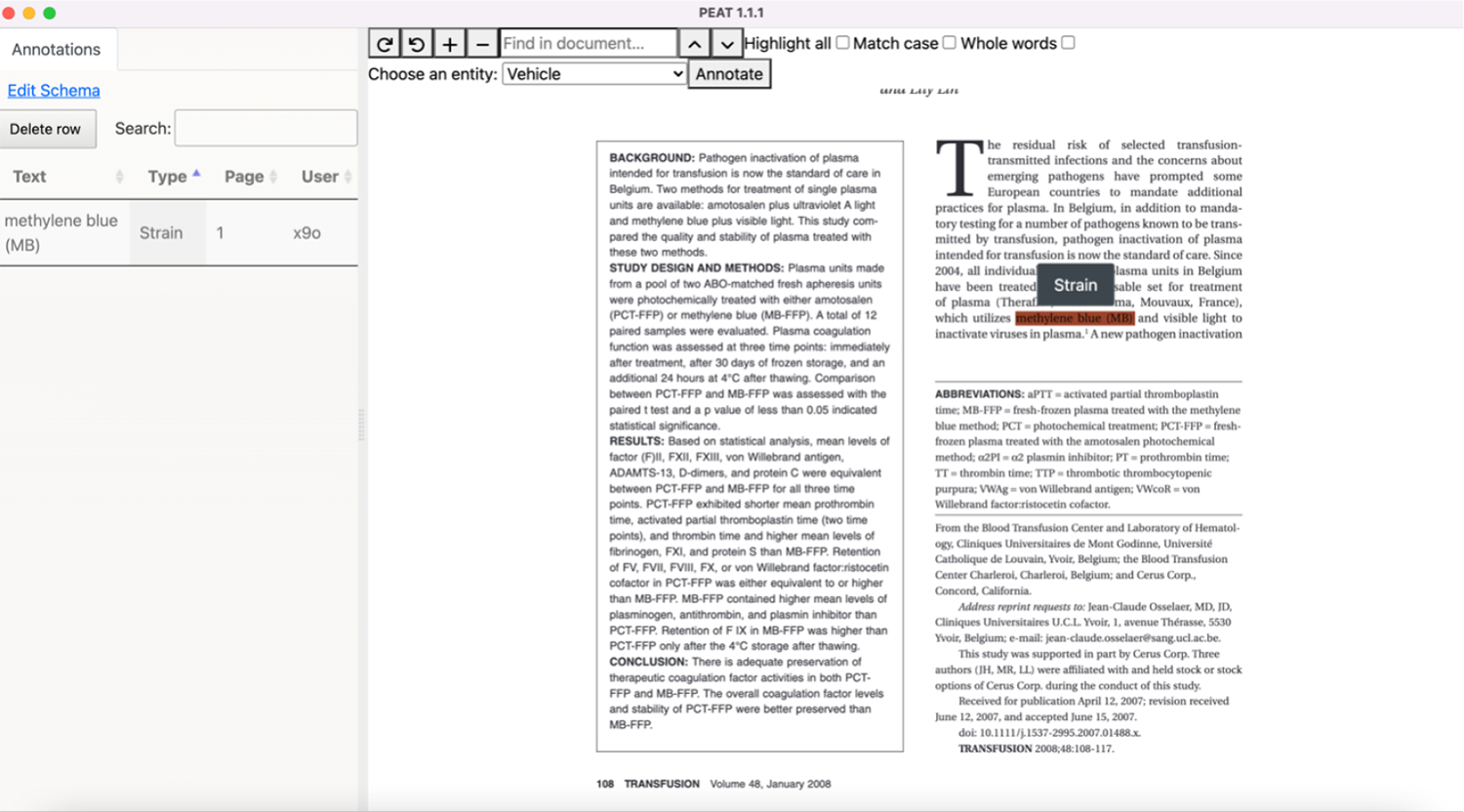 Figure 1
Peer Reviews
No public reviews on file for this paper yet. If you reviewed it on a platform where reviews are public (OpenReview, ICLR, NeurIPS, ICML), you can paste yours below so the community can read it here.
Videos
No videos yet. Explain this paper in a talk, walkthrough, or lecture? Add one.
Taxonomy
TopicsSemantic Web and Ontologies · Topic Modeling · Biomedical Text Mining and Ontologies
Statement of need
Data users are confronted with new data being published faster than manual data extractions are practical. Millions of publications are produced every year (White, 2021), potentially containing useful information for ongoing and future research, experiments, etc. With the sheer amount of data needing to be processed, it is unsustainable to manually keep up with the information being produced. The development and application of ML tools to help process and manage useful information from these publications is critically important to ensure that the most recent evidence is identified, evaluated, and extracted. Development of ML models requires manually labelled datasets, but currently, generation of those datasets is a high level of effort endeavor and not aligned with existing workflows used to manually summarize content presented in full-text (e.g., literature review workflows). Scientific literature is almost exclusively made available in print publications that are locked behind non-machine-readable formats, primarily PDF. The PDF format was designed to create digital versions of paper documents while maintaining their visual look and structure. While the format handles that task very well, it does not lend to the extraction of data to other formats. The opening of the PDF standard in 2008 (International Organization for Standardization, 2020) has helped facilitate PDF text extraction, but document formatting and content (e.g., coordinates of text within a document) can still be lost during PDF to text conversion using currently available tools (Xu et al., 2013).
Existing annotation solutions such as BRAT (Stenetorp et al., 2012), TeamTat (Islamaj et al., 2020), GATE (GATE, 2022), and Dextr (Walker et al., 2022) rely on first converting the PDF to a plain text layer before annotation by the user. Not only does this require the researcher to annotate unstructured plain text as opposed to a fully formatted PDF document, but also in many instances the PDF’s format (double/triple columns, tables, etc) would fail to extract and render a document unusable. This is due to the nature of the PDF document creation process. Text can be split into several chunks (splits within words, lines, columns, etc.) and extraction tools use heuristics to attempt to put the chunks back together like a puzzle. A separate tool, PDFAnno (Shindo et al., 2018), improved on this by allowing annotation layers to be created on top of PDF documents but is no longer maintained or functional. Reac-PDF Annot (Tyurin, 2022) is a library that allows for basic annotations to be created in on top of PDFJS (Mozilla, 2025) based applications and was used as a baseline for our application.
PEAT was designed to take advantage of the latest advancements in PDF text extraction methods while also allowing the user to annotate and label the data directly in PDF format. This approach allows a user to work in a document structure they are familiar with, improving the user experience and facilitating the creation of labeled data for machine consumption and training of future machine learning models. PEAT is a portable, standalone application built off the Electron software framework (Electron Authors, 2025) and can be used on all major operating systems (Windows, Linux, and Macintosh) and provides an interface for users to annotate PDFs that are displayed in their intended format (Figure 1).
The portability is accomplished by embedding all necessary dependencies into the framework, which does result in a larger than usual footprint, PEAT is 500 MB. The application allows users to load PDFs directly from their file system along with data annotation forms with standard or customizable annotation types, labels, entities, and other features such as custom color highlighting. The application also includes features for users to edit and import/export data extraction schemas, export annotations of X and Y PDF coordinate structure (based on the image layer of the PDF), search and manipulate annotations, and save/load progress. Once a user has completed document annotation, the labeled data, full text, and all associated metadata is exportable in JSON format that can be processed by a variety of NLP model building applications such as Spacy or PyTorch (Ansel et al., 2024; Honnibal et al., 2020).
Conclusion and Future Work
In this work we demonstrated PEAT’s ability to assist users in the creation of annotated datasets that provide a machine-readable output suitable for machine learning applications. It allows users to annotate PDF documents in their native form using standard or custom annotations suitable for direct use with named entity recognition tools. Additionally, the schema editor tool grants users the flexibility to customize their annotations for domain specific applications. PEAT provides the foundation for many additional features such as collaborative annotation, a hierarchical annotation system (i.e., groups of annotations forming “relationships”), auto annotation based on imported ontologies, and more. Finally, creating a pluggable architecture for generating and aligning text layers or segments which would be used for annotations and NLP processing would be desirable. These feature enhancements would further increase the user’s ability to create more advanced annotation sets, laying the groundwork for the continued growth and evolution of machine learning applications.
The reference list from the paper itself. Each links out to its DOI / PubMed record.
- 1Ansel J, Yang E, He H, Gimelshein N, Jain A, Voznesensky M, Bao B, Bell P, Berard D, Burovski E, Chauhan G, Chourdia A, Constable W, Desmaison A, De Vito Z, Ellison E, Feng W, Gong J, Gschwind M, … Chintala S (2024). Py Torch 2: Faster Machine Learning Through Dynamic Python Bytecode Transformation and Graph Compilation. 29th ACM International Conference on Architectural Support for Programming Languages and Operating Systems, Volume 2 (ASPLOS ‘24). 10.1145/3620665.3640366 · doi ↗
- 2Electron Authors. (2025). Electron. https://github.com/electron/electron
- 3GATE: A full-lifecycle open source solution for text processing. (2022). The University of Sheffield. https://gate.ac.uk/overview.html
- 4Honnibal M, Montani I, Van Landeghem S, & Boyd A (2020). spa Cy: Industrial-strength Natural Language Processing in Python. 10.5281/zenodo.1212303 · doi ↗
- 5International Organization for Standardization. (2020). ISO 32000-2:2020 document management – portable document format – part 2: PDF 2.0. https://www.iso.org/standard/75839.html
- 6Islamaj R, Kwon D, Kim S, & Lu Z (2020). Team Tat: a collaborative text annotation tool. Nucleic Acids Research, 48. 10.1093/nar/gkaa 333PMC 731944532383756 · doi ↗ · pubmed ↗
- 7Mozilla. (2025). PDF.js. https://github.com/mozilla/pdf.js
- 8Shindo H, Munesada Y, & Matsumoto Y (2018). PDF Anno: a Web-based Linguistic Annotation Tool for PDF Documents. Proceedings of the Eleventh International Conference on Language Resources and Evaluation (LREC 2018). http://www.lrec-conf.org/proceedings/lrec 2018/pdf/680.pdf