The coding mitochondrial genome of crayfish Cambarellus patzcuarensis (Cambaridae, Decapoda) with phylogenetic analysis
Chao Peng, Xianzhen Luo, Gaojie Chen, Linwen Xie, Peirong Ye, Sigang Fan

TL;DR
This paper reports the mitochondrial genome of a freshwater crayfish and uses it to study evolutionary relationships within its family.
Contribution
The paper provides the first complete coding mitochondrial genome sequence for Cambarellus patzcuarensis and its phylogenetic placement.
Findings
The mitogenome is 15,000 bp long with 13 protein-coding genes, 22 tRNAs, and 2 rRNAs.
C. patzcuarensis clusters with Procambarus species in phylogenetic analysis.
Ten protein-coding genes use ATN as the start codon, and three have incomplete stop codons.
Abstract
Cambarellus patzcuarensis is a popular aquarium freshwater crayfish in China. In this study, the mitochondrial genome of C. patzcuarensis was sequenced using Illumina HiSeq. The coding mitogenome of C. patzcuarensis is 15,000 bp in length, consisting 13 protein-coding genes (PCGs), 22 transfer RNAs, and two ribosomal RNAs. The A + T content was 70.17%. Ten PCGs had ATN as the start codon. Three PCGs were stopped with incomplete stop codon. The phylogenetic analysis shown that C. patzcuarensis was grouped with other Procambarus species. These results are useful for understanding the phylogenetic relationships of Cambaridae crayfish.
Genes, proteins, chemicals, diseases, species, mutations and cell lines named across the full text — each resolved to its canonical identifier and authoritative record.
Click any figure to enlarge with its caption.
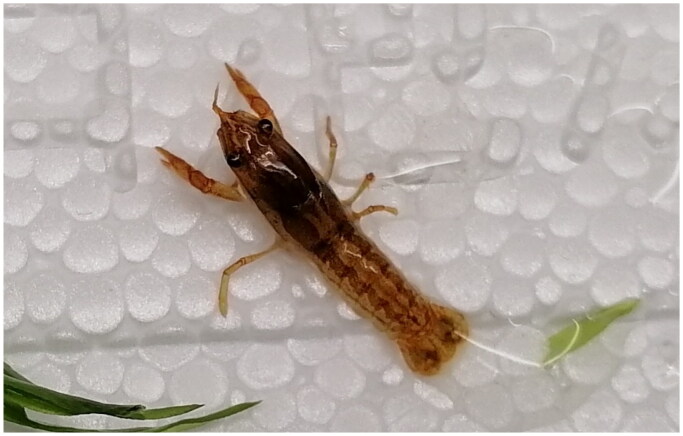 Figure 1
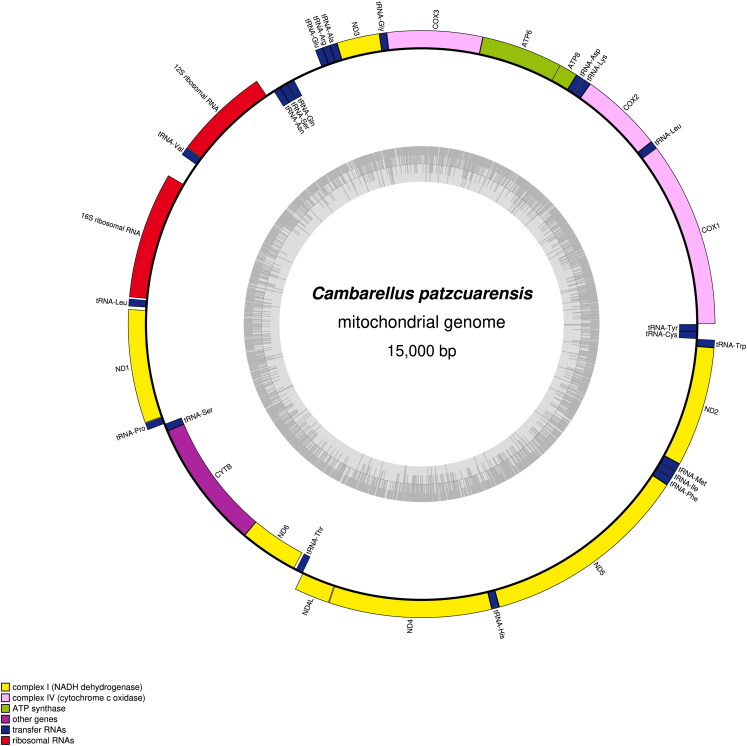 Figure 2
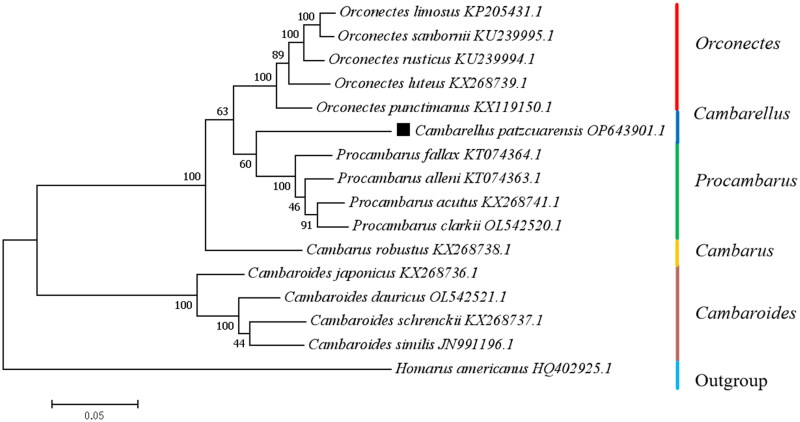 Figure 3
Peer Reviews
No public reviews on file for this paper yet. If you reviewed it on a platform where reviews are public (OpenReview, ICLR, NeurIPS, ICML), you can paste yours below so the community can read it here.
Videos
No videos yet. Explain this paper in a talk, walkthrough, or lecture? Add one.
Taxonomy
TopicsCrustacean biology and ecology · Aquaculture Nutrition and Growth · Identification and Quantification in Food