Mental health in children with and without disabilities in a register-based Swedish sample supports the two-continua model: a latent class analysis
Lina Homman, Lilly Augustine, Mats Granlund

TL;DR
This study supports the two-continua model of mental health in children, showing that well-being and problems are distinct but related, with differences between children with and without disabilities.
Contribution
The study applies the two-continua model to children, including those with disabilities, using latent class analysis in a large Swedish sample.
Findings
The two-continua model of mental health was confirmed in children with and without disabilities.
Children with disabilities showed distinct patterns in risk and protective factors like participation and social bonds.
Age, disability, and gender were significant predictors of mental health class adversity.
Abstract
Mental health is a term frequently used to describe mental health problems. However, mental health includes both mental health problems and well-being. Therefore, mental health can be seen as having two distinct yet related dimensions, as described in the two-continua model of mental health (Westerhof & Keyes, 2010) where an individual can simultaneously experience any combination of well-being and problems, suggesting four classes: (i) high well-being, low problems; (ii) high well-being, high problems; (iii) low well-being, low problems; and (iv) low well-being, high problems. Through this framework an understanding of differences in putative risk and protective factors can be gained when compared across classes. While the model has received support, it is unclear how it applies to children. In particular, children with disabilities, as disabilities pose a risk factor to poor mental…
Genes, proteins, chemicals, diseases, species, mutations and cell lines named across the full text — each resolved to its canonical identifier and authoritative record.
Click any figure to enlarge with its caption.
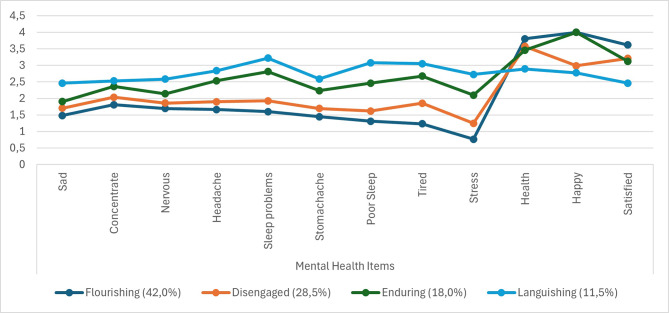 Figure 1
Peer Reviews
No public reviews on file for this paper yet. If you reviewed it on a platform where reviews are public (OpenReview, ICLR, NeurIPS, ICML), you can paste yours below so the community can read it here.
Videos
No videos yet. Explain this paper in a talk, walkthrough, or lecture? Add one.
Taxonomy
TopicsChild and Adolescent Psychosocial and Emotional Development · Health disparities and outcomes · Family and Disability Support Research