Caenorhabditis elegans Exhibits Selective Chemotaxis to Cancer Cell–Conditioned Media
Ridvan Aziz Ayaz, Deniz Yozlu, Elif Damla Arisan

TL;DR
C. elegans worms can detect cancer-related chemical signals and learn to respond to them, suggesting potential use in cancer screening.
Contribution
Demonstrates that C. elegans exhibits olfactory learning toward cancer cell-conditioned media.
Findings
Wild-type worms oriented toward non-cancerous cell media compared to controls.
Training with cancer-conditioned media altered worm chemotaxis behavior.
C. elegans shows potential for detecting cancer-associated metabolites.
Abstract
Caenorhabditis elegans is emerging as a valuable model for investigating chemosensory responses to disease-associated molecular cues recently. In this study, we examined the chemotaxis behavior of C. elegans toward the conditioned media from cancerous MIA PaCa-2 and PANC-1 cells and non-cancerous PNT1A cells. Untrained wild-type worms exhibited orientation to PNT1A media compared to the controls. Most importantly, training with cancer-conditioned media led to altered chemotaxis behavior, indicating olfactory learning. These findings support the use of C. elegans as a sensitive and adaptable system for detecting cancer-associated metabolites and demonstrate its potential role in non-invasive cancer screening applications and training-based models.
Genes, proteins, chemicals, diseases, species, mutations and cell lines named across the full text — each resolved to its canonical identifier and authoritative record.
Click any figure to enlarge with its caption.
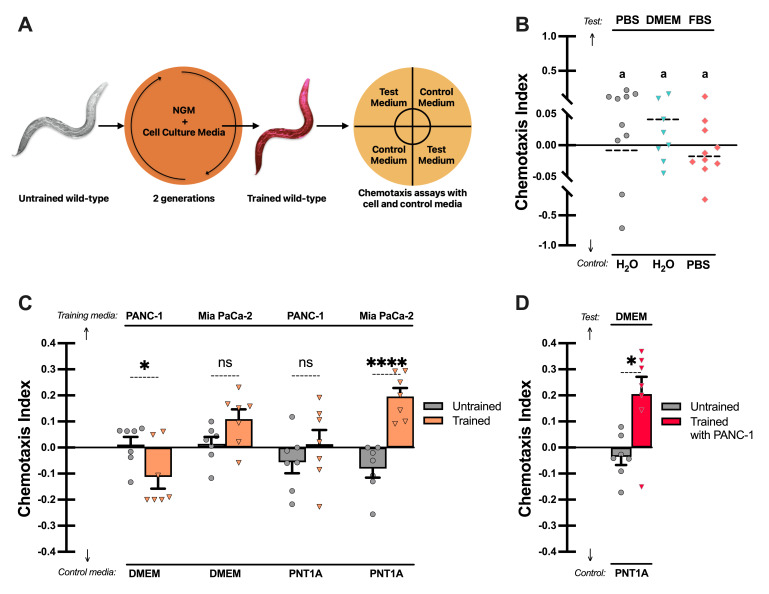 Figure 1
Peer Reviews
No public reviews on file for this paper yet. If you reviewed it on a platform where reviews are public (OpenReview, ICLR, NeurIPS, ICML), you can paste yours below so the community can read it here.
Videos
No videos yet. Explain this paper in a talk, walkthrough, or lecture? Add one.
Taxonomy
TopicsBone Tissue Engineering Materials · Cancer Research and Treatments · Nanoparticle-Based Drug Delivery