Pituitary dysfunction with eosinophilic granulomatosis with polyangiitis presenting with diabetes insipidus: a case report and review of the literature
Aifei Zhang, Xiaoxia Liu, Pengjia Wu, Longyan Qin, Na Li, Yi Yin, Jiashun Zeng

TL;DR
This case report highlights a rare instance of pituitary dysfunction in a patient with EGPA, presenting as diabetes insipidus, and reviews similar cases to raise awareness of this unusual condition.
Contribution
The paper reports a new case and reviews existing literature to highlight pituitary gland involvement as a rare manifestation of EGPA.
Findings
EGPA can cause central diabetes insipidus due to pituitary gland involvement.
Pituitary dysfunction may occur early or years after EGPA diagnosis.
Awareness of this rare manifestation can help avoid misdiagnosis.
Abstract
Central diabetes insipidus secondary to hypophysitis in eosinophilic granulomatosis with polyangiitis (EGPA) is very rare, and this article summarizes one case reported from our site as well as two previously reported patients with EGPA, both of whom had central diabetes insipidus, suggesting that new, rare organ involvement (pituitary gland) may occur in the early stages of EGPA or years later. The aim is to improve our understanding of central diabetes insipidus caused by EGPA involving the pituitary gland and avoid misdiagnosis or missed diagnosis.
Genes, proteins, chemicals, diseases, species, mutations and cell lines named across the full text — each resolved to its canonical identifier and authoritative record.
Click any figure to enlarge with its caption.
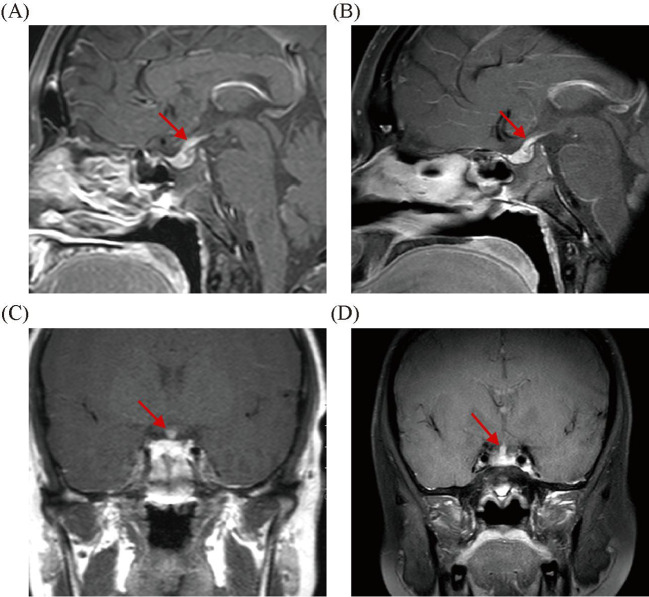 Figure 1
Peer Reviews
No public reviews on file for this paper yet. If you reviewed it on a platform where reviews are public (OpenReview, ICLR, NeurIPS, ICML), you can paste yours below so the community can read it here.
Videos
No videos yet. Explain this paper in a talk, walkthrough, or lecture? Add one.
Taxonomy
TopicsVasculitis and related conditions · Urticaria and Related Conditions · Eosinophilic Disorders and Syndromes