Naviculacongqiancuoensis sp. nov. — a new diatom species (Bacillariophyceae) from Sichuan Province, China

Abstract
Genes, proteins, chemicals, diseases, species, mutations and cell lines named across the full text — each resolved to its canonical identifier and authoritative record.
Click any figure to enlarge with its caption.
 Figures 1–7
 Figures 8–13
 Figures 14–18
| Outline | Linear to linear-lanceolate | Linear | Narrowly lanceolate | Linear and subtly triundulate with a distinctly tumid middle | Lanceolate to linear-lanceolate |
| Ends | Broadly rounded | Slightly protracted ends | Acutely rounded, subtly protracted apices | Broadly rounded, somewhat wedge-shaped apices | Slightly drawn-out ends |
| Axial area | Narrow and linear | Narrow | Narrow | Very | Narrow |
| Central area | Slightly widening | Moderately asymmetrical, wedge-shaped or irregularly shaped | Small, transversely widened, and asymmetrical with irregular borders. | Elliptical and asymmetric, bordered by 2–5 irregularly shortened and often faint striae. | Small |
| Valve length (μm) | 42.7–51.2 | 42.0–58.0 | 33.0–39.0 | 64.0–76.0 | 18.7–39.3 |
| Valve width (μm) | 4.9–6.1 | 6.0–7.0 | 4.9–5.7 | 6.8–8.0 | 5–6 |
| Striae in 10 μm | 18–20 | 12–13 | 19–20 | 11–13 | 14–16 |
| Areolae in 10 μm | 50 | 32 | Not given | 30 | Not given |
| Distribution | Lake Congqiancuo, Haizishan Nature Reserve, Daocheng County, Sichuan Province, China | Widely distributed | Northern Rocky Mountains, where it is typically associated with | Copper Lake in Shoshone County, northern Idaho | Widely distributed |
| Reference | This study |
|
Peer Reviews
No public reviews on file for this paper yet. If you reviewed it on a platform where reviews are public (OpenReview, ICLR, NeurIPS, ICML), you can paste yours below so the community can read it here.
Videos
No videos yet. Explain this paper in a talk, walkthrough, or lecture? Add one.
Taxonomy
TopicsDiatoms and Algae Research · Freshwater macroinvertebrate diversity and ecology · Aquatic Ecosystems and Phytoplankton Dynamics
Introduction
The genus Navicula Bory (1822), initially described by Bory de Saint-Vincent in 1822, has undergone several revisions over time, including those by Patrick (1959), Cox (1979), and Round et al. (1990). Since its original description, numerous genera have been separated from Navicula, such as DiadesmisKützing (1844), Luticola D.G.Mann in Round et al. (1990), GandhiaKulikovskiy et al. (2023), Trialacinia Kociolek, Liu & Fan (2025). Consequently, the current definition of Navicula sensu stricto is based on the type of Naviculatripunctata (Müller 1786) Bory (1822), and is restricted to the members of the section Lineolatae previously described by Cleve (1895) as Cox (1979). Species within the genus Navicula typically exhibit a narrow to broad lanceolate, naviculoid valve outline with apices that display a variety of shapes. The central sternum is asymmetrically thickened to varying degrees. The raphe branches are straight and filiform, with the proximal ends slightly deflected unilaterally and the distal ends strongly recurved. The striae are uniseriate and composed of apically elongated areolae called lineolae, characteristics that facilitate the identification of Navicula among other diatom genera (Lange-Bertalot 2001).
To date, according to Diatom base, > 1000 species of the genus Navicula have been accepted taxonomically (Kociolek et al. 2024). Despite this, many Navicula species in inland waters remain undescribed, with numerous new species discovered globally over the past decades. These discoveries span Africa, Europe, America, Asia, and even Antarctica (Taylor et al. 2016; Van de Vijver and Lange-Bertalot 2009; Witkowski et al. 2010; Edlund and Soninkhishig 2009; Zidarova et al. 2016).
In China, the genus Navicula is still insufficiently studied. Li and Qi (2016) listed 133 species and 32 varieties in the Diatom Flora of China, yet it is evident that an in-depth study of this genus within the country’s borders is still lacking. Recent findings by Gong et al. (2015) of new species from the Yunnan Plateau’s lakes include Naviculacraticuloides Y. Li & Metzeltin, Naviculagongii Metzeltin & Y. Li and Naviculayunnanensis Y. Li & Metzeltin. Adding to this diversity, Chudaev and Georgiev (2016) added two new Navicula in a high-altitude Tibetan lake: Naviculagololobovae Chudaev in Chudaev and Georgiev (2016) and Naviculacryptofallaxvar.tibetica Chudaev in Chudaev and Georgiev (2016). Meanwhile, in a stark contrast of habitat, a new benthic brackish diatom species, Naviculaamoyensis, was identified in the estuarine environment of the Jiulong River (Chen et al. 2017) in Southern China. Furthermore, expanding the known diatom flora of China, Fu (2018) documented six previously unrecorded Navicula species from the Changbai Mountain regions. Wang et al. (2020) reported a new species, Naviculadaochengensis, from Lake Congqiancuo in Sichuan, China, highlighting the ongoing exploration and documentation of Navicula diversity in the country. Furthermore, Naviculaaustralasiatica, Naviculaperangustissima and Naviculaturriformis in Li et al. (2020); Naviculafuxianturriformis in Zhang et al. (2022) and Naviculasinicomeniscus in Xiao et al. (2023).
The aim of this paper is to describe a new Navicula species, Naviculacongqiancuoensis sp. nov., from a small mountain lake — Lake Congqiancuo, Haizishan Nature Reserve, Daocheng County (Sichuan Province, China) — based on its unique morphological features, revealed by detailed light and scanning electron microscopy (SEM) observations and its comparison with similar taxa.
Material and methods
Study area
Samples containing Naviculacongqiancuoensis sp. nov. were collected from pebbles (i.e. epilithon) in the littoral zone of Lake Congqiancuo, located at the geographic coordinates 29°21'N and 100°04'E. The lake is situated within the Haizishan Nature Reserve, found in Daocheng County, Sichuan Province, China, in the southeastern part of the Qinghai-Tibet Plateau. The elevation within the area where Lake Congqiancuo is located ranges from 3160 to 6204 m a.s.l., with an average altitude of around 4200 m. The region experiences a highland climate, characterized by an annual mean temperature of approximately 3.0 °C and an average annual precipitation of roughly 720 mm. Previously, we reported the discovery of two new diatom species, Halamphoradaochengensis W. Zhang, Jüttner & Levkov and Naviculadaochengensis W. Zhang, Chudaev & T. Wang, from this freshwater lake. However, it remains largely under-investigated with the likelihood that numerous diatom species are yet to be identified and studied.
Field and laboratory procedures
Water physico-chemical characteristics were measured using a YSI Pro Plus multimeter, and Secchi Depth was determined following APHA’s standard procedures (Odum et al. 1995). Chemical analyses samples (1 L water) were collected from surface waters (the top 50 cm) at 12 sampling points (Zhang 1991), including total phosphorus (TP), total nitrogen (TN). Samples were initially fixed in 10% Lugol’s solution. In the laboratory, 10% hydrochloric acid was used to dissolve the carbonate content, and 30% hydrogen peroxide was applied to oxidize the organic components of diatom cells, following the protocol described by Battarbee (1986). After the digestion process, which included heating at 80 °C for 6 hours, the samples underwent centrifugation (3500 rpm for 5 min) and multiple washes with distilled water (4–5 times) until the pH reached neutrality. The cleaned material was stored in 95% ethanol. Permanent mounts were prepared using Naphrax for examination under an Olympus BX53–DIC compound microscope equipped with an Olympus DP72 digital camera. Additionally, the cleaned material was observed using a Hitachi S–3400N field-emission scanning electron microscope (SEM) at Shanghai Ocean University (operating voltage 5 kV). All samples and slides are deposited in the Herbarium of Hydrobiological Department, Shanghai Ocean University (SHOU), China.
Results
Class Bacillariophyceae
Order Naviculales
Family Naviculaceae
Genus Navicula
Navicula
congqiancuoensis
Taxon classificationPlantaeNaviculalesNaviculaceae
W.Zhang & S.Blanco sp. nov.
459382DC-D60A-5C43-9554-60E07D5A482F
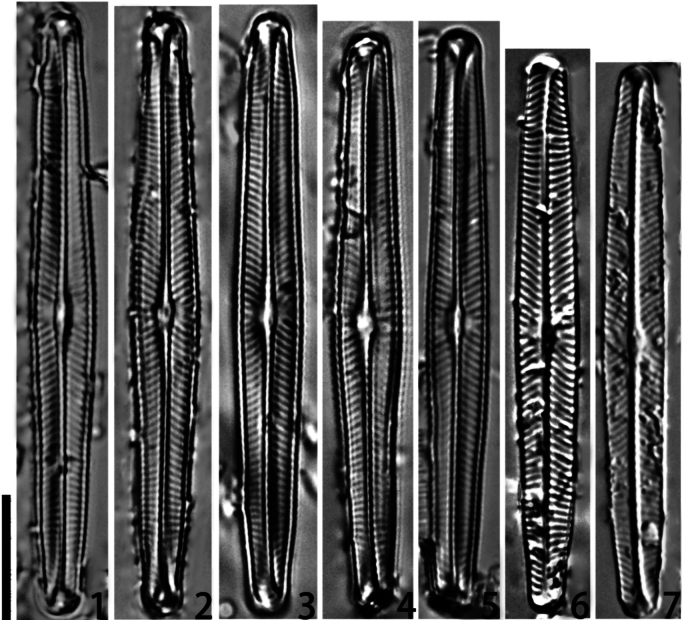
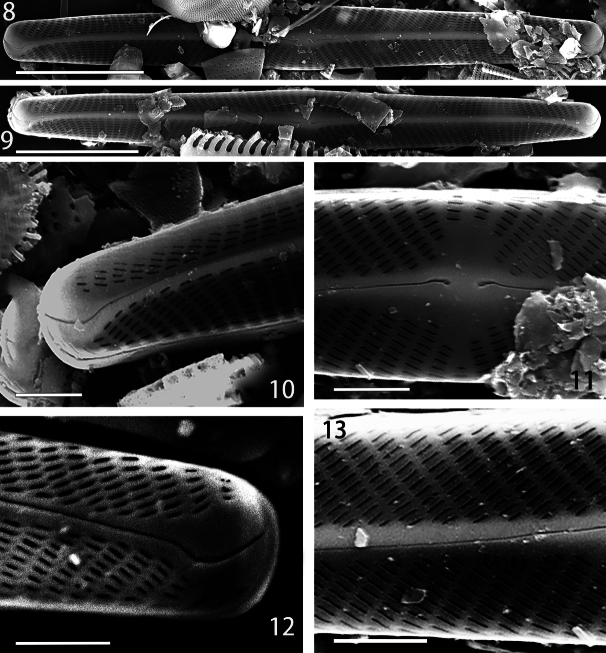
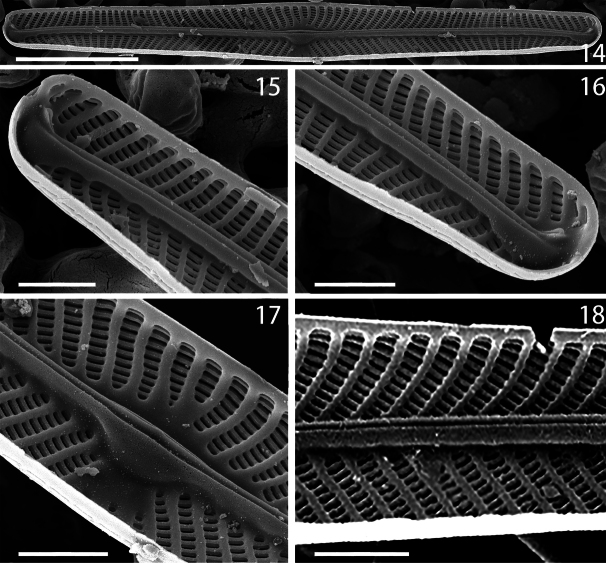
LM: Figs 1–7 , SEM: Figs 8–13 , 14–18
Description.
Light microscopy (LM) (Figs 1–7). The valve is linear to linear-lanceolate, with a slight widening in the center and broadly rounded at the apices, with a length of 42.7–51.2 μm and a width of 4.9–6.1 μm, giving an average L/W ratio 8.2 (40 valves were measured to obtain these size ranges). The raphe is weakly lateral, and the external distal raphe ends are deflected on to the mantle. The striae are radiate and convergent at the ends, and there are two to three short striae in the central area, 14–16 in 10 μm. The axial area is narrow and linear, and the central area is small and elliptical in the central nodule.
Naviculacongqiancuoensis sp. nov. Size diminution series. Scale bar: 10 μm.
Scanning electron microscopy (SEM) (Figs 8–18). External view: Valves flat. Raphe fissure straight (Figs 8, 9). Proximal raphe endings slightly unilaterally hooked towards secondary valve side. External distal raphe endings curved to the secondary side of valve, with ends positioned on valve mantle (Figs 10, 12). Axial area very narrow and often thickened. Lineolae density ca. 50 in 10 µm (Fig. 11). Transversal striae radial, convergent at the ends. The lineolae and the virgae separating them are aligned longitudinally so that there appear to be both longitudinal and transverse striae (Figs 8–13). Internal view: the raphe is straight and slightly inclined towards the secondary valve side (Fig. 14). On the side of the raphe sternum opposite to central nodule, there is a longitudinal, semilanceolate thickening. Distal raphe endings are well-developed helictoglossae (Figs 15, 16). The accessory rib is well-developed on the primary valve side and unilaterally widened in the center, forming an asymmetrical central nodule that is visible under light microscopy (Figs 17, 18). The Voigt discordance is not visible in the valves we observed.
Naviculacongqiancuoensis sp. nov. SEM external views 8, 9 whole valve showing the outline and external raphe structure 10, 12 distal raphe ends and areolae 11 details of external central area with slightly expanded proximal raphe ends 13 details of external view of striae. Scale bars: 10 μm (8, 9); 2 μm (10, 11, 12, 13).
Naviculacongqiancuoensis sp. nov. SEM internal views 14 whole valve showing the outline and internal raphe structure 15, 16 distal raphe endings with helictoglossae 17 central area 18 details of areolae. Scale bars: 10 μm (14); 2 μm (15, 16, 17, 18).
Type.
China. • Sichuan Province: Tibetan Autonomous Prefecture of Garzi, Daocheng County, Haizishan Nature Reserve, Lake Congqiancuo, 29°21'58"N, 100°04'51"E, elevation 4389 m a.s.l., samples collected by Q.C. ZHOU, 20 Sep. 2018. Holotype CQC1#, SHOU! Herbarium of Hydrobiological Department, College of Fisheries and Life Science, Shanghai Ocean University (SHOU), Shanghai, China = Fig. 3.
Etymology.
The specific epithet, congqiancuoensis, refers to the locality from which the new species was described.
Ecology.
Naviculacongqiancuoensis sp. nov. was found in epilithon samples collected in a high-altitude freshwater lake, with a pH of 8.9–9.4 and very low conductivity of 17.5–17.6 µS/cm. The water temperature at the time of collection was 13.5 °C, total nitrogen (TN) 0.032–0.043 mg/L, total phosphorus (TP) 0.014–0.016 mg/L.
Discussion
Naviculacongqiancuoensis sp. nov. shares some features with other taxa in this genus, such as NaviculaangustaGrunow (1860), N.leptostriataJørgensen (1948) and N.pierceiBahls (2012). They all are more or less similar in valve outline (linear or linear-lanceolate), raphe (almost lateral) and axial area (narrow and linear). A comparison of characteristics of these taxa in Navicula is provided in Table 1.
Naviculacongqiancuoensis and N.piercei (Bahls 2012) exhibit similarities in their valve shapes, yet there are subtle distinctions. Both possess linear valves; however, in N.piercei they are distinctly tumid in the middle and with broadly rounded, somewhat wedge-shaped apices, a feature not present in N.congqiancuoensis, which is also shorter compared to N.piercei (42.7–51.2 μm vs. 64–76 μm). Additionally, the stria density is higher in N.congqiancuoensis than in N.piercei (14–16 in 10 µm vs. 11–13 in 10 µm). Furthermore, the areola density of N.congqiancuoensis is higher than that of N.piercei (50 areolae in 10 μm vs. 30 areolae in 10 µm).Naviculacongqiancuoensis and N.angusta (Grunow 1860) exhibit certain differences in their valves: in N.congqiancuoensis is linear to linear-lanceolate, with a slight widening in the center and broadly rounded ends, while in N.angusta valves are linear with slightly protracted ends. Naviculacongqiancuoensis is also narrower than N.angusta (width: 4.9–6.0 μm vs. 6–7 μm). The stria density of N.congqiancuoensis is higher than that of N.angusta (15–18 in 10 µm vs. 12–13 in 10 µm). Furthermore, the areola density of N.congqiancuoensis is higher than that of N.angusta (50 areolae in 10 μm vs. 32 areolae in 10 µm). Naviculacongqiancuoensis and N.leptostriata (Jørgensen 1948) show also certain differences in their valves: N.congqiancuoensis has linear to linear-lanceolate valves, with a slight widening in the center and broadly rounded ends, while in N.leptostriata valves are narrowly lanceolate with acutely rounded, subtly protracted apices. Naviculacongqiancuoensis is also longer N.leptostriata in length (42.7–51.2 μm vs. 33–39 μm), and the stria density is lower in N.congqiancuoensis compared to N.leptostriata (15–18 in 10 µm vs. 19–20 in 10 µm). N.congqiancuoensis is longer than N.heimansioides (length: 42.7–51.2 μm vs. 18.7–39.3 μm) (Lange–Bertalot 1993). And N.heimansioides valves are lanceolate to linear-lanceolate with slightly drawn-out ends, N.congqiancuoensis exhibit linear to linear-lanceolate valve shapes with broadly rounded ends. The stria density of N.congqiancuoensis and N.heimansioides are the same (14–16 in 10 µm), and both striae are radiate and bent at the valve center, convergent at apices.
To sum up, the discovery of N.congqiancuoensis in Lake Congqiancuo underscores the importance of continued exploration of diatom diversity in remote and understudied regions. As we expand our knowledge of diatom taxonomy in China, findings such as N.congqiancuoensis contribute to a more comprehensive understanding of biodiversity patterns and ecological dynamics in high-altitude aquatic environments. Further research into the ecology and distribution of this species may provide valuable insights into the biogeography and environmental preferences of diatoms in mountainous freshwater systems.
Supplementary Material
XML Treatment for Navicula congqiancuoensis
The reference list from the paper itself. Each links out to its DOI / PubMed record.
- 1Bahls LL (2012) Seven new species in Navicula sensu stricto from the Northern Great Plains and Northern Rocky Mountains. Nova Hedwigia.Beiheft 141: 19–38.
- 2Battarbee RW (1986) Diatom analysis. In: Berglund BE (Ed.) Handbook of Holocene palaeoecology and palaeohydrology.Wiley, Chichester, 527–570.
- 3Bory de Saint Vincent JBM (1822) Encyclopédie Méthodique, Histoire Naturelle Des Zoophytes ou Animaux Rayonnés. Veuve Agasse, Paris, 563–565.
- 4Chen CP Sun JD Zhao L Sun L Li XS Liang JR Gao YH (2017) Naviculaamoyensis sp. nov. (Bacillariophyceae), a new benthic brackish diatom species from the Jiulong River estuary, Southern China.Phytotaxa 291(4): 253–263. 10.11646/phytotaxa.291.4.2 · doi ↗
- 5Chudaev DA Georgiev AA (2016) New taxa of Navicula sensu stricto (Bacillariophyta, Naviculaceae) from highaltitude lake in Tibet, China.Phytotaxa 243(2): 180–184. 10.11646/phytotaxa.243.2.9 · doi ↗
- 6Cleve PT (1895) Synopsis of the naviculoid diatoms. Part II.Kongliga Svenska Vetenskapsak Akademiens Handlingar 27(3): 1–219.
- 7Cox E (1979) Taxonomic studies on the diatom genus Navicula Bory: The typification of the genus.Bacillaria 2: 137–153.
- 8Edlund MB Soninkhishig N (2009) The Naviculareinhardtii species flock (Bacillariophyceae) in ancient Lake Hövsgöl, Mongolia: Description of four taxa.Nova Hedwigia 135: 239–256.