Uncommon complications arising during endoscopic ultrasound-guided gastroenterostomy – splenic injury
Shan-Shan Hu, Peng Tang, Jie Hou, Yun-Chao Yang, Wei-Hui Liu

Abstract
Genes, proteins, chemicals, diseases, species, mutations and cell lines named across the full text — each resolved to its canonical identifier and authoritative record.
Click any figure to enlarge with its caption.
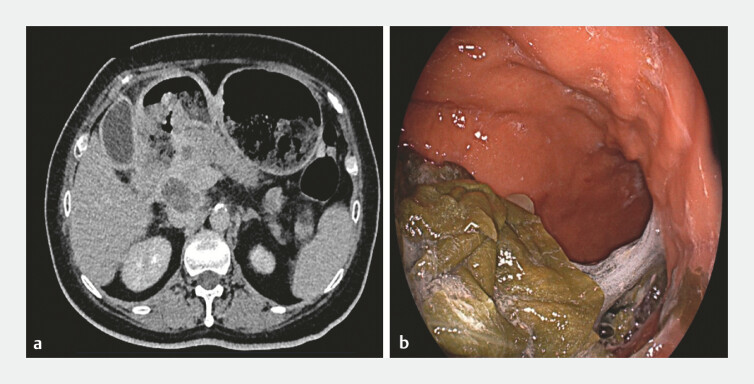 Fig. 1
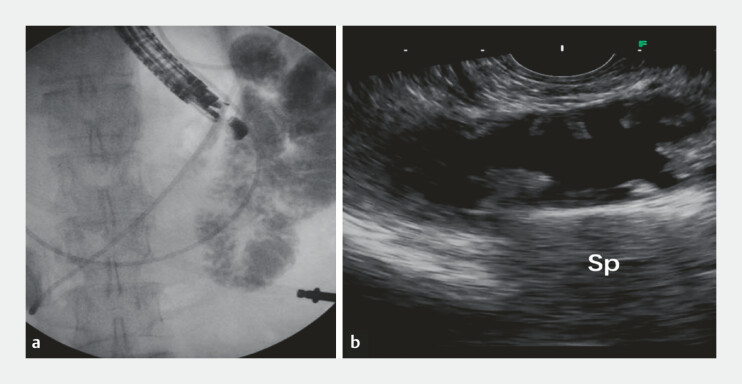 Fig. 2
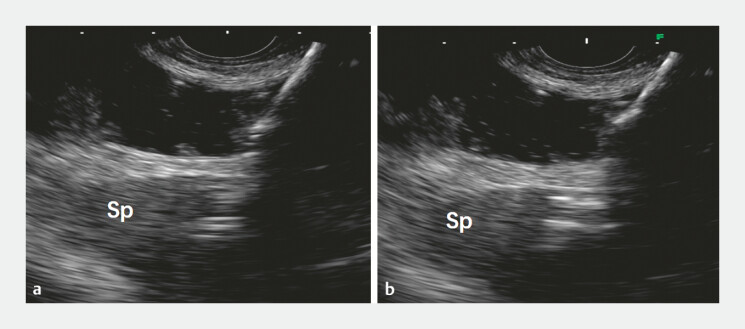 Fig. 3
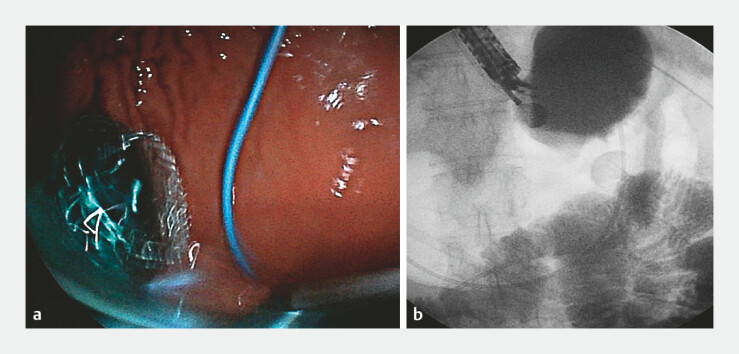 Fig. 4
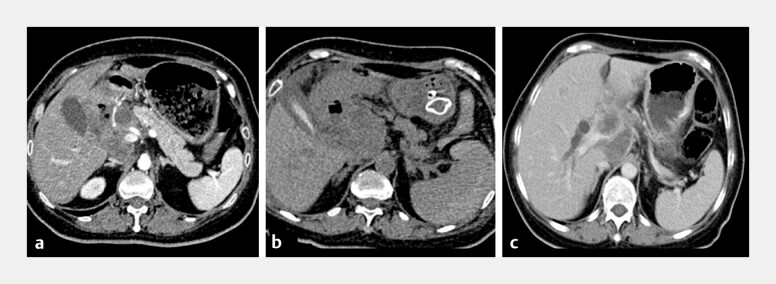 Fig. 5
- —The Program for Sichuan Medical and Health Care Promotion Institute
- —Department of Science and Technology Department of Sichuan Province
Peer Reviews
No public reviews on file for this paper yet. If you reviewed it on a platform where reviews are public (OpenReview, ICLR, NeurIPS, ICML), you can paste yours below so the community can read it here.
Videos
No videos yet. Explain this paper in a talk, walkthrough, or lecture? Add one.
Taxonomy
TopicsEsophageal and GI Pathology · Abdominal Surgery and Complications · Biliary and Gastrointestinal Fistulas
Endoscopic ultrasound (EUS)-guided gastroenterostomy (EUS-GE) is an advanced technique primarily used to treat benign and malignant gastric outlet obstruction 1 2 . This technology overcomes the limitations of traditional duodenal stent placement and surgical procedures 3 , offering an effective alternative therapy. Although the one-step delivery system significantly reduces procedural risks, adverse events still occur. Common complications are often related to stent displacement or blockage 4 5 . This article reports a rare adverse event – spleen injury.
A 65-year-old female patient, with duodenal cancer causing gastric outlet obstruction and accompanying systemic metastasis, was no longer a candidate for surgical resection ( Fig. 1 ). Therefore, the patient was referred to EUS-GE to alleviate the obstruction. EUS and X-rays were used to locate the target intestine ( Fig. 2 ). After identifying a suitable location for the gastroenterostomy, direct puncture was made with a 15-mm cautery-enhanced lumen-apposing metal stent (LAMS) from the gastric wall into the jejunum. However, due to the transverse shape and frequent peristalsis of the target intestine, the puncture space was limited, causing the tip of the LAMS delivery system to penetrate the opposite intestinal wall and mistakenly enter the spleen at the distal jejunum ( Fig. 3 ). Despite successful stent release ( Fig. 4 ), the patient experienced severe left abdominal pain postoperatively. Subsequent abdominal CT scans revealed a subcapsular splenic hematoma and intraperitoneal hemorrhage. Given the patient’s hemodynamically stable condition, observation and conservative treatment were pursued, and the condition ultimately stabilized ( Fig. 5 ). The patient was successfully discharged. One month post-surgery, the spleen’s shape had returned to normal ( Video 1 ).
Duodenal cancer leads to gastric outlet obstruction.
EUS and X-rays were used to select the target intestine. a The intestine closest to the gastric wall and jejunum was selected under X-rays, ensuring no stricture in the distal intestine. b The morphology of the target intestine observed under EUS was transverse. Abbreviation: EUS, endoscopic ultrasound.
EUS images revealed damage to the spleen caused by the puncture needle. ( a ) The tip of the puncture needle penetrated into the spleen. ( b ) The high-echo gas shadow inside the spleen after the needle tip was retracted. Abbreviation: EUS, endoscopic ultrasound.
The release position of the stent was ideal. a Methylene blue dye flowed smoothly from the jejunum into the stomach cavity through the stent. b The exact position of the stent under X-ray.
Comparison of preoperative and postoperative CT imaging of the spleen. a Normal splenic morphology prior to surgery. b Postoperative splenic swelling, subcapsular hematoma, and intraperitoneal hemorrhage. c One month post-surgery, the spleen’s shape had returned to normal. Abbreviation: CT, computed tomography.
Uncommon complications arising during endoscopic ultrasound-guided gastroenterostomy – splenic injury.Video 1
From this case, we learned that, it is important to choose a loop that appears longitudinal under EUS to provide sufficient space for puncture and stent release. Before puncturing, intestinal peristalsis should be minimized, and careful observation of the surrounding organs is necessary. During the puncture, continuous attention should be given to the position of the needle tip to ensure the safety of the procedure.
Endoscopy_UCTN_Code_TTT_1AS_2AI
CorrectionCorrection: Uncommon complications arising during endoscopic ultrasound-guided gastroenterostomy – splenic injury Hu Shan-Shan,Tang Peng, Hou Jie et al. Uncommon complications arising during endoscopic ultrasound-guided gastroenterostomy – splenic injury. Endoscopy 2025; 57: E595–E597, doi:10.1055/a-2603-7497 In the original published version of this article, the video was incorrect. The video has been replaced with the correct version on July 22, 2025.
The reference list from the paper itself. Each links out to its DOI / PubMed record.
- 1van der Merwe S Wvan Wanrooij RLJ Bronswijk M Therapeutic endoscopic ultrasound: European Society of Gastrointestinal Endoscopy (ESGE) Guideline Endoscopy 20225418520510.1055/a-1717-139134937098 · doi ↗ · pubmed ↗
- 2Nguyen NQ Hamerski CM Nett A Endoscopic ultrasound-guided gastroenterostomy using an oroenteric catheter-assisted technique: a retrospective analysis Endoscopy 2021531246124910.1055/a-1392-090433860483 · doi ↗ · pubmed ↗
- 3Teoh AYB Lakhtakia S Tarantino I Endoscopic ultrasonography-guided gastroenterostomy versus uncovered duodenal metal stenting for unresectable malignant gastric outlet obstruction (DRA-GOO): a multicentre randomised controlled trial Lancet Gastroenterol Hepatol 2024912413210.1016/S 2468-1253(23)00242-X 38061378 · doi ↗ · pubmed ↗
- 4Hujova A Stirand P Turza P Endoscopic management of gastrojejunocolic fistula as an unusual complication of endoscopic ultrasound-guided gastroenterostomy Endoscopy 20235501 E 151E 15210.1055/a-1937-955836307072 PMC 9829763 · doi ↗ · pubmed ↗
- 5Kuo YT Wang HPA tent-like sign during endoscopic ultrasound-guided gastroenterostomy: an indication of a misdeployed stent in the peritoneum Endoscopy 20235501 E 934E 93510.1055/a-2106-154437500085 PMC 10374396 · doi ↗ · pubmed ↗