Zebrafish sperm outsource activation to eggs’ protease-activated receptors
Rafael A. Fissore, Emily M. Lopes, Francesca Carpentiero

TL;DR
Zebrafish eggs start their development by triggering a calcium signal through protease-activated receptors before sperm even enters.
Contribution
The study reveals a new pathway where zebrafish eggs activate themselves using protease-activated receptors.
Findings
Zebrafish eggs initiate a calcium wave via protease-activated receptors before sperm entry.
This calcium signal starts embryogenesis independently of sperm in zebrafish.
Abstract
The calcium surge that starts embryogenesis varies across species and is elusive in many. A new study in PLOS Biology shows that zebrafish eggs self-activate, initiating a protease-activated receptor calcium wave and uncovering a novel pathway in egg activation. The calcium surge that starts embryogenesis varies across species. A new study in PLOS Biology presents a novel mechanism of egg activation in zebrafish, wherein protease-activated receptors mediate a calcium signal that initiates egg activation before sperm entry.
Genes, proteins, chemicals, diseases, species, mutations and cell lines named across the full text — each resolved to its canonical identifier and authoritative record.
Click any figure to enlarge with its caption.
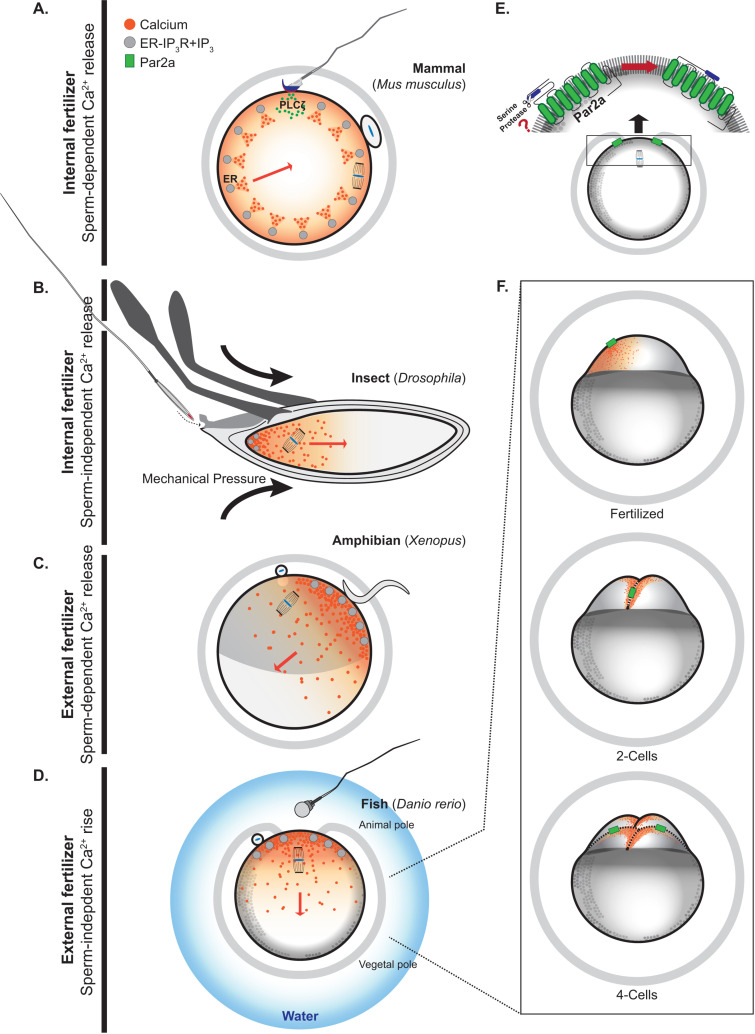 Figure 1
Peer Reviews
No public reviews on file for this paper yet. If you reviewed it on a platform where reviews are public (OpenReview, ICLR, NeurIPS, ICML), you can paste yours below so the community can read it here.
Videos
No videos yet. Explain this paper in a talk, walkthrough, or lecture? Add one.
Taxonomy
TopicsReproductive biology and impacts on aquatic species · Sperm and Testicular Function · Reproductive Biology and Fertility
Fertilization marks the initiation of development, as gametes from opposite sexes unite to produce progeny and ensure the continuity of the species. An early and remarkable event associated with this union is egg activation, the first and transitional step in development that transforms two haploid cells into a single, developmentally competent zygote. The necessary remodeling, unfolding in minutes or hours, is coordinated by a specialized calcium (Ca^2+^) signal within the egg [1,2]: a unifying feature of egg activation across a range of fertilization strategies (Fig 1). In a new article in this issue, Ma and Carney [3] uncover how zebrafish (Danio rerio) eggs autonomously initiate a protease-activated receptor 2 (Par-2)-triggered Ca^2+^ elevation that spreads as a wave and reaches the antipode within 1 minute and represents the activating signal. They also investigate the Par-2 signaling pathway and its association with the Ca^2+^ transients of cleavage divisions.
Animal species can be broadly categorized as internal or external fertilizers. Internal fertilization occurs in the female reproductive organs and is typically observed in but not limited to mammals, birds, reptiles, insects, and nematodes. In mammals and nematodes, sperm entry and egg activation are tightly coupled, with sperm entry directly triggering the activating Ca^2+^ signal [1]. Insects, however, often exhibit a temporal separation between fertilization and activation. In Drosophila, egg activation is completed before fertilization, whereas in other insects, sperm entry precedes activation, yet in others, it does not occur at all, leading to parthenogenesis.
Bony fish, including zebrafish, are external fertilizers, implying sperm entry and activation occur outside the body, typically in water. Other external fertilizers include amphibians, echinoderms, and other marine invertebrates [1]. To ensure fertilization, external fertilizers rely on strategies such as amplexus, jelly coat, sperm chemotaxis, and rapid signaling at the egg plasma membrane to accomplish interspecific sperm recognition and block polyspermy, respectively. In these species, including the medaka fish, Oryzias latipes, contact with or entry of sperm triggers egg activation. However, the egg activation mechanism in zebrafish has remained unclear despite the evidence that sperm entry and activation are separate events [4], partly because the activation onset is immediate after spawning and closely followed by the release of the male’s milt, obscuring the sperm’s role in this process. In their new study [3], Ma and Carney advance compelling evidence that zebrafish eggs activate independently from the sperm via a Par-2 pathway. Their results include preventing egg activation events after natural spawning with or without sperm by serine protease inhibitors and the failure of CRISPR/Cas9-generated par2a homozygous mutant female eggs to activate under similar circumstances. These findings point to a novel, protease-activated receptor-dependent mechanism of egg activation in zebrafish. Research in other species has provided convincing evidence for the participation of proteases and their receptors in egg activation. However, the underlying pathways remained undiscerned, or their essential role was masked by redundancy [5].
Ma and Carney [3] also explored the Par-2 signaling pathway during zebrafish fertilization. Pars are G protein-coupled receptors, and their activation usually follows partial receptor cleavage by a proteinase that unleashes a “tethered ligand”, or another activation mechanism [6]. This leads to downstream signaling, inositol 1,4,5-trisphosphate (IP_3_) production, and Ca^2+^ release via the IP_3_ receptor (IP_3_R) [5,6]. The role of IP_3_ signaling in egg activation is conserved across species, including zebrafish, where IP_3_R function has been demonstrated using broad antagonists [7]. In this study [3], eggs treated with 2-aminoethyl diphenylborinate or a molecular IP_3_R inhibitor were prevented from becoming activated after spawning. Further, IP_3_ injection rescued activation in protease inhibitor-treated or par-2a mutant eggs, demonstrating that Par signaling promotes egg activation through the canonical IP₃-Ca^2+^ pathway.
The involvement of IP_3_ signaling suggests a role for phosphoinositide-hydrolyzing enzymes such as phospholipases (PLCs), which are well characterized in fertilization. In marine invertebrates and Xenopus, IP_3_ production is controlled by PLC and Src kinases, but the upstream receptor(s) remain unknown [5,8,9]. In mammals, a sperm-specific PLC is released into the cytosol upon gamete fusion, triggering Ca^2+^ oscillations [10]. In zebrafish, the new transcriptomic studies in eggs identified robust expression of Gαq family members (gna11a and gna11b) along with PLCβ isozymes (plcb3 and plcb4), consistent with canonical Par signaling in other systems [3]. Pharmacological inhibition of Gαq/11 and PLCβ activity yielded variable outcomes, and even though the PLCβ inhibitor U-73122 blocked egg activation, the precise molecular players downstream of Par-2 need to be defined with genetic and molecular approaches.
Following the initial Ca^2+^ surge, activated zebrafish eggs undergo meroblastic cleavages, each accompanied by a discrete Ca^2+^ transient. Similar IP₃R-dependent Ca^2+^ spikes occur in early cleavage in Xenopus [11]. Ma and Carney argue that Par-2 signaling is necessary for the blastomere cleavages because pharmacological inhibition of Par-2 impairs them and cannot be rescued by exogenous IP₃. However, IP₃ injection rescued activation and, in many cases, near-normal blastomere division, when par2a is genetically inactivated, as is the case with par2a mutant eggs. Therefore, despite the additional demonstration that Par-2 localizes to the cleavage furrows, the extent of Par-2 and IP_3_ signaling contribution to blastomere division requires clarification.
Overall, Ma and Carney [3] have demonstrated that zebrafish egg activation is independent of sperm entry and initiated by a Par-2-mediated, IP_3_-induced Ca^2+^ release. This signaling triggers egg activation, but the role in blastomere division remains inconclusive. Open questions include the identity of the serine protease that activates the tethered Par-2 ligand(s) and the localization of Par-2 in the egg membrane. Importantly, this study identifies a plasma membrane receptor involved in activating embryo development and confirms the essential role of the IP_3_-IP_3_R-Ca^2+^ axis in this process. The conservation of Par-2-like signaling should be extended, especially in species of external fertilizers where tantalizing evidence is already available. The findings here and the supporting literature remind us of nature’s inexhaustible ingenuity to devise diverse yet convergent solutions for initiating life across species and environments, even if we are unaware of many aspects of their origin and regulation.
The reference list from the paper itself. Each links out to its DOI / PubMed record.
- 1Krauchunas AR, Wolfner MF. Molecular changes during egg activation. Curr Top Dev Biol. 2013;102:267–92. doi: 10.1016/B 978-0-12-416024-8.00010-6 23287037 PMC 3931425 · doi ↗ · pubmed ↗
- 2Stein P, Savy V, Williams AM, Williams CJ. Modulators of calcium signalling at fertilization. Open Biol. 2020;10(7):200118. doi: 10.1098/rsob.200118 32673518 PMC 7574550 · doi ↗ · pubmed ↗
- 3Ma J, Carney TJ. Protease-mediated activation of Par 2 elicits calcium waves during zebrafish egg activation and blastomere cleavage. P Lo S Biol. 2025;23(6). doi: 10.1371/journal.pbio.3003181 PMC 1217323740526581 · doi ↗ · pubmed ↗
- 4Lee KW, Webb SE, Miller AL. A wave of free cytosolic calcium traverses zebrafish eggs on activation. Dev Biol. 1999;214(1):168–80. doi: 10.1006/dbio.1999.9396 10491266 · doi ↗ · pubmed ↗
- 5Iwao Y, Ueno S. Sperm factors and egg activation: divergent sperm factors for egg activation in amphibian fertilization. Reproduction. 2022;164(1):F 29–37. doi: 10.1530/REP-21-0480 35239502 · doi ↗ · pubmed ↗
- 6Hollenberg MD. Physiology and pathophysiology of proteinase-activated receptors (PA Rs): proteinases as hormone-like signal messengers: PA Rs and more. J Pharmacol Sci. 2005;97(1):8–13. doi: 10.1254/jphs.fmj 04005 x 2 15665444 · doi ↗ · pubmed ↗
- 7Lee KW, Webb SE, Miller AL. Ca 2+ released via IP 3 receptors is required for furrow deepening during cytokinesis in zebrafish embryos. Int J Dev Biol. 2003;47(6):411–21. 14584779 · pubmed ↗
- 8Runft LL, Jaffe LA, Mehlmann LM. Egg activation at fertilization: where it all begins. Dev Biol. 2002;245(2):237–54. doi: 10.1006/dbio.2002.0600 11977978 · doi ↗ · pubmed ↗