Interlaboratory comparison of culture- and PCR-based methods for Legionella pneumophila detection in drinking water samples
Maria Scaturro, Antonietta Girolamo, Antonino Bella, Maria Cristina Rota, Anna Maria Marella, Rossana Amari, Massimiliano Ingrassia, Daria Barberis, Chiara Romano, Francesca Borney, Florida Damasco, Maria Teresa Buratto, Monica Fortin, Gaetano Caricato, Giovanna La Vecchia

TL;DR
This study compares different methods for detecting Legionella pneumophila in drinking water to ensure reliable results and better disease prevention.
Contribution
The study provides an interlaboratory comparison of culture-based and PCR-based methods for Legionella detection in compliance with new European water quality regulations.
Findings
The Legiolert rapid liquid culture method showed high agreement with the standard culture method.
Real-time PCR methods were more sensitive than the standard culture method.
Non-selective media improved Legionella recovery compared to traditional media.
Abstract
The European Directive 2020/2184 concerning the quality of water for human consumption now includes Legionella among the pathogens for assessment in domestic water systems. It states that “for risk-based verification and to complement spread-plate culture methods, rapid culture methods, non-culture-based methods, and molecular-based methods may be used.” In this study, 33 laboratories across Italy analyzed a number of unique water samples ranging from 10 to 30 for the presence of Legionella pneumophila. All laboratories used the standard spread-plate culture method, 31 laboratories also performed the Legiolert rapid liquid culture method (IDEXX Laboratories), and 27 out of 33 performed the DI-Check Legionella pneumophila real-time PCR method (Diatheva). In all, 23 laboratories executed all three methods. Data generated from 817 samples were collected and statistically analyzed. The…
Genes, proteins, chemicals, diseases, species, mutations and cell lines named across the full text — each resolved to its canonical identifier and authoritative record.
Click any figure to enlarge with its caption.
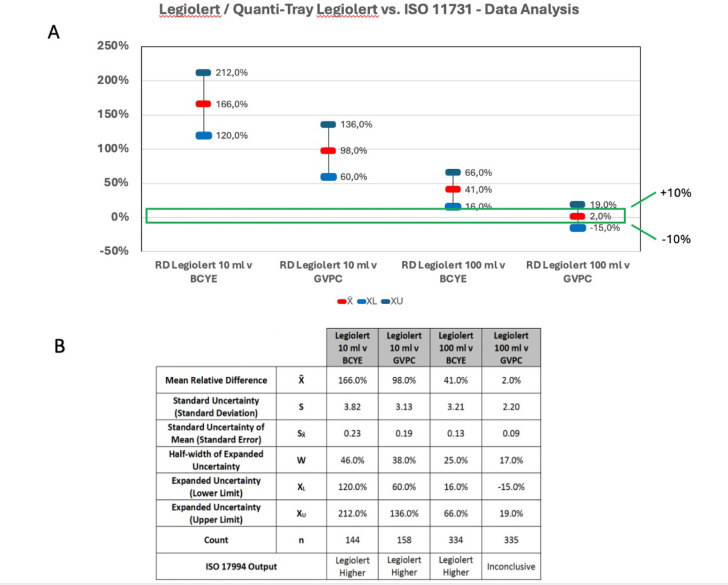 Fig 1
Fig 1| BCYE | GVPC | ||
|---|---|---|---|
| Negative (%) | Positive (%) | Total | |
| Negative (%) | 371 (45.4) | 121 (14.8) | 492 |
| Positive (%) | 40 (4.9) | 285 (34.8) | 325 |
| Total | 411 | 406 | 817 |
| Range of CFU/L on GVPC | |||||
|---|---|---|---|---|---|
| <50 | 50–1,000 | 1,001–10,000 | >10,000 | Total positive | |
| Range of CFU/L on BCYE | |||||
| <50 | 371 | 78 | 30 | 13 | 121 |
| 50–1,000 | 21 | 60 | 10 | 0 | 70 |
| 1,001–10,000 | 17 | 21 | 86 | 9 | 116 |
| >10,000 | 2 | 1 | 14 | 84 | 99 |
| Total positive | 40 | 82 | 110 | 93 | 285 |
| Comparison | Sensitivity | Specificity | PPV | NPV | Agreement (%) | K value |
|---|---|---|---|---|---|---|
| Legiolert 100 vs spread-plate culture | 86.9 | 92.1 | 92.9 | 85.6 | 89.3 | 0.785 |
| Legiolert 10 vs spread-plate culture | 84.3 | 95.8 | 96.3 | 82.6 | 89.3 | 0.79 |
| Legiolert 10 vs Legiolert_100 | 85.8 | 100 | 100 | 84.1 | 91.9 | 0.84 |
| Comparison | Sensitivity (95% CI) | Specificity | PPV | NPV | Agreement (%) | K value |
|---|---|---|---|---|---|---|
| Standard method vs spread-plate culture | 93.9% | 53.9% | 73.5% | 86.7% | 77.0 | 0.50 |
| Exp1 vs spread-plate culture | 95.2% | 48.7% | 76.0% | 85.7% | 78 | 0.48 |
| Exp2 vs spread-plate culture | 98.8% | 67.7% | 73.7% | 98.4% | 82.6 | 0.66 |
| Comparison | Sensitivity (95% CI) | Specificity (95% CI) | PPV (95% CI) | NPV (95% CI) | Agreement (%) | K value |
|---|---|---|---|---|---|---|
| Exp1 vs DI-Check | 92.4% | 69.8% | 91.8% | 71.4% | 87.5 | 0.63 |
| Exp2 vs DI-Check | 91.8% | 96.4% | 98.2% | 84.4% | 93.3 | 0.85 |
| Method | No. of laboratories performing each method | Variations | Additional details |
|---|---|---|---|
| Spread plate | 33 | Non-selective BYCE media | ISO 11731:2017 protocol (with lab-specific variations based on Annex J) |
| Selective GVPC media | ISO 11731:2017 protocol (with lab-specific variations based on Annex J) | ||
| Legiolert liquid culture method (IDEXX) | 11 | 10 mL sample method | According to the manufacturer’s protocol and ASTM 8429:2021 |
| 31 | 100 mL sample method | According to the manufacturer’s protocol and ASTM 8429:2021 Includes an adjustment for water hardness | |
| DI-Check | 26 | Standard method: | According to the manufacturer’s protocol and ISO12869: 2019 |
| 4 | “Exp1” | Slight modification of the standard method. | |
| 5 | “Exp2” | A major modification of the standard method. |
Peer Reviews
No public reviews on file for this paper yet. If you reviewed it on a platform where reviews are public (OpenReview, ICLR, NeurIPS, ICML), you can paste yours below so the community can read it here.
Videos
No videos yet. Explain this paper in a talk, walkthrough, or lecture? Add one.
Taxonomy
TopicsLegionella and Acanthamoeba research · Bacterial biofilms and quorum sensing · Water Treatment and Disinfection
INTRODUCTION
Legionella is an opportunistic premise plumbing pathogen (OPPP) responsible for Legionnaires’ disease (LD) and is acquired through the inhalation of water microdroplets from contaminated potable water distribution systems. LD cases, generally categorized as travel, community, or hospital acquired, were reported at an overall rate of 1.9 cases per 100,000 people in 2020 in the EU (European Union) and EEA (European Economic Area), with Italy, Spain, France, and Germany accounting for the highest number of cases (1). Legionella pneumophila (L. pneumophila) is the leading cause of OPPP-associated outbreaks in the United States (2), and the World Health Organization has stated that Legionella pose the highest health burden of all water-borne pathogens (3). The New European Directive 2020/2184 concerning the quality of water for human consumption includes Legionella among the parameters that should be controlled, and Member States (MS) should ensure that the parameters included in this directive are monitored (4). A risk-based evaluation approach has been advocated for monitoring Legionella in different settings, with special focus on specific buildings that have been named as priority premises. Based on this assessment, MS should take all necessary measures to ensure, among other things, that adequate management and control measures are put in place. Therefore, the water safety plan is a more effective approach to assess and minimize the risk of Legionella in water systems, which includes both its detection and quantification, which are essential factors for making decisions on water management (4).
With 3,111 cases and an incidence of 51.9 cases per million population in 2022, LD continues to increase in Italy, with 3,911 cases in 2023 and an incidence of 66.3 cases per million population (5). This underscores the critical need to manage L. pneumophila (5). The European Drinking Water Directive 2020/2184 states that for risk-based verification and to complement spread-plate culture, rapid culture methods, non-culture-based methods, and molecular-based methods may also be used.
The gold standard for detection and enumeration of Legionella in water samples is the spread-plate culture method, commonly performed according to ISO 11731:2017 (6). However, it is known that the spread-plate culture method is time-consuming, less sensitive for non-pneumophila species of Legionella, and is unable to detect Legionella that are within amoeba or in a viable but not culturable state (7–9). Given these and other limitations, this study was undertaken to assess the performance of validated commercial kits on Italian drinking water samples, which could offer practical advantages when used for risk-based verifications for L. pneumophila.
An alternative culture method is the Legiolert test (IDEXX Laboratories), which is based on a bacterial enzyme detection technology that highlights the presence of L. pneumophila through a change in the color of the medium. Several studies comparing this liquid culture method with traditional plate culture methods, including studies according to ISO 17994, have shown that Legiolert detects similar counts of L. pneumophila in potable water samples as the plate culture method. In 2021, US EPA researchers, Boczek et al., in a 185-sample comparison study, detected L. pneumophila in 83% and 85% of the samples with Legiolert and the plate culture method, respectively (10). Authors concluded that the two methods were statistically equivalent and that Legiolert showed a high degree of specificity of 96.5% (i.e., 3.5% false positives and 0% false negatives) versus the plate culture method. Scaturro et al. also demonstrated that no significant difference was found between either the Legiolert 10 mL and Legiolert 100 mL vs. the plate culture (P = 0.9 and P = 0.3, respectively) or between the Legiolert 10 mL vs. Legiolert 100 mL tests (P = 0.83; 11).
Spies et al. showed that Legiolert yielded, on average, higher counts of L. pneumophila than the ISO 11731–2 method, although the comparison with ISO 11731 was inconclusive due to the number of samples needing to be tested (12). In the same study, comparisons of Legiolert using 100 mL and the adoption of ISO 11731 or ISO 11731-2, as recommended by the Federal Environmental Agency (2012), did not show any conclusive difference, regardless of whether non-pneumophila species of Legionella were included in the evaluation. Legiolert has a high specificity for L. pneumophila of 97.9%, which compares favorably to the specificity of 95.3% quoted for ISO 11731. The authors concluded that Legiolert provides a significant improvement in the enumeration of L. pneumophila from drinking water and related samples (12).
Finally, Monteiro et al. showed that Legiolert, compared to data obtained with ISO 11731 and v-PCR for quantification of L. pneumophila in potable and non-potable waters, revealed concentrations of L. pneumophila greater than ISO 11731 and generally similar results to those of v-qPCR. The Legiolert method was highly specific and easy to use, representing a significant advancement in the quantification of L. pneumophila from potable and non-potable waters (13).
Other choices include well-established molecular-based techniques with excellent specificity and sensitivity, including the real-time PCR assay. To differentiate L. pneumophila from other species and L. pneumophila serogroup 1 from other serogroups, a number of real-time PCR assays have been proposed. Furthermore, intra-amoeba and viable but non-culturable Legionella were detected in water samples using real-time PCR assays (14–16).
Real-time PCR assays that have been validated according to ISO 12869:2019 are recommended over in-house ones to ensure that performance and quality control requirements are met, and that the assay is robust and accurate (17, 18).
The standard spread-plate culture method, the DI-Check Legionella pneumophila real-time PCR method (Diatheva), and the Legiolert liquid culture method (IDEXX) were used in a multicenter study to analyze potable water samples, to determine which techniques would best supplement the spread-plate culture method. Water samples from various sources, obtained from the laboratory’s routine operations, were examined for the study. In this study, the use of non-selective buffered charcoal yeast extract (BCYE) agar plates according to ISO 11731:2017 was also investigated. Furthermore, to enhance the application of real-time PCR for the detection of Legionella in environmental samples, alternative DNA extraction protocols utilizing reduced water volumes were evaluated.
RESULTS
Spread-plate culture method
Overall, 817 drinking water samples were analyzed by spread-plate culture on BCYE and GVPC media, and 54.6% (n = 446) were positive (Table 1). L. pneumophila was the prevalent species (88%), while only 12% (54 of the 446) of positive water samples included Legionella non*-pneumophila*. Of the 54 samples with other species, 33% also included L. pneumophila. Overall, 45.4% (n = 371) of the samples were negative on both types of media, and 34.8% (285) were positive on both, while 14.8% (n = 121) were positive only on GVPC and 4.9% (n = 40) were positive only on BCYE (Table 1), with a significant difference between the two (McNemar’s test, P < 0.0001). However, when the number of colony-forming units per L (CFU/L) of water sampled was determined and samples outside the appropriate range (<50 CFU/L) were excluded, there was no significant difference between the CFU/L on BCYE and GVPC agar plates (P = 0.2331) (Table 2). Based on CFU/L count, 40 samples were positive on BCYE and negative on GVPC, but 121 samples were positive on GVPC and negative on BCYE, and this difference was statistically significant (McNemar’s chi^2^ = 40.75) (Table 2). Non-pneumophila species of Legionella were detected in only 18 water samples: 38.8% (n = 7) on GVPC, 22.2% (n = 4) on BCYE, and the remaining 7 on both media. There were 45 samples that were uncountable on BCYE agar plates due to interfering microbial flora, while they were all positive on GVPC agar plates.
Legiolert tests
Of the 817 water samples analyzed by the spread-plate culture, many were also tested using the Legiolert 100 mL (717 samples) and Legiolert 10 mL (272 samples) tests. The Cohen’s Kappa coefficient (K value) calculated on samples analyzed by the Legiolert 100 mL test in comparison with samples analyzed by the spread-plate culture method was 0.785, indicating a good quality of agreement (P < 0.0001). A similar result was found for the 10 mL test. Likewise, a comparison of samples analyzed by both the Legiolert 100 mL test and the Legiolert 10 mL test was 0.840, also indicating very good agreement within these testing methods (Table 3). When compared according to the requirements in ISO 17994: 2014(19), the Legiolert 100 mL and 10 mL tests both showed greater sensitivity. The smaller number of samples required for the 10 mL comparisons to reach a conclusive output according to ISO 17994 is a function of the fact that in this study, the 10 mL method performed significantly differently than either BCYE or GVPC. In both cases, the 10 mL demonstrated to be more sensitive. In three out of four comparisons, the lower confidence limit was above the upper threshold (10%) recommended for drinking water, indicating that Legiolert is more sensitive than the spread-plate culture method on BCYE, but only the Legiolert 10 mL was more sensitive than the GVPC agar plates. When comparing the Legiolert 100 mL and GVPC agar plates, the results were consistent, with the two methods being equivalent, though a statistical analysis was inconclusive for the methods being different, indicating that more data are required for that comparison (Fig. 1).
(A) Graphical representation of ISO17994 analysis of data generated during the trial. The mean relative difference for all comparisons is above “0.” In three out of four comparisons, the lower confidence limit was above the upper threshold (10%) recommended for drinking water, indicating that Legiolert is more sensitive. (B) Summary of ISO 17994 mean relative difference analysis comparing the Legiolert 100 mL (717 samples) and 10 mL (272 samples) tests versus the spread-plate method on BCYE and GVPC media (817 samples).
DI-Check Legionella pneumophila real-time PCR method
Of the 817 water samples that were analyzed by the spread-plate culture method, 599 were also tested with the DI-Check Legionella pneumophila real-time PCR method. 200 of the 599 were also used for DNA extraction using the Exp1 alternative protocol and 178 of the 599 with the Exp2 alternative protocol. The percent positive samples from the standard and two alternate protocols, Exp1 and Exp2, were 73.62%, 79% and 64%, respectively.
The K values for comparisons between the DI-Check Legionella pneumophila standard and Exp1 methods versus the spread-plate culture method were 0.5 and 0.48, respectively, consistent with moderate agreement. There was slightly better agreement between the Exp2 protocol and the spread-plate culture method (K = 0.66) (Table 4). When the different methods of DNA extraction were compared with each other, there was substantial agreement. The K values for Exp1 and Exp2 compared with the standard protocol were 0.63 and 0.85, respectively (Table 5).
DISCUSSION
In this broad study involving 33 independent Italian laboratories, two effective methods for detection and enumeration of Legionella pneumophila, one based on liquid culture and one based on real-time PCR, were compared with the standard spread-plate culture method according to ISO 11731:2017. Both methods tested, Legiolert and DI-Check Legionella pneumophila, were found to be good candidates to complement the spread-plate culture method in risk assessment and to monitor Legionella, as required by the new European Directive, Annex III part A (4). This new directive, concerning the quality of water for human consumption, highlights the importance of monitoring the genus Legionella using ISO 11731 as the reference method. However, much of the literature reports that L. pneumophila is the predominant species responsible for environmental spread in Europe, and particularly in Italy, which has one of the highest incidences of LD (52 cases per million inhabitants in 2022) and where L. pneumophila is responsible for 100% of diagnosed cases (1, 5). For this reason, even though we are aware that surveillance data may be biased due to the frequent use of clinical diagnostic methods that specifically detect L. pneumophila SG1, this study focused on L. pneumophila. A primary goal of this study was to identify more sensitive testing methods to complement the spread-plate culture method, even if the presence and frequency of other Legionella species identified by the latter method have been noted.
As already demonstrated (10–13), Legiolert is an effective method to detect and enumerate L. pneumophila in potable water samples when compared to the spread-plate culture method. This study confirmed these findings across a large cross-section of settings, in 31 independent laboratories from 22 regions across Italy, and helps answer the question of the feasibility of the method being implemented as an alternative method at a national scale. None of the 31 laboratories reported difficulty running the method or interpreting the results from the Legiolert Quanti-trays. The largest number of samples (717) was analyzed with the Legiolert 100 mL protocol, which offers a limit of detection consistent with the threshold limits articulated in the European Directive 2020/2184 (4). Per ISO 17994: 2014 analysis, the 100 mL Legiolert protocol showed significantly higher sensitivity compared to BCYE spread-plate results and equivalent performance to GVPC spread-plate culture results. This means that the Legiolert tests not only complement but can also be an effective substitute for the spread-plate culture method when the detection of L. pneumophila alone is appropriate.
In this study, a lower mean relative difference (2%) between 100 mL Legiolert protocol and the GVPC culture ISO 11731 results (335 paired counts) was calculated compared with the mean relative difference (35.3%) determined by Sartory et al. in a previous study, involving four laboratories and analyzing a comparable number of samples (290 paired counts) (20). The laboratories in this study found an unbiased variance with greater or lesser sensitivity between the two technologies, in contrast to the Sartory et al. study, where higher counts were determined with Legiolert (12.4%–73.1% mean relative difference). In this study, the participating laboratories analyzed the samples according to the ISO-11731:2017, adopting filtration (1L) and washing procedures specific for each laboratory but always compliant with the ISO norm. The four laboratories in Sartory et al. adhered to a specific, consistent protocol based on ISO-11731-2 (membrane filtration followed by acid washing and plating on GVPC) using the same volume of Legiolert test (100 mL). Perhaps the largest difference observed between Legiolert and the spread culture method in the Sartory et al. study could be due to the use of the same volume of water in the two methods, which could have disadvantaged the spread culture method that usually uses larger volumes. In our study, all laboratories used 1 L of water for comparing Legiolert, probably increasing the sensitivity of the culture method and showing smaller differences between the two methods in the statistical analyses. These results confirm that Legiolert can be widely adopted as an alternative method, having also demonstrated its validity between different laboratories. The agreement between the Legiolert 100 mL and Legiolert 10 mL tests, as determined by Cohen’s kappa coefficient (0.84), points to a more streamlined workflow and similarly effective results with a smaller volume sample. Albeit over a smaller number of samples (n = 158), the Legiolert 10 mL test also demonstrated agreement with the BCYE and GVPC spread-plate methods, with higher sensitivity than both of these methods. One unexpected finding of the study was that the average mean relative difference for the subset of laboratories (n = 11) that generated results with the Legiolert 10 mL test was 98% (Legiolert higher) relative to the GVPC test results, which was notably larger than the 2% average greater sensitivity relative to GVPC seen by the 31 laboratories running the 100 mL protocol. This has not been seen previously in other studies or by the method developer, so additional information about the process and results from using the Legiolert 10 mL protocol was requested from the six out of ten laboratories that saw these higher counts for the 10 mL protocol. No patterns emerged from this further investigation, so we plan to explore this finding further in an upcoming study.
DI-Check Legionella pneumophila is a real-time PCR-based method validated by AFNOR for the detection and quantification of L. pneumophila in all types of water samples, according to NF T90-471 and ISO 12869 (17). The DI-Check Legionella pneumophila method performed very well. It is highly sensitive and has an elevated negative predictive value when compared to the spread-plate method. It was, as expected, moderately specific (53%), due to the ability of real-time PCR to detect a higher number of positive samples (Table 4). There are widely discussed points concerning the overestimation of positive samples using this method versus the spread-plate culture method, and concerning the different measurements used by the two methods, which are Genomic Unit /L (GU/L) and CFU/L (14, 16, 21). GU/L calculations are independent of cell viability and can therefore be affected by the presence of dead cells, a fraction of which may result from the disinfection treatments used in potable water systems. In this study, 70% (n = 419) of the samples analyzed by DI-Check Legionella pneumophila were from water systems that did not use disinfecting treatments, and among the 117 samples that were positive by real-time PCR but negative by spread-plate culture, 29% (n = 34) contained interfering microorganisms that could have masked the presence of Legionella in spread-plate cultures. This suggests that most probably the exceeding number of positive samples by the DI-Check Legionella pneumophila method were true-positive results that escaped notice in the spread-plate culture method.
According to the Italian national guidelines for Legionella prevention and control, real-time PCR may be used as a method for rapid screening for the presence of Legionella in water samples (21). Indeed, thanks to the high negative predictive value of real-time PCR, negative samples can be reported without spread-plate culture confirmation (7, 16, 21). On the contrary, samples testing positive by real-time PCR must subsequently be analyzed by spread-plate culture to determine the Legionella concentration levels. Therefore, in Italy, laboratories intending to use real-time PCR for Legionella detection must collect at least 2 L of water, and very often must additionally perform the spread-plate culture method. For this reason, the real-time PCR method is seldom used. To evaluate possibilities for reducing the time and effort required for laboratory analyses, this study explored two alternative experimental procedures, Exp1 and Exp2, for preparing samples for real-time PCR, both utilizing a portion of the 1 L water sample concentrated for culturing purposes (equivalent to 500 mL of water sample) rather than starting with an additional 1 L water sample as for the standard method. They differed in the way samples were prepared for DNA extraction: for Exp1, the filter was placed into 2 mL lysis buffer, heated, and the DNA was purified using a DNApure Water Isolation kit; for Exp2, the filter was placed into 500 µL of lysis buffer, heated, and then the suspended DNA was used directly in the real-time PCRs (Fig. S1). A comparison of the spread-plate culture method to any of the three real-time PCR protocols showed similar results. When the two alternate experimental protocols were compared with the standard protocol, Exp2 showed very good agreement and high sensitivity, specificity, PPV, and NPV (Table 5). This may be explained by the fact that there was less sample manipulation since DNA was isolated from all cells embedded on the filter membrane, minimizing overall loss. In addition, considering the very good K value of Exp2 in comparison with the standard protocol, Exp2 appears to be more effective at detecting Legionella DNA (Table 5). Further testing of the Exp1 and Exp2 protocols should be carried out on a higher number of water samples to confirm that this is consistently advantageous before introducing either of these experimental procedures into routine use in testing labs.
In this multicenter study, the detection and enumeration of Legionella by the spread-plate culture method on both selective GVPC and non-selective BCYE media, according to ISO 11731, were compared. Our current results are consistent with what we reported previously (11), in that there was a statistically significant higher number of positive samples on GVPC compared to BCYE agar plates, which we attribute, at least in part, to there being many BCYE plates that were unreadable due to a high level of interfering growth.
The current data confirm and strengthen our previous data in many respects, contesting statements in Ditommaso et al. that attributed our previous results to a poor ability to recognize Legionella colonies, differing bench protocols, and differing statistical analyses (22, 23). Twenty-one laboratories participating in this study have been accredited according to ISO 11731 by Accredia, the Italian accreditation body, meaning that those carrying out the work are trained in microbiology and are skilled at analyzing the growth of Legionella. Furthermore, it is unlikely that different bench protocols may have affected the results because, in the current study, the work from 33 different laboratories was comparable. Ditommaso et al. (23) reported a higher number of positive samples; however, their data come from a single laboratory, whereas our results are more robust due to the added value of interlaboratory variability. The different results between this study and the Ditommaso et al. (23) study could reflect a differing risk of interfering growth on the non-selective BCYE media. As stated above, our study included many unreadable BCYE plates, and this interference makes this medium less useful.
The usefulness of non-selective BCYE is that species of Legionella other than pneumophila do not grow well on selective media. However, in our analyses, non-pneumophila were seldom detected (number of samples with only L. non-pneumophila detected = 18), and only four were detected on BCYE agar plates, meaning that a measure of these species is of less importance.
In this study, we had a high number of positive samples (n = 446 of 817, 54.5%) and L. pneumophila was the predominant species (392 samples, 88%), with non-pneumophila species comprising only 12% (n = 54), which agrees with data reported in the literature (24–29). Our data are also representative of the frequency typically observed for Legionella species throughout Italy, given that the water samples analyzed in this study were collected from domestic water systems across the 21 regions where Legionella species likely vary, as they have been reported to have been in water samples taken across Spain (30).
The lack of any significant difference in the average CFU/L values in BCYE agar plates versus GVPC suggests that perhaps the additional effort of including BCYE media in the analysis is not worth the time, the additional personnel, or the generation of excess waste. In addition, other Legionella species are less pathogenic than L. pneumophila, as demonstrated by the low incidence of infection and the lack of cluster and/or outbreak events due to non*-pneumophila* species (1). The only exception is clusters of Legionella longbeacheae associated with potting compost (31–33).
A disadvantage of this study could be that different samples were examined using conventional techniques in several labs, some of which differed somewhat from one another. However, a specific laboratory’s standard procedures were not the subject of the comparison. The study’s objective was to assess how well the results produced by several labs using their normal procedures agreed with one another. The robustness of the studied methodologies is demonstrated by the fact that the results were consistent across the different laboratories.
Conclusions
In conclusion, we show that both Legiolert and the DI-Check Legionella pneumophila method are reliable methods that complement the spread-plate culture method for the detection of Legionella in water samples intended for human consumption. The use of Legiolert would shorten both the time and sample volume needed for analysis. Furthermore, the DI-Check Legionella pneumophila method provides the benefit of a rapid turnaround time and high sensitivity, which could further reduce the time to results as well as reduce the number of spread-plate analyses that are needed, if spread-plate cultures are carried out only when RT-PCR results are positive. In addition, we show that, using either Exp1 or Exp2 methods, the same concentrated water sample can be used for both RT-PCR and spread-plate cultures, which saves time and sampling volume.
The most recent European Directive 2020/2184 (4) concerning the quality of water for human consumption allows for the use of alternative methods to complement the spread-plate culture method. As a result, there should be a considerable increase in the amount of data that can be collected, and in the future, this should facilitate approval of these methods as reliable and accurate for Legionella determination across Europe*,* highlighting the importance of this study beyond Italy.
The joint action of adopting the new drinking water directive, implemented in Italy by a new law (30), and having experienced alternative rapid methods through the entire network of Italian laboratories will ultimately allow for better prevention and much more effective control of LD, which will be closely monitored in the future.
MATERIALS AND METHODS
Participating laboratories and water sampling
Thirty-three Italian laboratories participated in the study, including the National Reference Laboratory and 22 Regional Reference Laboratories for Legionella, as well as universities and private companies (Table 6). The laboratories were selected based on their qualifications for Legionella testing, according to ISO 11731:2017 by Accredia, the Italian accreditation body, and/or their participation in external quality assessment schemes for Legionella in water (Tables S1 and S2; 6). Each laboratory was asked to analyze the presence of L. pneumophila in a number of potable water samples ranging between 10 and 30, according to their daily routine, collecting samples in a single sterile bottle (containing a blocking solution for the disinfecting agent) at a volume sufficient to run all the methods they chose, which generally amounted to 3 L. All the laboratories were invited to run water samples by spread-plate culture, 31 performed the Legiolert 100 mL test, and 11 out of 31 also performed the Legiolert 10 mL test. Twenty-six of the laboratories also used real-time PCR: 4 of which used the slightly modified Exp1 protocol and 5 of which used the Exp2 protocol, which differs more significantly in that it excludes the DNA purification steps.
The sampled buildings were quite varied and mainly included hospitals, healthcare homes, and hotels but also included private homes, public offices, barracks, gyms, and school buildings (34). Generally, the water from health facilities and hotels was disinfected through building-level water treatment, while that from private buildings was not.
Many of the laboratories were already experienced in the alternative methods being assessed, and all other participants were trained in the methods to be performed. Laboratories reported the identity of the sampled buildings, the specific points of sampling, the temperature of the water samples, and the presence of any disinfectant treatments in the building.
Spread-plate culture method
Water samples (1 L) were analyzed by each laboratory using the spread-plate culture method according to ISO 11731:2017, following the Decision Matrix in Annex J. The water samples were classified as matrix A, meaning with low interfering flora, and the filtration with the membrane washing procedure was utilized. Laboratories used their own standard detailed protocols to remove Legionella from the membrane (scraping, rubbing, etc.) and to concentrate the volume to 10 mL. Three milliliters of the concentrated sample was divided into three aliquots of 1 mL and treated as follows: no treatment, incubation at 50°C for 30 minutes, and treatment with an acid solution (6). Each aliquot was then seeded at 100 or 200 µL on non-selective Legionella BCYE (buffered charcoal yeast extract, ThermoFisher, United Kingdom) agar plates and on selective Legionella GVPC (glycine vancomycin polymyxin cycloheximide, ThermoFisher, United Kingdom) agar plates. Plates were inspected after 2, 3, 4, or 5 days and at the end of the incubation period (10 days). The remaining bacterial concentrate was used to perform additional tests described in Section 2.4. Per standard procedure, the highest counts for each sample were recorded and used for the comparison with the other methods.
At least three colonies were spread-plate cultured onto BCYE and BCYE without cysteine if only one morphological type was present. Otherwise, at least one representative of each type was cultured, and plates were incubated at 36°C ± 2°C for at least 48 hours. Colonies were identified by latex agglutination (ThermoFisher, United Kingdom), an immunochromatographic test (Vircell, Spain), or MALDI-TOF MS (Bio-Merieux, France).
Legiolert test
The Legiolert test (IDEXX Laboratories, USA; (35), which is validated by AFNOR, was performed using 100 mL and/or 10 mL of each water sample, according to the manufacturer’s instructions. Briefly, for a Legiolert test using a 100 mL water sample, water hardness was measured, and depending on this determination, 0.33 mL or 1 mL of the supplied supplement kit was added. Then, the Legiolert blister pack content was added to the 100 mL of water sample, shaken, and poured into a Quanti-Tray/Legiolert. The Quanti-Tray was immediately sealed and incubated at 39°C for 7 days. For a Legiolert test using 10 mL, the sample volume was added to 90 mL of sterile water, and no hardness measure was performed. All the other steps were as for the 100 mL Legiolert test. Thirty-one laboratories performed the Legiolert test using 100 mL water samples, and 11 of them also performed the test on 10 mL water samples. Quanti-Trays from samples which were positive for Legiolert and negative by spread-plate culture were verified by subculturing an aliquot of Legiolert broth onto BCYE agar plates.
DI-Check Legionella pneumophila real-time PCR
Real-time PCR experiments were performed using the DI-Check Legionella pneumophila kit (Diatheva, Italy), according to the manufacturer’s instructions, including the use of the DNApure Water Isolation kit (Diatheva, Italy) for DNA extractions following the procedure validated by AFNOR for reliability (36). As the DI-Check Legionella pneumophila kit is validated for several real-time PCR instruments, each laboratory used its platforms. Specifically, 17 labs used the CFX96 Real-Time Detection System and one the Chromo4 system (both from Bio-Rad Laboratories, USA). Four labs used the QuantStudio 5 and one the StepOne Real-Time PCR System (both from Applied Bio-System, USA). Lastly, two labs used the Rotor Gene Q (QIAGEN, Germany) and one the Agilent Stratagene Mx3000P (Agilent Technologies, USA). The manufacturer’s instructions for the DI-Check Legionella pneumophila method include concentration of water samples via filtration. Here, two additional procedures for DNA extraction, designated Exp1 and Exp2, were utilized. These procedures were included to explore the possibility of reducing the sample volume requirements for the method, such that the collection of a single 1 L sample would be sufficient to perform both the spread-plate culture and real-time PCR methods, rather than requiring 1 L of sample for each method. For the standard DNA extraction protocol, 1 L of a water sample is filtered, then the filter is placed in a tube containing 2 mL of the lysis buffer provided with the DNApure Water Isolation kit. After boiling, the DNA freed in solution is purified by column centrifugation. For the two alternate procedures, 5 mL of the 10 mL bacterial concentrate described in Section 2.2, which was prepared during the spread-plate culture analysis, was filtered a second time through a polycarbonate filter with a nominal porosity of 0.45 µm. For Exp1, the membrane filter was placed in a tube containing 2 mL of lysis buffer, heated at 95°C for 15 minutes, and then the DNA extraction proceeded according to the manufacturer’s instructions for the DNApure Water Isolation kit. For Exp2, the membrane filter was placed in 500 µL of sterile distilled water, heated at 95°C for 10 minutes, and the DNA freed in solution was analyzed by real-time PCR without any further purification. Finally, 5 µL of DNA from each extraction method was used in a real-time PCR (Fig. S1).
Statistical analysis
Data from all contributing laboratories were analyzed for statistical significance using Stata software version 11.2 (Stata Corp, College Station, TX, USA). McNemar’s test was used to compare frequencies in paired data. The concordance between media was evaluated using the Cohen’s Kappa coefficient for which K < 0.20 = “poor,” K = 0.20–0.40 = “fair,” K = 0.40–0.60 = “moderate,” K = 0.60–0.80 = “good,” and K = 0.80–1.00 = “very good” (36). Specificity and sensitivity, as well as positive and negative predictive values (PPV and NPV, respectively), and 95% confidence intervals (CI) on both media were also calculated. To compare the Legiolert 10 mL and Legiolert 100 mL tests to spread-plate culture methods, mean relative difference analysis was performed according to ISO 17994:2014 (37). According to the ISO 17994 two-sided evaluation criteria, when the Upper (U) and Lower (L) limits of the confidence interval around the mean relative difference were respectively −10% ≤ xL ≤ 0 and 0 ≤ xU ≤ + 10%, the methods are determined to be “not different” (10% is the threshold value recommended for drinking water). Alternatively, if xL >0 or xU <0, the methods were determined to be “different.” Furthermore, the smaller the amplitude of this confidence interval, the greater the confidence in the statistical output.
The reference list from the paper itself. Each links out to its DOI / PubMed record.
- 1European Centre for Disease Prevention and Control (ECDC). 2023. Legionnaires’ disease. In Annual epidemiological report for 2021. ECDC, Stockholm.
- 2Kunz JM, Lawinger H, Miko S, Gerdes M, Thuneibat M, Hannapel E, Roberts VA. 2024. Surveillance of waterborne disease outbreaks associated with drinking water - United States, 2015-2020. MMWR Surveill Summ 73:1–23. doi:10.15585/mmwr.ss 7301 a 1PMC 1189235338470836 · doi ↗ · pubmed ↗
- 3World Health Organization (WHO) Regional Office for Europe. 2017. Drinking water parameter cooperation project - support to the revision of annex I council directive 98/83/EC on the quality of water intended for human consumption (drinking water directive): recommendations. Bonn: WHO Regional Office for Europe. Available from: https://ec.europa.eu/environment/water/water
- 4Directive (EU) 2020/2184 of the European Parliament on the quality of water intended for human consumption. 2020. Official Journal of the European Union L 435, 23 December 2020, pp. 1-62. Available from: https://eur-lex.europa.eu/eli/dir/2020/2184/oj?eliuri=eli%3Adir%3A 2020%3A 2184%3Aoj&locale=en
- 5Iera J, Cannone A, Urcioli R, Giannitelli S, Sciurti A, Rota MC, Caporali MG, Mancini F, Pezzotti P, Bella A, Scaturro M, Ricci ML. 2024. I risultati del sistema di sorveglianza nazionale della legionellosi coordinato dall’Istituto Superiore di sanità, anno 2023. Boll Epidemiol. doi:10.53225/BEN_094 · doi ↗
- 6ISO 11731:2017 water quality: enumeration of Legionella.
- 7Lee JV, Lai S, Exner M, Lenz J, Gaia V, Casati S, Hartemann P, Lück C, Pangon B, Ricci ML, Scaturro M, Fontana S, Sabria M, Sánchez I, Assaf S, Surman-Lee S. 2011. An international trial of quantitative PCR for monitoring Legionella in artificial water systems. J Appl Microbiol 110:1032–1044. doi:10.1111/j.1365-2672.2011.04957.x 21276147 PMC 3564408 · doi ↗ · pubmed ↗
- 8Bartram J, Chartier Y, Lee JV, Pond K, Surman-Lee S. 2007 Legionella and the prevention of legionellosis. World Health Organization, Geneva.