Safety assessment of the process Gneuss 5 used to recycle post‐consumer PET into food contact materials
Claude Lambré, Riccardo Crebelli, Maria da Silva, Koni Grob, Maria Rosaria Milana, Marja Pronk, Gilles Rivière, Mario Ščetar, Georgios Theodoridis, Els Van Hoeck, Nadia Waegeneers, Vincent Dudler, Constantine Papaspyrides, Maria de Fátima Tavares Poças, Daniele Comandella

TL;DR
This paper evaluates the safety of the Gneuss 5 process for recycling PET into food contact materials and concludes it is safe under specified conditions.
Contribution
The study confirms the decontamination efficiency of the Gneuss 5 process for food-grade PET recycling.
Findings
The melt-state polycondensation step is critical for decontamination efficiency.
Migration levels of contaminants are below safety thresholds for all food types.
Recycled PET is safe for long-term storage at room temperature but not for microwave or oven use.
Abstract
The EFSA Panel on Food Contact Materials (FCM) assessed the safety of the recycling process Gneuss 5. The input is hot caustic washed and dried poly(ethylene terephthalate) (PET) flakes mainly originating from collected post‐consumer PET containers, with no more than 5% PET from non‐food consumer applications. The flakes are melted in an extruder (step 2), decontaminated during a melt‐state polycondensation (MSP) ■■■■■ (step 3) and finally pelletised. Having examined the challenge test provided, the Panel concluded that MSP (step 3) is critical in determining the decontamination efficiency of the process. The operating parameters to control the efficiency of step 3 are the pressure, the temperature, the residence time as well as the geometrical and operational characteristics of the reactor. It was demonstrated by the challenge test that this recycling process ensures that the level of…
Genes, proteins, chemicals, diseases, species, mutations and cell lines named across the full text — each resolved to its canonical identifier and authoritative record.
Click any figure to enlarge with its caption.
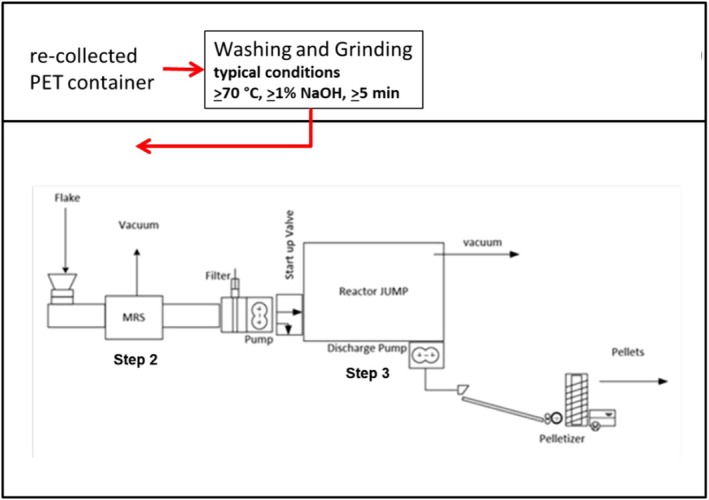 FIGURE 1
| Surrogates | Concentration of surrogates before step 3 (mg/kg PET) | Concentration of surrogates after step 3 (mg/kg PET) | Decontamination efficiency (%) |
|---|---|---|---|
|
| 93.8 | < 0.5 | > 99.5 |
|
| 52.5 | < 0.3 | > 99.4 |
|
| 79.6 | < 0.1 | > 99.8 |
|
| 93.5 | < 0.1 | > 99.8 |
|
| 9.7 | < 0.2 | – |
|
| 129.4 | 4.6 | 96.5 |
|
| 124.6 | 1.6 | 98.7 |
| Surrogates | Decontamination efficiency (%) |
|
|
|---|---|---|---|
|
| > 99.5 | < 0.015 | 0.04 |
|
| > 99.4 | < 0.018 | 0.05 |
|
| > 99.8 | < 0.006 | 0.05 |
|
| > 99.8 | < 0.006 | 0.13 |
|
| 96.5 | 0.106 | 0.15 |
|
| 98.7 | 0.038 | 0.29 |
Peer Reviews
No public reviews on file for this paper yet. If you reviewed it on a platform where reviews are public (OpenReview, ICLR, NeurIPS, ICML), you can paste yours below so the community can read it here.
Videos
No videos yet. Explain this paper in a talk, walkthrough, or lecture? Add one.
Taxonomy
TopicsOccupational exposure and asthma · Environmental Policies and Emissions · Risk and Safety Analysis
INTRODUCTION
1
Background
1.1
Recycled plastic materials and articles shall only be placed on the market if the recycled plastic is from an authorised recycling process. Before a recycling process is authorised, the European Food Safety Authority (EFSA)'s opinion on its safety is required. This procedure has been established in Articles 17 and 18 of Commission Regulation (EU) 2022/16161 on recycled plastic materials intended to come into contact with foods. More specifically, according to Article 18 of Commission Regulation (EU) 2022/1616 on recycled plastic materials intended to come into contact with foods, EFSA is required to carry out risk assessments on the risks originating from the migration of substances from recycled food contact plastic materials and articles into food, to evaluate the microbiological safety of these materials and articles and to deliver a scientific opinion on the recycling process examined.
According to this procedure, the process developers submit applications to the competent authorities of Member States, which transmit the applications to EFSA for evaluation. In this case, EFSA received an application from the German Competent Authority (Federal Office of Consumer Protection and Food Safety), for evaluating the recycling process Gneuss 5. The request has been registered in the EFSA's register of received questions under the number EFSA‐Q‐2023‐00467. The dossier was submitted by Fraunhofer IVV, on behalf of Gneuß Kunststofftechnik GmbH, Mönichhusen 42, 32549 Bad Oeynhausen, Germany (see Section 6).
Terms of Reference
1.2
The German Competent Authority (Federal Office of Consumer Protection and Food Safety) requested the safety evaluation of the recycling process Gneuss 5, in compliance with Article 17 of Commission Regulation (EU) 2022/1616. The recycling process uses the recycling technology number 1 of the list of suitable recycling technologies of Table 1 of Annex 1 of Commission Regulation (EU) 2022/1616.
DATA AND METHODOLOGIES
2
Data
2.1
The applicant submitted a confidential and a non‐confidential version of a dossier, following EFSA's ‘Scientific Guidance on the criteria for the evaluation and on the preparation of applications for the safety assessment of post‐consumer mechanical PET recycling processes intended to be used for manufacture of materials and articles in contact with food’ (EFSA CEP Panel, 2024) and EFSA's ‘Administrative guidance for the preparation of applications for the authorisation of individual recycling processes to produce recycled plastics materials and articles intended to come into contact with food’ (EFSA, 2024).
Additional information was received from the applicant during the assessment process, in response to a request from EFSA sent on 21 May and 18 November 2024 (see Section 6).
In accordance with Art. 38 of the Regulation (EC) No 178/20022 and taking into account the protection of confidential information and personal data in accordance with Articles 39 to 39e of the same Regulation, and of the Decision of the EFSA's Executive Director laying down practical arrangements concerning transparency and confidentiality,3 the non‐confidential version of the dossier has been published on Open.EFSA.4
According to Art. 32c(2) of Regulation (EC) No 178/2002 and to the Decision of EFSA's Executive Director laying down the practical arrangements on pre‐submission phase and public consultations, EFSA carried out a public consultation on the non‐confidential version of the application from 13 September to 4 October 2024 for which no comments were received.
The following information on the recycling process was provided by the applicant and used for the evaluation (EFSA, 2024; EFSA CEP Panel, 2024):
- –Recycling process,
- –Determination of the decontamination efficiency of the recycling process,
- –Table of operating parameters,
- –Self‐evaluation of the recycling process.
Methodologies
2.2
The risks associated with the use of recycled plastic materials and articles in contact with food come from the possible migration of chemicals into the food in amounts that would endanger human health. The quality of the input, the efficiency of the recycling process to remove contaminants, as well as the intended use of the recycled plastic are crucial points for the risk assessment (EFSA CEP Panel, 2024).
The criteria for the safety evaluation of a mechanical recycling process to produce recycled PET intended to be used for the manufacture of materials and articles in contact with food are described in the scientific guidance developed by the EFSA Panel on Food Contact Materials, Enzymes and Processing Aids (EFSA CEP Panel, 2024). The principle of the evaluation is to apply the decontamination efficiency of a recycling process, obtained from a challenge test with surrogate contaminants, to a reference contamination level for post‐consumer PET, conservatively set at 3 mg/kg PET for contaminants resulting from possible misuse. The resulting residual concentration of each surrogate contaminant in recycled PET (C res) is compared with a modelled concentration of the surrogate contaminants in PET (C mod). This C mod is calculated using generally recognised conservative migration models so that the related migration does not give rise to a dietary exposure exceeding 0.0025 μg/kg body weight (bw) per day (i.e. the human exposure threshold value for chemicals with structural alerts for genotoxicity), below which the risk to human health would be negligible, considering different dietary exposure scenarios (EFSA CEP Panel, 2024). If the C res is not higher than the C mod, the recycled PET manufactured by such recycling process is not considered of safety concern for the defined conditions of use (EFSA CEP Panel, 2024).
The assessment was conducted in line with the principles described in the EFSA Guidance on transparency in the scientific aspects of risk assessment, considering the relevant guidance from the EFSA Scientific Committee (EFSA, 2009).
ASSESSMENT
3
General information
5
3.1
According to the applicant, the recycling process Gneuss 5 is intended to recycle food grade PET containers. The recycled PET is intended to be used at up to 100% for the manufacture of materials and articles for direct contact with all kinds of foodstuffs, such as bottles for mineral water, soft drinks, and beer, for long‐term storage at room temperature or below, with or without hot‐fill. The recycled PET may also be used for sheets, which are thermoformed to make food trays/containers and take‐away packaging. The final articles are not intended to be used in microwave or conventional ovens.
Description of the process
3.2
General description
6
3.2.1
The recycling process Gneuss 5 produces recycled PET pellets from PET materials originating from post‐consumer collection systems (deposit and kerbside waste collection systems).
Input
- In step 1, the post‐consumer PET is processed into hot caustic washed and dried flakes.
Decontamination and production of recycled PET material
- In step 2, the flakes are extruded.
- In step 3, the material is decontaminated in a melt‐state polycondensation (MSP) process.
After step 3, the PET is pelletised. The operating conditions of the process have been provided to EFSA.
Characterisation of the preprocessed plastic input
7
3.2.2
According to the applicant, the input material consists of hot caustic washed and dried flakes obtained from PET materials, e.g. bottles, previously used for food packaging, from post‐consumer collection systems (kerbside and deposit systems). A small fraction may originate from non‐food applications. According to the applicant, the proportion will be no more than 5%, as specified in Article 7 and Table 1 of Annex I of Commission Regulation (EU) 2022/1616.
Technical specifications on the hot washed and dried flakes are provided, such as on physical properties and on residual contents of moisture, polystyrene, polycarbonate, poly(vinyl chloride) (PVC), polyolefins, polyamides, glue, cellulose and metals (see Appendix A).
Gneuss 5 process
3.3
Description of the main steps
8
3.3.1
The process flow diagram of the Gneuss 5 process, as provided by the applicant, is reported in Figure 1. The steps are:
- Extrusion (step 2): The hot caustic washed and dried flakes are melted, extruded ■■■■■ and filtered. The extruder used ■■■■■ comprises a ■■■■■.
- MSP (step 3): The melt is decontaminated in a ■■■■■ reactor (■■■■■) ■■■■■. The reactor consists of a ■■■■■ where the melt is moved by ■■■■■. ■■■■■.
Process flow diagram of the process (provided by the applicant).
The process is run under defined operating parameters9 of temperature, pressure, residence time as well as the geometrical and operational characteristics. According to the applicant, all critical parameters are monitored. The parameter values are automatically reported via the relevant software and monitored to alert for deviations from the acceptable values or ranges.10
According to the applicant, the pellets, the final product of the process, are checked against technical requirements, such as intrinsic viscosity, black spots and colour.
Decontamination efficiency of the recycling process
11
3.3.2
To demonstrate the decontamination efficiency of the recycling process Gneuss 5, a challenge test performed at pilot plant scale on step 3 was submitted to EFSA.
PET flakes were contaminated with toluene, chloroform, chlorobenzene, phenylcyclohexane, methyl salicylate, benzophenone and methyl stearate, selected as surrogates in agreement with the EFSA Scientific Guidance (EFSA CEP Panel, 2024) and in accordance with the recommendations of the US Food and Drug Administration (FDA, 2021). The mixture of these surrogates was spiked into the PET flakes during the extrusion (step 2). The extruder used in the challenge test was ■■■■■.
The decontamination efficiency was calculated from the concentration differences of the surrogate substances in the pellets sampled before and after MSP (step 3). When surrogates were not detected, the limit of detection was considered for the calculation of the decontamination efficiency. The results are summarised in Table 1.
Discussion
3.4
Considering the high temperatures used during the process, contamination by microorganisms can be discounted. Therefore, this evaluation focuses on the chemical safety of the final product.
Specifications on the input material (i.e. washed and dried flakes) are listed in Appendix A.
The flakes are produced from PET containers, e.g. bottles, previously used for food packaging, collected through post‐consumer collection systems. However, a small fraction may originate from non‐food applications, such as bottles for soap, mouthwash or kitchen hygiene agents. According to the applicant, the collection system and the sorting are managed in such a way that this fraction will be no more than 5% in the input stream, as recommended by the EFSA CEP Panel in its Guidance (EFSA CEP Panel, 2024).
The process is adequately described. The Gneuss 5 process comprises the extrusion (step 2) and MSP (step 3). The operating parameters of temperature, residence time, pressure as well as the geometrical and operational characteristics have been provided to EFSA.
A challenge test to measure the decontamination efficiency was conducted at pilot plant scale on process step 3. The Panel considered that it was performed correctly according to the recommendations of the EFSA Guidance (EFSA, CEP Panel, 2024). The decontamination of the material in the ■■■■■ reactor by MSP (step 3) is critical and depends on the surface area of the melt ■■■■■, the residence time, the pressure and the temperature. ■■■■■. Consequently, the pressure, the temperature, the residence time as well as the geometrical and operational characteristics of the reactor specified in Appendix C are to be controlled to guarantee the efficiency of the decontamination.
The Panel noted that the extrusion ■■■■■ (step 2) ■■■■■ is expected to lead to additional decontamination, as reported in the EFSA opinion on the Gneuss 1 process (EFSA CEF Panel, 2018). However, only the contribution of step 3 was considered to assess the safety of the Gneuss 5 process.
The decontamination efficiencies obtained for each surrogate, ranging from 96.5% to > 99.8%, have been used to calculate the residual concentrations of potential unknown contaminants in PET (C res). By applying the decontamination efficiency percentage to the reference contamination level of 3 mg/kg PET, the C res values shown in Table 2 were obtained.
According to the evaluation principles (EFSA CEP Panel, 2024), the dietary exposure must not exceed 0.0025 μg/kg body weight (bw) per day, below which the risk to human health is considered negligible. The C res value should not exceed the modelled concentration in PET (C mod) that, after 1 year at 25°C, results in a migration giving rise to a dietary exposure of 0.0025 μg/kg bw per day. As the recycled PET is intended for the manufacturing of articles (e.g. bottles) to be used in direct contact with drinking water, the exposure scenario for infants has been applied for the calculation of C_mod_ (Exposure Scenario A; water could be used to prepare infant formula). A maximum dietary exposure of 0.0025 μg/kg bw per day corresponds to a maximum migration of 0.0481 μg/kg (= 5 × 0.00962 μg/kg) or 0.0962 μg/kg (= 10 × 0.00962 μg/kg), depending on the molecular mass of a contaminant substance,12 into infants' food and has been used to calculate C mod (EFSA CEP Panel, 2024). C res reported in Table 2 is calculated for 100% recycled PET. The results of these calculations are shown in Table 2. The relationship between the key parameters for the evaluation scheme is reported in Appendix B.
TABLE 2: Decontamination efficiency from the challenge test, residual concentrations of the surrogates (C res) related to the reference contamination level and calculated concentrations of the surrogates in PET (C mod) corresponding to a modelled migration of 0.0481 or 0.0962 μg/kg after 1 year at 25°C (C mod).
On the basis of the provided data from the challenge test and the applied conservative assumptions, the Panel considered that, under the given operating conditions, the recycling process Gneuss 5 is able to ensure that the level of migration of unknown contaminants from the recycled PET into food is below the conservatively modelled migration of 0.0481 or 0.0962 μg/kg, depending on the molecular mass of a contaminant substance into infant's food. At this level, the risk to human health is considered negligible when the recycled PET is used at up to 100% to produce materials and articles intended for contact with all types of foodstuffs, including drinking water (exposure scenario A), for long‐term storage at room temperature or below, with or without hot‐fill.
CONCLUSIONS
4
The Panel considered that the process Gneuss 5 is adequately characterised and that the main steps used to recycle the PET flakes into decontaminated PET pellets have been identified. Having examined the challenge test provided, the Panel concluded that the melt‐state polycondensation (step 3) is critical for the decontamination efficiency. The parameters to control the process performance are the pressure, the temperature, the residence time as well as the geometrical and operational characteristics of the reactor specified in Appendix C.
The Panel concluded that the recycling process Gneuss 5 is capable of reducing contamination of post‐consumer food contact PET to a concentration that does not give rise to concern for a risk to human health if:
- it is operated under conditions that are at least as severe as those applied in the challenge test used to measure the decontamination efficiency of the process;
- the input material of the process is washed and dried post‐consumer PET flakes originating from materials and articles that have been manufactured in accordance with the EU legislation on food contact materials and contain no more than 5% of PET from non‐food consumer applications;
- the recycled PET obtained from the process Gneuss 5 is used at up to 100% for the manufacture of materials and articles for contact with all types of foodstuffs, including drinking water, for long‐term storage at room temperature or below, with or without hot‐fill.
The final articles made of this recycled PET are not intended to be used in microwave and conventional ovens, and such uses are not covered by this evaluation.
RECOMMENDATION
5
The Panel recommended periodic verification that the input to be recycled originates from materials and articles that have been manufactured in accordance with the EU legislation on food contact materials and that the proportion of PET from non‐food consumer applications is no more than 5%. This adheres to good manufacturing practice and the Commission Regulation (EU) 2022/1616. Critical steps in recycling should be monitored and kept under control. In addition, supporting documentation should be available on how it is ensured that the critical steps are operated under conditions at least as severe as those in the challenge test used to measure the decontamination efficiency of the process.
DOCUMENTATION PROVIDED TO EFSA
6
Dossier ‘Gneuss 5’. July 2023. Submitted by Fraunhofer IVV on behalf of Gneuß Kunststofftechnik GmbH.
Additional information, September 2024. Submitted by Fraunhofer IVV on behalf of Gneuß Kunststofftechnik GmbH.
Additional information, February 2025. Submitted by Fraunhofer IVV on behalf of Gneuß Kunststofftechnik GmbH.
ABBREVIATIONSbwbody weightCEF PanelPanel on Food Contact Materials, Enzymes, Flavourings and Processing AidsCEP PanelPanel on Food Contact Materials, Enzymes and Processing Aids C mod modelled concentration in PET C res residual concentrations in PETFCM PanelPanel on Food Contact MaterialsMSPmelt‐state polycondensationPETpoly(ethylene terephthalate)rPETrecycled poly(ethylene terephthalate)
REQUESTOR
German Competent Authority (Federal Office of Consumer Protection and Food Safety).
QUESTION NUMBER
EFSA‐Q‐2023‐00467
COPYRIGHT FOR NON‐EFSA CONTENT
EFSA may include images or other content for which it does not hold copyright. In such cases, EFSA indicates the copyright holder and users should seek permission to reproduce the content from the original source.
PANEL MEMBERS
Claude Lambré, Riccardo Crebelli, Maria de Silva, Koni Grob, Evgenia Lampi, Maria Rosaria Milana, Marja Pronk, Gilles Rivière, Mario Ščetar, Georgios Theodoridis, Els Van Hoeck and Nadia Waegeneers.
WAIVER
In accordance with Article 21 of the Decision of the Executive Director on Competing Interest Management, a waiver was granted to an expert of the Working Group. Pursuant to Article 21(6) of the aforementioned Decision, the concerned expert was allowed to take part in the preparation and discussion of the scientific output but was not allowed to take up the role of rapporteur within that time frame. Any competing interests are recorded in the respective minutes of the meetings of the CEP Panel Working Group on Recycling Plastics.
LEGAL NOTICE
The scientific output published implements EFSA's decision on the confidentiality requests submitted on specific items. As certain items have been awarded confidential status by EFSA, they are consequently withheld from public disclosure by redaction.
The reference list from the paper itself. Each links out to its DOI / PubMed record.
- 1EFSA (European Food Safety Authority) . (2009). Guidance of the Scientific Committee on transparency in the scientific aspects of risk assessments carried out by EFSA. Part 2: General principles. EFSA Journal, 7(5), 1051. 10.2903/j.efsa.2009.1051 · doi ↗
- 2EFSA (European Food Safety Authority) . (2024). Administrative guidance for the preparation of applications on recycling processes to produce recycled plastics intended to be used for manufacture of materials and articles in contact with food. EFSA Journal, 21(7), EN‐8968. 10.2903/sp.efsa.2024.EN-8968 · doi ↗
- 3EFSA CEF Panel (EFSA Panel on Food Contact Materials, Enzymes, Flavourings and Processing Aids) , Silano, V. , Bolognesi, C. , Castle, L. , Chipman, K. , Cravedi, J. P. , Engel, K. H. , Fowler, P. , Franz, R. , Grob, K. , Gürtler, R. , Husøy, T. , Kärenlampi, S. , Mennes, W. , Pfaff, K. , Riviere, G. , Srinivasan, J. , Tavares Poças, M. F. , Tlustos, C. , … Milana, M. R. (2018). Safety assessment of the process ‘Gneuss 1’, based on Gneuss technology, used to recycle post‐cons · doi ↗ · pubmed ↗
- 4EFSA CEP Panel (EFSA Panel on Food Contact Materials, Enzymes and Processing Aids) . (2024). Scientific Guidance on the criteria for the evaluation and on the preparation of applications for the safety assessment of post‐consumer mechanical PET recycling processes intended to be used for manufacture of materials and articles in contact with food. EFSA Journal, 22(7), 8879. 10.2903/j.efsa.2024.8879 PMC 1128719439081816 · doi ↗ · pubmed ↗
- 5FDA (Food and Drug Administration) . (2021). Guidance for industry: Use of recycled plastics in food packaging: Chemistry considerations. https://www.fda.gov/regulatory‐information/search‐fda‐guidance‐documents/guidance‐industry‐use‐recycled‐plastics‐food‐packaging‐chemistry‐considerations.