Survival outcomes in patients with sigmoid volvulus
Rosa D. E. Bock, Peter G. Vaughan-Shaw, A. J. Clark, M. Collie, D. Collins, M. Duff, S. Goodbrand, J. Mander, N. T. Ventham, H. M. Paterson, M. A. Potter, C. Reddy, D. Speake, F. V. N. Din, M. G. Dunlop, G. Smith

TL;DR
This study examines the outcomes of elderly patients with sigmoid volvulus, showing that surgery can improve survival but is not suitable for all due to factors like frailty.
Contribution
The study provides insights into the management and outcomes of sigmoid volvulus in elderly patients, emphasizing the role of individualized care.
Findings
Non-operative treatment led to high recurrence and poor survival in elderly patients with sigmoid volvulus.
Surgery showed excellent outcomes in selected patients, but this likely reflects case selection based on frailty and comorbidities.
Mortality in non-surgical patients was largely due to underlying conditions, not the volvulus itself.
Abstract
This study aimed to assess management pathways and outcomes in sigmoid volvulus (SV). A retrospective review was performed on patients first admitted with SV between 2019 and 2023 within a tertiary-level colorectal service. Demographic, management, and outcome data, including frailty, ASA (American Society of Anaesthesiologists), and National Emergency Laparotomy Audit (NELA) score, were collected. Comparative statistics were used to compare baseline demographics between those operated on and those not and to identify factors associated with survival. A total of 72 patients were included, median age of 78 years, with 25 undergoing surgery. After index discharge without surgery, 50 patients (88%) were re-admitted with SV at least once, with a total of 212 hospital admissions and 1952 hospital bed days at the end of follow-up. A trend towards lower age, NELA score, ASA score and frailty…
Genes, proteins, chemicals, diseases, species, mutations and cell lines named across the full text — each resolved to its canonical identifier and authoritative record.
Click any figure to enlarge with its caption.
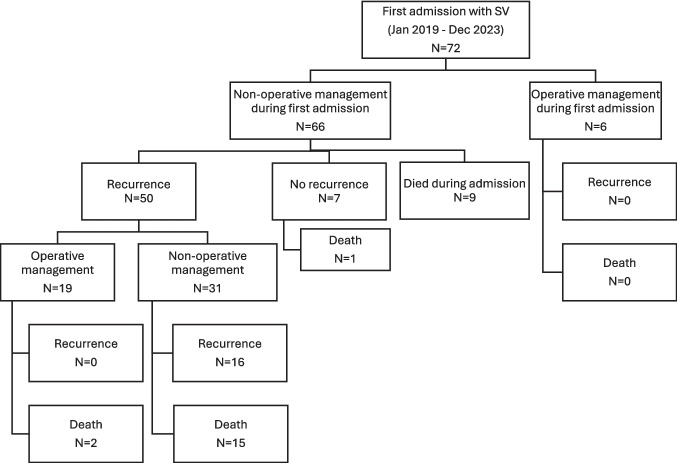 Figure 1
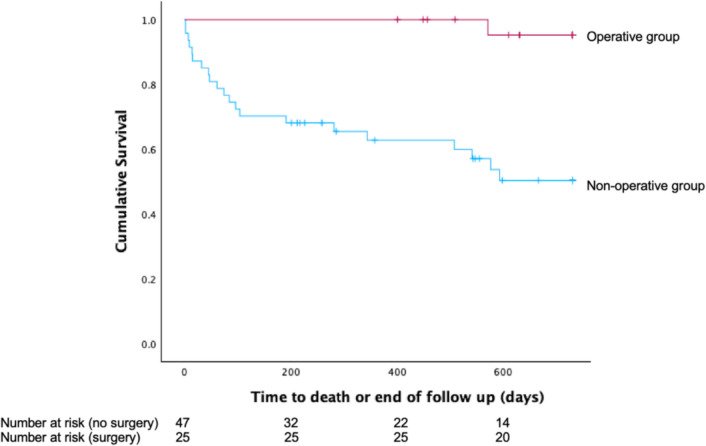 Figure 2
Peer Reviews
No public reviews on file for this paper yet. If you reviewed it on a platform where reviews are public (OpenReview, ICLR, NeurIPS, ICML), you can paste yours below so the community can read it here.
Videos
No videos yet. Explain this paper in a talk, walkthrough, or lecture? Add one.
Taxonomy
TopicsIntestinal Malrotation and Obstruction Disorders · Esophageal and GI Pathology · Pediatric Hepatobiliary Diseases and Treatments