Establishment and epidemiological investigation of a dual fluorescent qPCR assay for Pasteurella multocida and Salmonella in yaks in the Tibetan Autonomous Prefecture of Garzê, China
Yao Pan, Qingting Yu, Qi Wang, Qiang Li, Wei Tian, Lingxiang Xin, Xing Hu, Haiyue Xiao, Yuanjie Liu, Luo Rong Deng Zhu, Lan Lan, Liangquan Zhu, Jianping Wu

TL;DR
A new dual fluorescent qPCR test was developed to quickly detect two harmful bacteria in yaks in China's Garzê region, improving disease diagnosis and monitoring.
Contribution
The novel contribution is a dual fluorescent qPCR assay for simultaneous detection of Pasteurella multocida and Salmonella in yaks.
Findings
The assay detected P. multocida and Salmonella with high sensitivity (limits of 100 and 10 copies, respectively).
Clinical testing showed 20.35% and 38.50% infection rates for P. multocida and Salmonella in yak samples.
The assay demonstrated strong specificity and no cross-reactivity with other pathogens.
Abstract
Yaks serve as a vital economic and ecological resource in high-altitude regions, but it faces significant health challenges from various pathogens. Among these, Pasteurella multocida and Salmonella are critical pathogens that contribute to severe diseases. A duplex real-time fluorescence quantitative PCR assay was developed to simultaneously detect Pasteurella multocida and Salmonella. The species-specific genes kmt1 and invA were selected as target regions for primer and probe design. Following rigorous optimization, a duplex assay was established. Recombinant plasmids were constructed to serve as standards for generating standard curves. The detection thresholds were determined using SPSS statistical analysis and receiver operating characteristic curve methods. Furthermore, the assay’s sensitivity, specificity, stability, and clinical applicability were evaluated. The established…
Genes, proteins, chemicals, diseases, species, mutations and cell lines named across the full text — each resolved to its canonical identifier and authoritative record.
Click any figure to enlarge with its caption.
 Figure 1
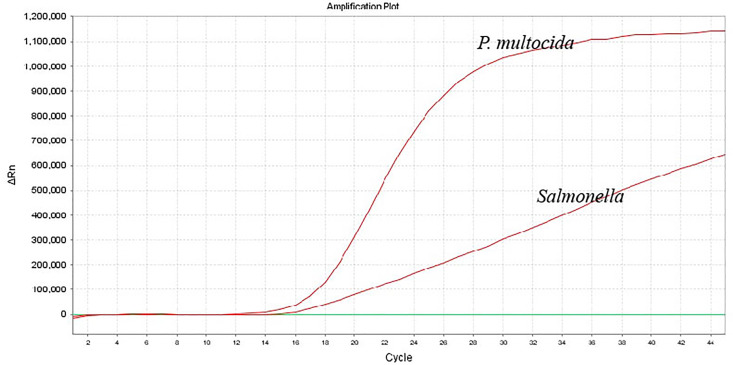 Figure 2
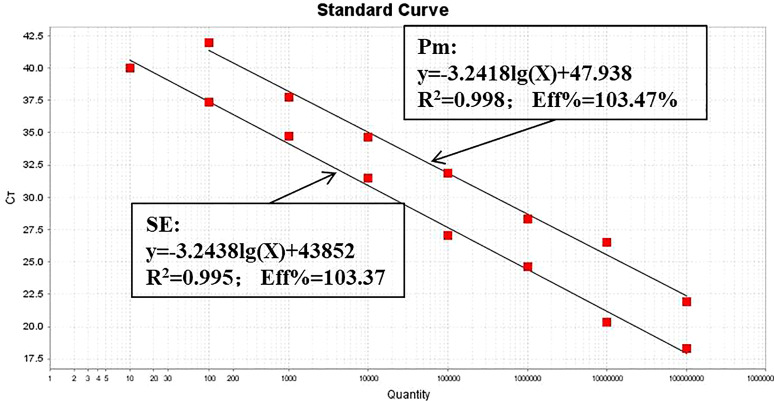 Figure 3
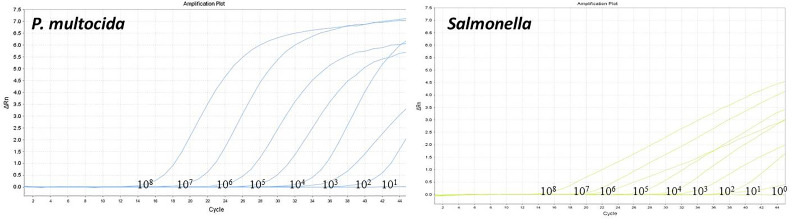 Figure 4
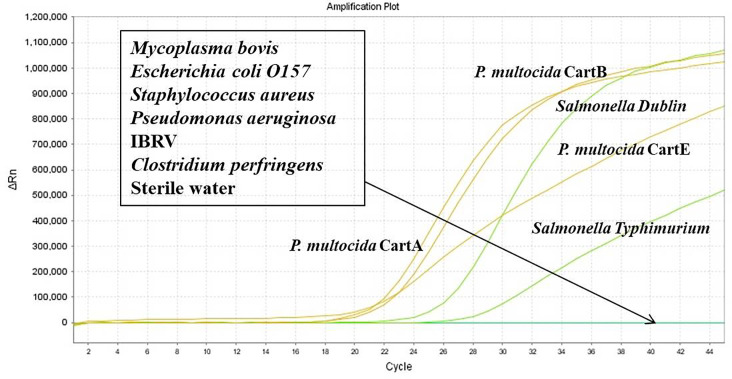 Figure 5
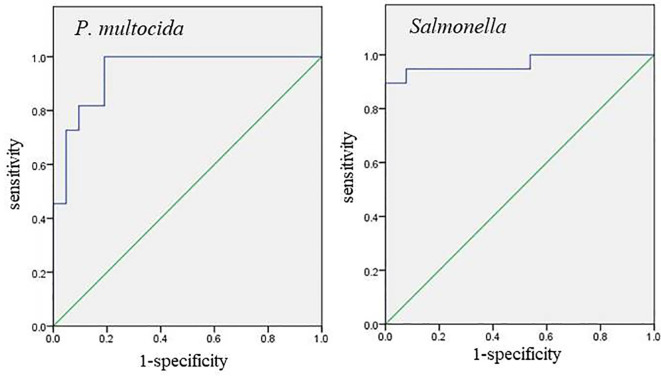 Figure 6
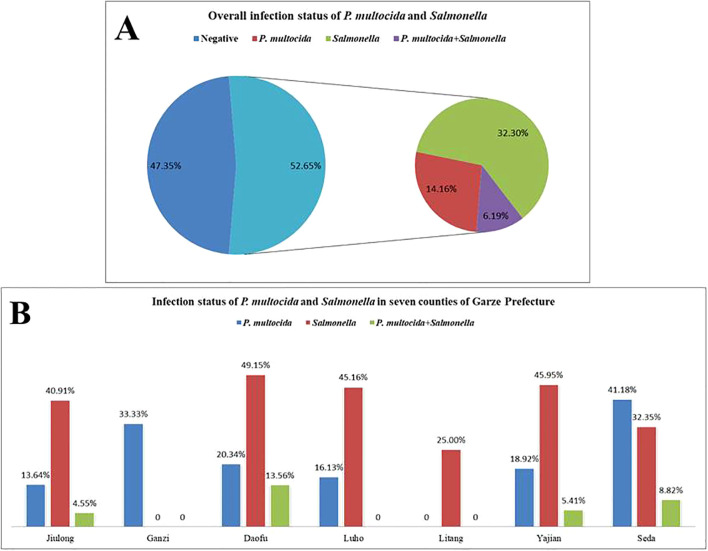 Figure 7
Peer Reviews
No public reviews on file for this paper yet. If you reviewed it on a platform where reviews are public (OpenReview, ICLR, NeurIPS, ICML), you can paste yours below so the community can read it here.
Videos
No videos yet. Explain this paper in a talk, walkthrough, or lecture? Add one.
Taxonomy
TopicsMicrobial infections and disease research · Herpesvirus Infections and Treatments · Aquaculture disease management and microbiota