Enhancing mu-ERD through combined robotic assistance and motor imagery: a novel approach for upper limb rehabilitation
Hiroki Yasuda, Masaya Ueda, Keita Ueno, Yasuo Naito, Ryouhei Ishii, Takashi Takebayashi

TL;DR
Combining robotic therapy with imagining movements may enhance brain activity linked to motor recovery in healthy adults, potentially aiding stroke rehabilitation.
Contribution
The novel combination of robotic full-assist therapy and motor imagery is shown to increase mu-ERD in healthy individuals.
Findings
Mu-ERD occurrence was significantly higher at C3 (8–10 Hz) and C4 (10–13 Hz) when motor imagery was combined with robotic therapy.
No significant differences in mu-ERD attenuation rates were found between the tested conditions.
Individual variability in responses suggests the need for further research with larger and clinical populations.
Abstract
Previous research has suggested that mu-event-related desynchronization (mu-ERD) reflects neural activity associated with motor observation and execution, primarily within the sensorimotor cortex. This study aimed to investigate the effects of combining robotic full-assist therapy with motor imagery on mu-ERD in healthy adults for potential application in stroke patients with severe upper limb paralysis. Fifteen healthy adults were included in this study. Each participant performed three conditions using the ReoGo-J® robotic system: voluntary movement, full-assist robotic therapy without motor imagery, and full-assist robotic therapy with motor imagery. Electroencephalography (EEG) was used to measure mu-ERD, focusing on the 8–10 Hz and 10–13 Hz frequency bands at the C3, C4, Cz, and Pz electrodes. Significant differences in mu-ERD occurrence were observed at C3 (8–10 Hz) and C4…
Genes, proteins, chemicals, diseases, species, mutations and cell lines named across the full text — each resolved to its canonical identifier and authoritative record.
Click any figure to enlarge with its caption.
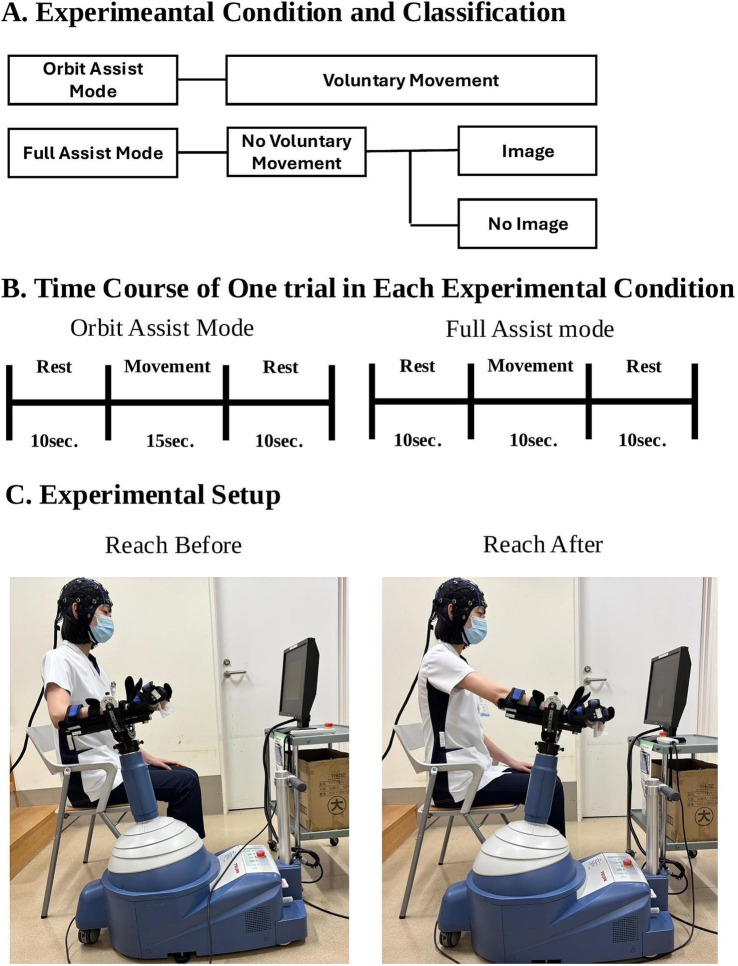 Figure 1
Peer Reviews
No public reviews on file for this paper yet. If you reviewed it on a platform where reviews are public (OpenReview, ICLR, NeurIPS, ICML), you can paste yours below so the community can read it here.
Videos
No videos yet. Explain this paper in a talk, walkthrough, or lecture? Add one.
Taxonomy
TopicsEEG and Brain-Computer Interfaces · Neuroscience and Neural Engineering · Muscle activation and electromyography studies