Low climate-patterned temperature and cardiovascular disease: Worldwide trends and implications for public health policy
Wenpeng You, Jacob Sevastidis, Frank Donnelly

TL;DR
Colder climates are linked to higher rates of heart disease worldwide, especially in wealthier countries, suggesting temperature should be considered in public health strategies.
Contribution
This study identifies long-term mean temperature as a significant and independent predictor of cardiovascular disease incidence globally.
Findings
A significant inverse correlation exists between climate-patterned temperature and CVD incidence (r = −0.646, p < 0.001).
TMP remains a significant predictor of CVD after controlling for confounders like aging, GDP, and obesity.
The predictive effect of TMP on CVD is stronger in high-income countries compared to low- and middle-income countries.
Abstract
Short-term cold spells and heat events are commonly considered risk factors for cardiovascular disease (CVD). This study quantitatively examined the effects of country-specific "climate-patterned temperature" (TMP), measured as long-term mean temperature, on global CVD incidence. Recently published country-specific data on CVD incidence and TMP were analysed for statistical correlations at the population level using Microsoft Excel and SPSS. Confounding effects of humidity, aging, GDP PPP, obesity prevalence, and urbanization were controlled. Fisher r-to-z transformation compared correlation coefficients. Pearson's r and nonparametric analyses revealed a significant inverse correlation between TMP and CVD incidence worldwide (r = −0.646 and −0.574, respectively, p < 0.001). This relationship remained significant after controlling for confounders in a partial correlation model (r =…
Genes, proteins, chemicals, diseases, species, mutations and cell lines named across the full text — each resolved to its canonical identifier and authoritative record.
Click any figure to enlarge with its caption.
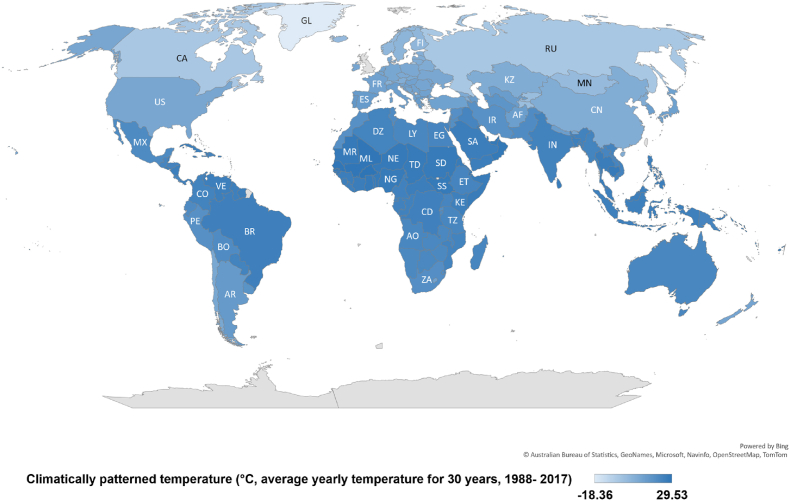 Figure 1
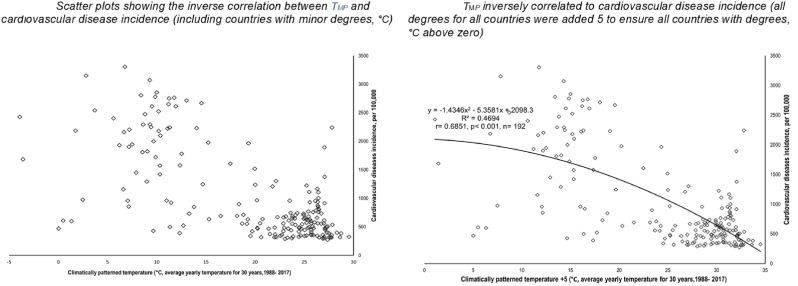 Figure 2
Peer Reviews
No public reviews on file for this paper yet. If you reviewed it on a platform where reviews are public (OpenReview, ICLR, NeurIPS, ICML), you can paste yours below so the community can read it here.
Videos
No videos yet. Explain this paper in a talk, walkthrough, or lecture? Add one.
Taxonomy
TopicsClimate Change and Health Impacts · Global Health Care Issues · Thermoregulation and physiological responses