Turtle Study: A Phase 2 Study of Durvalumab Plus Carboplatin and Etoposide in Elderly Patients With Extensive-Stage SCLC (LOGiK 2003)
Hidenobu Ishii, Koichi Azuma, Yuta Yamanaka, Hiroshige Yoshioka, Yukihiro Toi, Naoki Shingu, Katsuhiko Naoki, Masaki Okamoto, Yuko Tsuchiya-Kawano, Taishi Harada, Hiroyuki Inoue, Hiroshi Ishii, Kazunori Tobino, Chiho Nakashima, Yoshifusa Koreeda, Yasushi Hisamatsu

TL;DR
This study tested a treatment combining durvalumab with chemotherapy in elderly patients with extensive-stage small cell lung cancer and found it to be safe and effective.
Contribution
The study evaluates the safety and efficacy of durvalumab plus carboplatin and etoposide in elderly patients with extensive-stage SCLC.
Findings
Grade 3 or higher adverse events occurred in 94.6% of patients, primarily hematologic.
The objective response rate was 89.5%, with a median progression-free survival of 5.4 months and median overall survival of 16.1 months.
No significant decline in quality of life or functional assessment scores was observed.
Abstract
The combination of immune checkpoint inhibitors with chemotherapy is the standard treatment for extensive-stage (ES) SCLC. However, its safety for elderly patients is not fully validated. We evaluated the safety and efficacy of durvalumab plus carboplatin and etoposide in elderly patients with ES-SCLC. In this prospective, single-arm, multicenter, phase 2 clinical trial, patients with ES-SCLC aged above or equal to 75 years received chemotherapy with up to four cycles of durvalumab 1500 mg on day 1, carboplatin at a dose equivalent to an area under the curve of 5 on day 1, and etoposide 80 mg/m2 on days 1 to 3 every 3 weeks as induction therapy. Maintenance therapy with durvalumab 1500 mg was administered every 4 weeks until disease progression or unacceptable toxicity. The primary end point was safety, and key secondary end points were objective response rate, progression-free…
Genes, proteins, chemicals, diseases, species, mutations and cell lines named across the full text — each resolved to its canonical identifier and authoritative record.
Click any figure to enlarge with its caption.
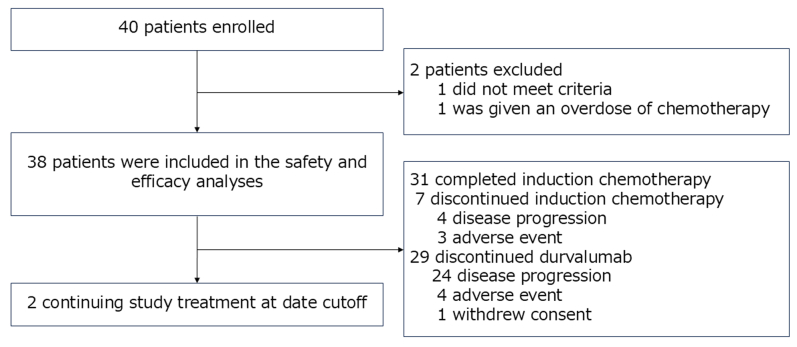 Figure 1
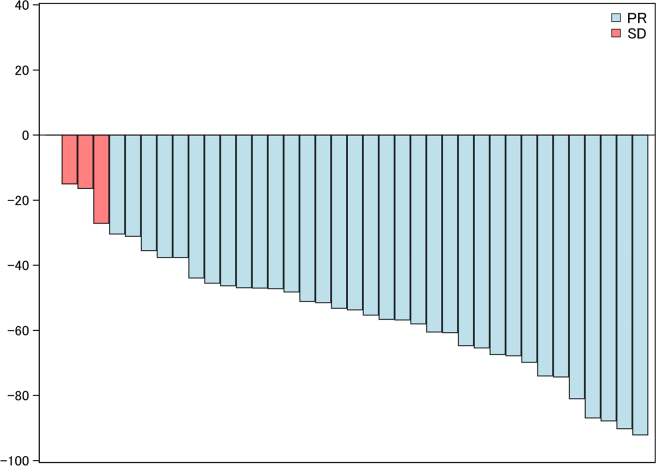 Figure 2
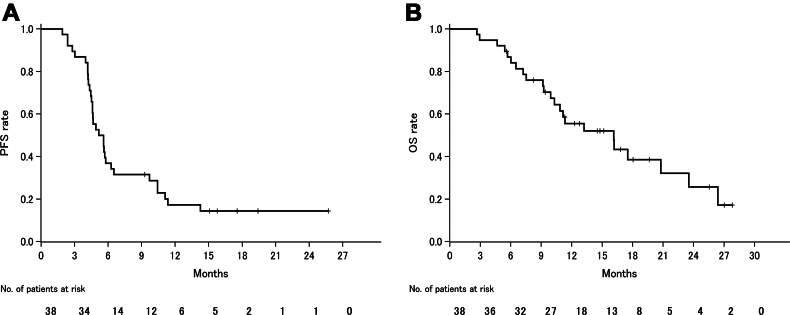 Figure 3
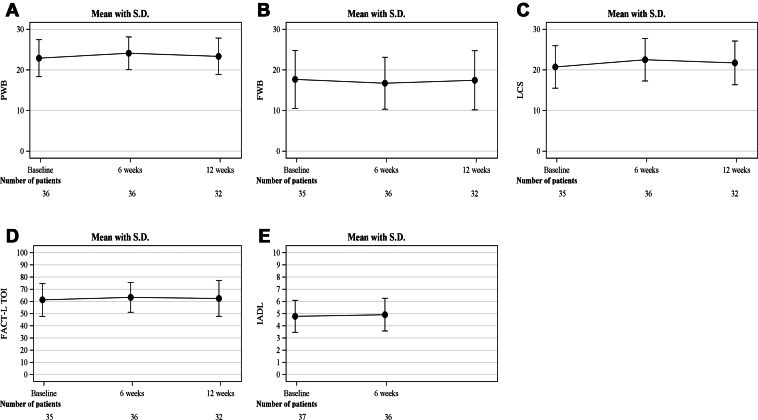 Figure 4
Peer Reviews
No public reviews on file for this paper yet. If you reviewed it on a platform where reviews are public (OpenReview, ICLR, NeurIPS, ICML), you can paste yours below so the community can read it here.
Videos
No videos yet. Explain this paper in a talk, walkthrough, or lecture? Add one.
Taxonomy
TopicsLung Cancer Research Studies · Neuroendocrine Tumor Research Advances · Cancer therapeutics and mechanisms