Circadian activity predicts breeding phenology in the Asian burying beetle Nicrophorus nepalensis
Hao Chen, Dustin R. Rubenstein, Guan-Shuo Mai, Chung-Fan Chang, Sheng-Feng Shen

TL;DR
This study shows that circadian activity patterns in Asian burying beetles can predict their breeding behavior, offering a non-invasive way to track how climate change affects reproduction.
Contribution
A novel machine learning framework that links circadian behavior to breeding phenology in beetles using non-invasive methods.
Findings
A model predicted breeding phenology with 95% accuracy using three behavioral features under long-day conditions.
The model retained 76% accuracy under short-day conditions, showing distinct behavioral differences between breeding strategies.
The approach provides a scalable method for tracking population responses to climate change across elevational gradients.
Abstract
Climate change continues to alter breeding phenology in a range of plant and animal species across the globe. Traditional methods for assessing when organisms reproduce often rely on time-intensive field observations or destructive sampling, creating an urgent need for efficient, non-invasive approaches to assess reproductive timing. Here, we examined three populations of the Asian burying beetle Nicrophorus nepalensis from subtropical Okinawa, Japan (500 m) and Taiwan (1100–3200 m) that were reared under contrasting photoperiods in order to develop a predictive framework linking circadian activity to breeding phenology. Using automated activity monitors, we quantified adult circadian rhythms and used machine learning to predict breeding phenology (seasonal versus year-round breeding) from behaviour alone. Our model achieved 95% accuracy under long-day conditions using just three…
Genes, proteins, chemicals, diseases, species, mutations and cell lines named across the full text — each resolved to its canonical identifier and authoritative record.
Click any figure to enlarge with its caption.
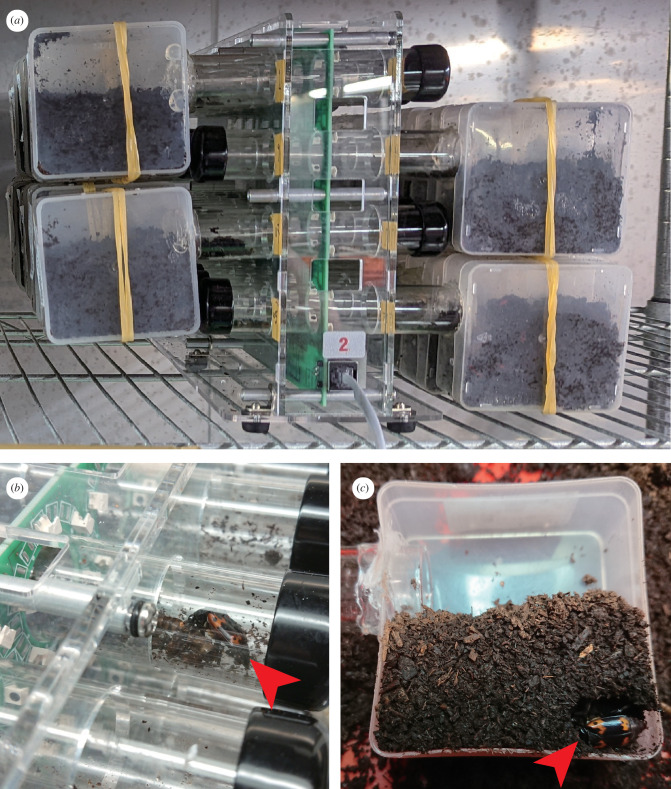 Figure 1
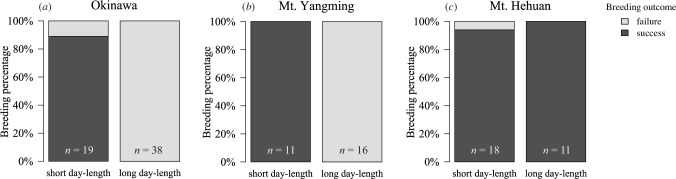 Figure 2
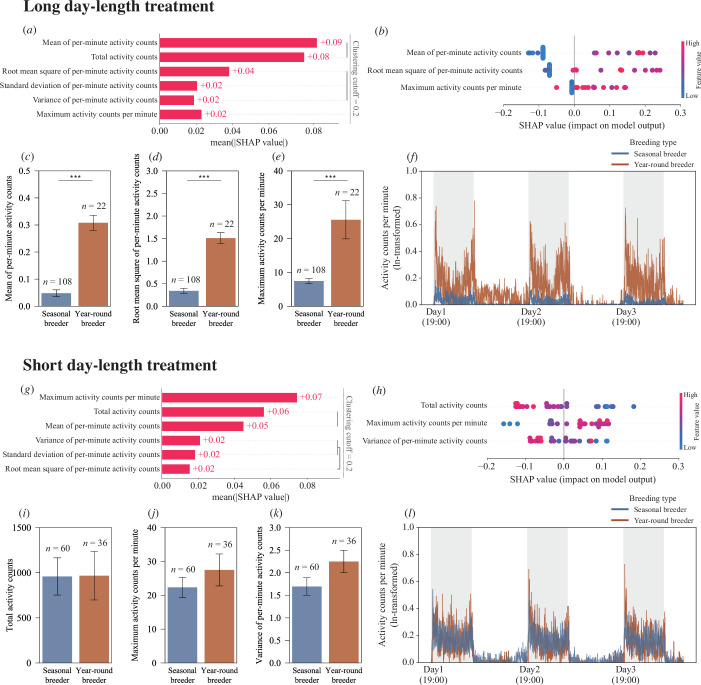 Figure 3
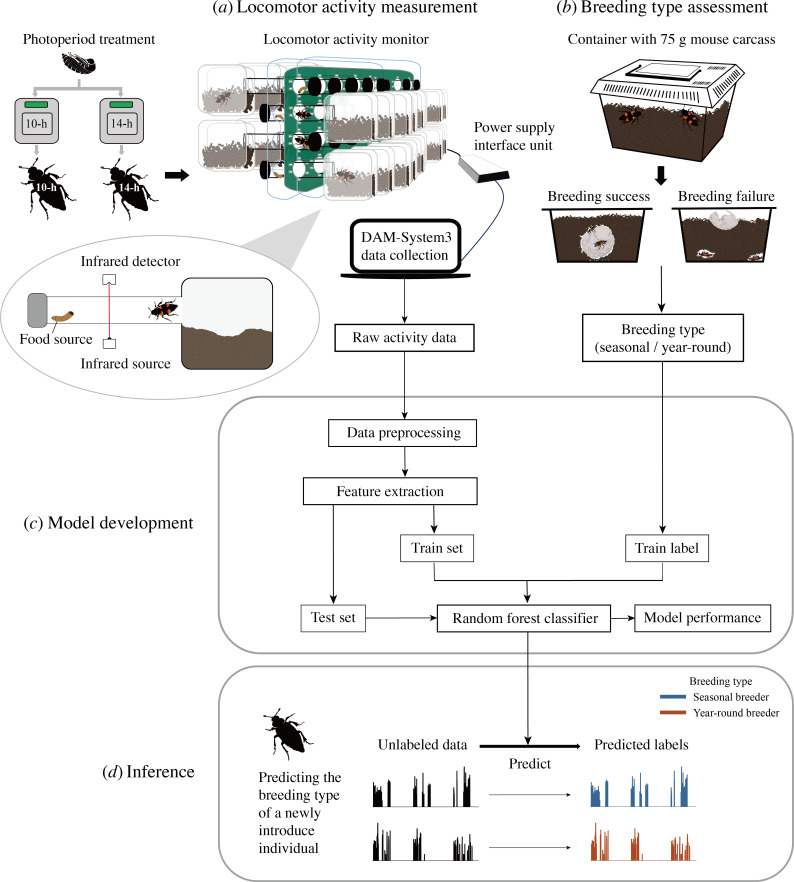 Figure 4
Peer Reviews
No public reviews on file for this paper yet. If you reviewed it on a platform where reviews are public (OpenReview, ICLR, NeurIPS, ICML), you can paste yours below so the community can read it here.
Videos
No videos yet. Explain this paper in a talk, walkthrough, or lecture? Add one.
Taxonomy
TopicsInsect and Arachnid Ecology and Behavior · Plant and animal studies · Forest Insect Ecology and Management