Sociodemographically differential patterns of chronic pain progression revealed by analyzing the all of us research program data
Edwin Baldwin, Jin Zhou, Wenting Luo, W. Michael Hooten, Jungwei W. Fan, Haiquan Li, Mengyu Wang, Miguel E Rentería, Mengyu Wang, Miguel E Rentería

TL;DR
The study finds that chronic pain conditions progress differently among various demographic groups, highlighting the need for personalized treatment approaches.
Contribution
This study is the first to reveal sociodemographic influences on the progression of chronic overlapping pain conditions using large-scale data.
Findings
Black or African Americans with a COPC condition show increased progression to other COPCs or mental disorders.
Females are more likely to develop chronic low back pain after anxiety and depression.
Low-income individuals face higher risks of progressing from one COPC to another or to mental disorders.
Abstract
The differential progression of ten chronic overlapping pain conditions (COPC) and four comorbid mental disorders across demographic groups have rarely been reported in the literature. To fill in this gap, we conducted retrospective cohort analyses using All of Us Research Program data from 1970 to 2023. Separate cohorts were created to assess the differential patterns across sex, race, and ethnicity. Logistic regression models, controlling for demographic variables and household income level, were employed to identify significant sociodemographic factors associated with the differential progression from one COPC or mental condition to another. Among the 139 frequent disease pairs, we identified group-specific patterns in 15 progression pathways. Black or African Americans with a COPC condition had a significantly increased association in progression to other COPCs (CLBP- > IBS, CLBP- >…
Genes, proteins, chemicals, diseases, species, mutations and cell lines named across the full text — each resolved to its canonical identifier and authoritative record.
Click any figure to enlarge with its caption.
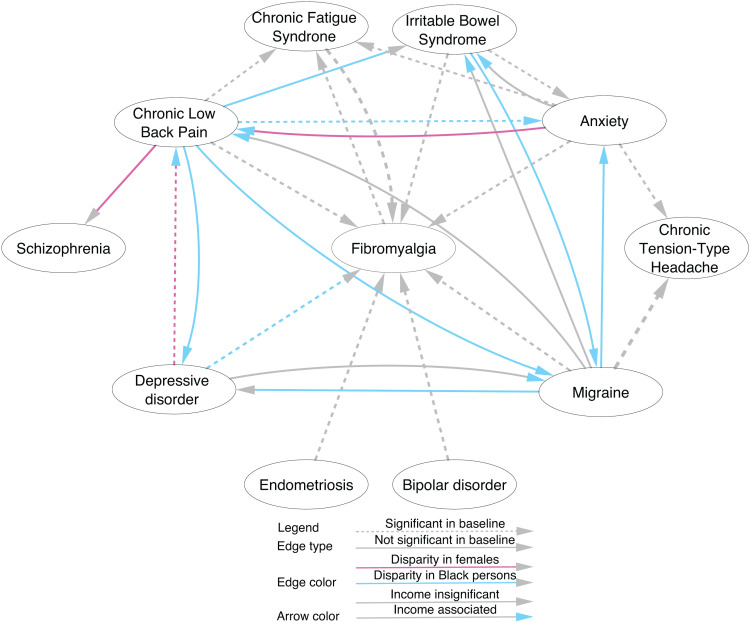 Figure 1
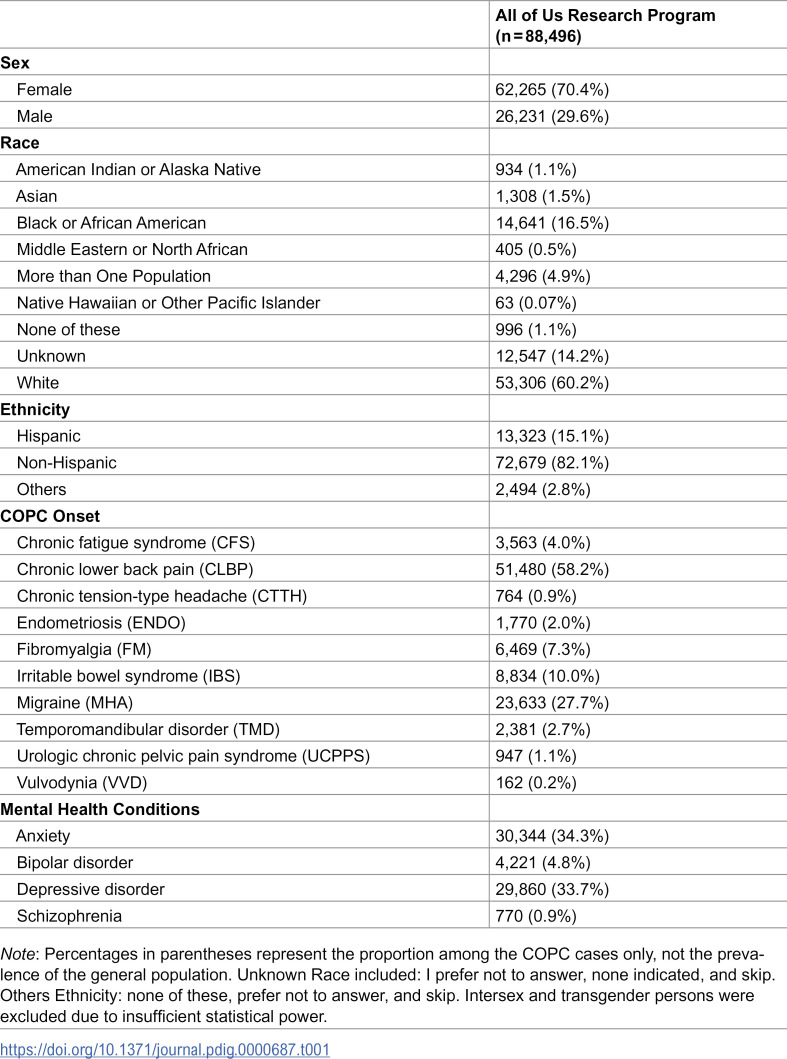 Figure 2
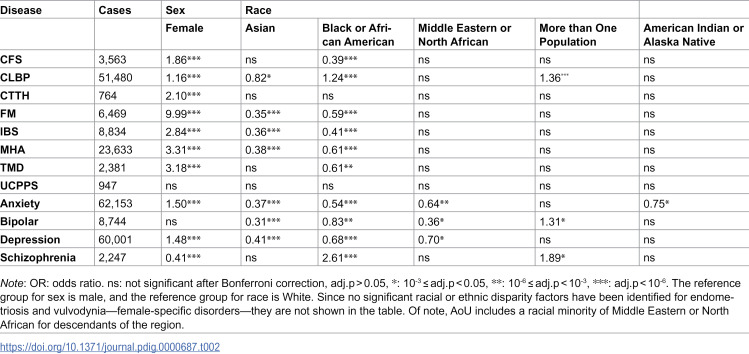 Figure 3
Peer Reviews
No public reviews on file for this paper yet. If you reviewed it on a platform where reviews are public (OpenReview, ICLR, NeurIPS, ICML), you can paste yours below so the community can read it here.
Videos
No videos yet. Explain this paper in a talk, walkthrough, or lecture? Add one.
Taxonomy
TopicsMusculoskeletal pain and rehabilitation · Fibromyalgia and Chronic Fatigue Syndrome Research · Pain Mechanisms and Treatments