Women’s Preferences and Willingness to Pay for AI Chatbots in Women’s Health: Discrete Choice Experiment Study
Jing Wang, Hewei Min, Tao Li, Jiaheng Li, Yang Jiang, Jingbo Zhang, Yibo Wu, Xinying Sun

TL;DR
This study explores what features women prefer in AI chatbots for health education, finding that accuracy, clarity, and free access are most important.
Contribution
The study introduces a discrete choice experiment to quantify women's preferences and willingness to pay for specific AI chatbot features in health education.
Findings
Participants preferred chatbots with 100% response accuracy and very easy-to-understand information.
Women were willing to pay up to CN ¥11.45 for practical information utility and CN ¥9.91 for high accuracy.
Information utility and response accuracy were the most influential factors in user preferences.
Abstract
Over 96% of adult women face health issues, with 70% experiencing conditions like infections. Mobile health education is increasingly popular but faces challenges in personalization and readability. Artificial intelligence (AI) chatbots provide tailored support, and a discrete choice experiment can help in understanding user preferences to improve chatbot design. This study aims at exploring the preferences of women toward AI chatbots to improve health education communication and user experience. A discrete choice experiment was conducted, identifying 6 main attributes of AI chatbots: response accuracy, legibility, service cost, background information collection, information utility, and content provision. A total of 957 female participants from a hospital in Hebei Province participated, choosing between 2 hypothetical chatbots or opting for neither (a no-choice option). The…
Genes, proteins, chemicals, diseases, species, mutations and cell lines named across the full text — each resolved to its canonical identifier and authoritative record.
Click any figure to enlarge with its caption.
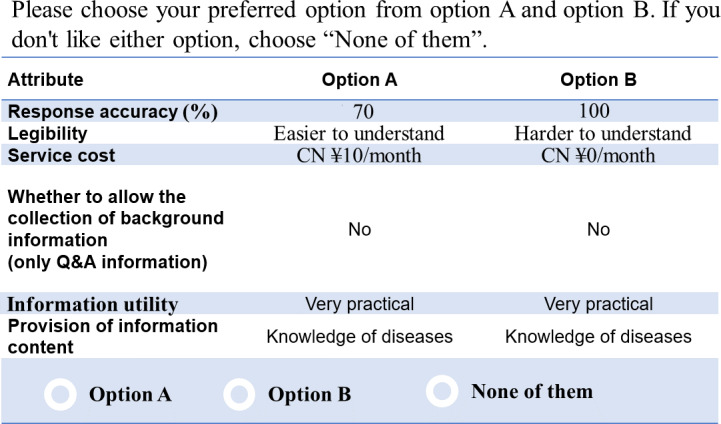 Figure 1
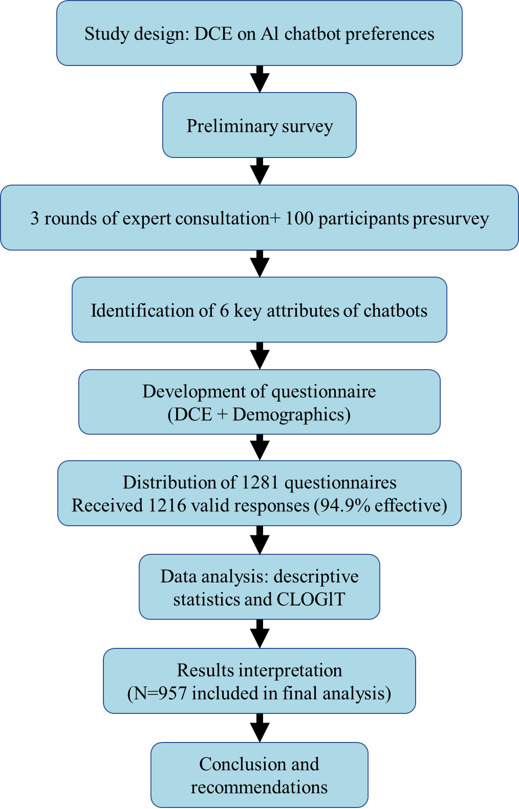 Figure 2
Peer Reviews
No public reviews on file for this paper yet. If you reviewed it on a platform where reviews are public (OpenReview, ICLR, NeurIPS, ICML), you can paste yours below so the community can read it here.
Videos
No videos yet. Explain this paper in a talk, walkthrough, or lecture? Add one.
Taxonomy
TopicsMobile Health and mHealth Applications · Artificial Intelligence in Healthcare and Education · Technology Use by Older Adults