Validation of Chinese version of the familiar tools use test for assessing limb apraxia in stroke patients
Jinni Wang, Jingxin Wei, Meilian Chen, Lu Gao, Xiaoyan Liao

TL;DR
This study validates a Chinese version of a test for assessing limb apraxia in stroke patients, showing it is reliable and effective.
Contribution
The study provides validation of the Familiar Tools Use Test for Chinese stroke patients, confirming its reliability and validity.
Findings
The FTT showed good internal consistency, test–retest reliability, and inter-rater reliability.
Exploratory factor analysis revealed distinct factors for tool selection and action execution.
Limb apraxia prevalence was higher in left brain damage patients compared to right brain damage patients.
Abstract
To validate the Familiar Tools Use Test (FTT) of the Diagnostic Instrument for Limb Apraxia-Short Version in Chinese stroke patients. Participants were conveniently enrolled from a neurology ward in a tertiary hospital in Guangzhou, China, between April 2023 and September 2023. Internal consistency, test–retest reliability, inter-rater reliability, dimensionality, convergent validity, and divergent validity were examined. In total, 110 ischemic stroke patients were included. The FTT demonstrated satisfactory internal consistency (Cronbach’s α = 0.70–0.75), test–retest reliability (ICC 0.88–0.99, 95%CI), and inter-rater reliability (Kappa coefficients ranging from 0.83 to 1.00, p < 0.001). Exploratory factor analysis extracted one common factor for tool selection and two common factors for action execution. There were mild to moderate correlations between the scores of the FTT scales…
Genes, proteins, chemicals, diseases, species, mutations and cell lines named across the full text — each resolved to its canonical identifier and authoritative record.
Click any figure to enlarge with its caption.
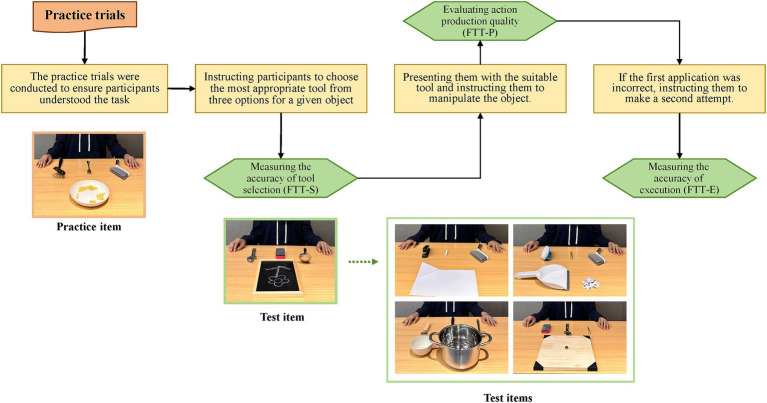 Figure 1
Peer Reviews
No public reviews on file for this paper yet. If you reviewed it on a platform where reviews are public (OpenReview, ICLR, NeurIPS, ICML), you can paste yours below so the community can read it here.
Videos
No videos yet. Explain this paper in a talk, walkthrough, or lecture? Add one.
Taxonomy
TopicsStroke Rehabilitation and Recovery · Action Observation and Synchronization · Botulinum Toxin and Related Neurological Disorders