Comparative genomics using long-read sequencing identifies nearly identical TAL effector regions in two Xanthomonas oryzae pv. Oryzae isolates collected from the basmati rice-growing region of Pakistan
Khansa Ejaz, Muhammad Zakria, Peiqi Zhang, Jose Huguet Tapia, Muhammad Arif, Frank White, Sumera Yasmin

TL;DR
This study uses long-read sequencing to analyze two Xoo isolates from Pakistan, revealing nearly identical TAL effector regions and their genetic relationships with other Asian strains.
Contribution
The study provides the first complete genome sequences of Xoo isolates from Pakistan and highlights conserved TAL effector regions.
Findings
Both isolates have nearly identical TAL effector regions with 18 TAL effectors each.
Phylogenomic analysis grouped the isolates with strains from India and Thailand.
The study emphasizes the utility of long-read sequencing for tracking Xoo diversity.
Abstract
The emergence of hostile and novel plant pathogenic strains poses a serious threat to global food security, which renders the strategies for disease management in modern agriculture ineffective. Preventing the consequences of these emerging phytopathogens requires accurate genetic information about the pathogen population to formulate effective management strategies. Bacterial leaf blight (BLB), caused by Xanthomonas oryzae pv. oryzae (Xoo), is the foremost reason for substantial yield losses in rice crops worldwide, especially in Asia. The genetic information regarding the Pakistani Xoo population is still unexplored. To bridge this gap, two representative Pakistani Xoo isolates, namely PkXoo1 and PkXoo2, were sequenced using long-read Oxford Nanopore Technology (ONT). Both isolates were obtained from the Basmati rice-growing region of Pakistan, with substantially high virulence on…
Genes, proteins, chemicals, diseases, species, mutations and cell lines named across the full text — each resolved to its canonical identifier and authoritative record.
Click any figure to enlarge with its caption.
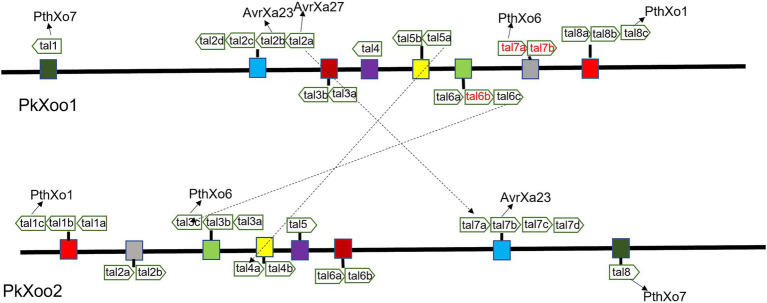 Figure 1
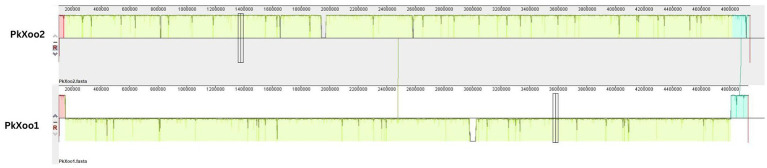 Figure 2
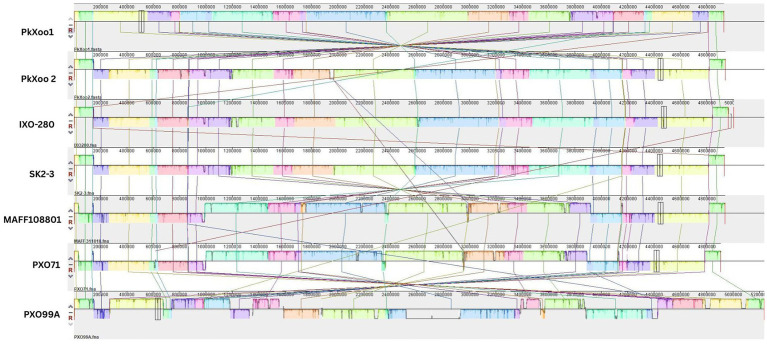 Figure 3
Peer Reviews
No public reviews on file for this paper yet. If you reviewed it on a platform where reviews are public (OpenReview, ICLR, NeurIPS, ICML), you can paste yours below so the community can read it here.
Videos
No videos yet. Explain this paper in a talk, walkthrough, or lecture? Add one.
Taxonomy
TopicsPlant Pathogenic Bacteria Studies · Plant-Microbe Interactions and Immunity · Plant Pathogens and Fungal Diseases