Imaging joy with generalized slice dithered enhanced resolution and SWAT reconstruction: 3T high spatial–temporal resolution fMRI
Jennifer D. Townsend, Angela Martina Muller, Zanib Naeem, Alexander Beckett, Bhavesh Kalisetti, Reza Abbasi-Asl, Congyu Liao, An Thanh Vu

TL;DR
This paper introduces a new MRI technique to study brain activity related to joy with high resolution at 3T scanners.
Contribution
The novel gSLIDER-SWAT method improves fMRI spatial and temporal resolution at 3T for studying neural correlates of joy.
Findings
gSLIDER-SWAT achieved ~2× higher tSNR than traditional SE-EPI.
gSLIDER-SWAT detected joy-related activation in amygdala, cingulate, hippocampus, striatum, and prefrontal cortex.
The method enables high-resolution fMRI at 3T for naturalistic emotion studies.
Abstract
To facilitate high spatial–temporal resolution fMRI (≦1mm3) at more broadly available field strengths (3T) and to better understand the neural underpinnings of joy, we used SE-based generalized Slice Dithered Enhanced Resolution (gSLIDER). This sequence increases SNR efficiency utilizing sub-voxel shifts along the slice direction. To improve the effective temporal resolution of gSLIDER, we utilized the temporal information within individual gSLIDER RF encodings to develop gSLIDER with Sliding Window Accelerated Temporal resolution (gSLIDER-SWAT). We first validated gSLIDER-SWAT using a classic hemifield checkerboard paradigm, demonstrating robust activation in primary visual cortex even with stimulus frequency increased to the Nyquist frequency of gSLIDER (i.e., TR = block duration). gSLIDER provided ~2× gain in tSNR over traditional SE-EPI. GLM and ICA results suggest improved signal…
Genes, proteins, chemicals, diseases, species, mutations and cell lines named across the full text — each resolved to its canonical identifier and authoritative record.
Click any figure to enlarge with its caption.
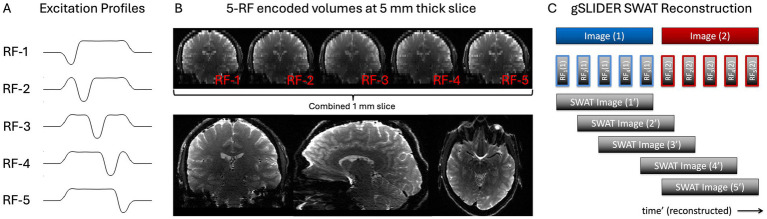 Figure 1
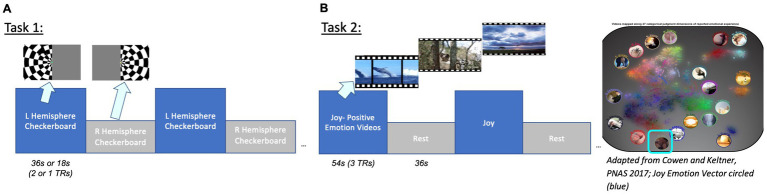 Figure 2
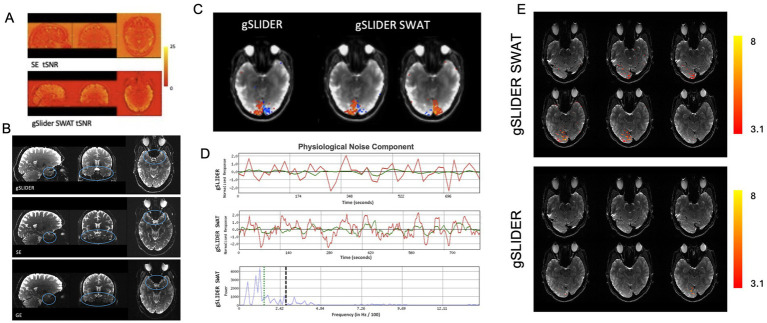 Figure 3
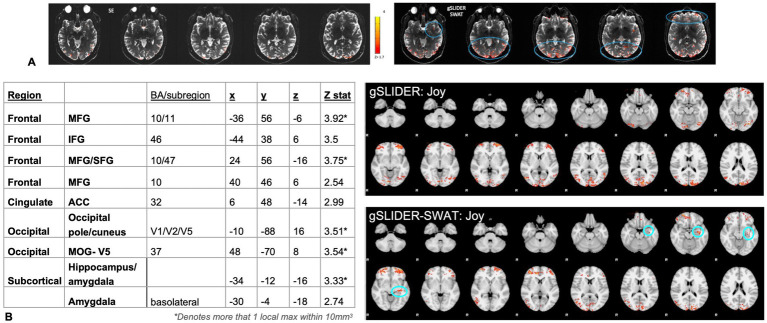 Figure 4
Peer Reviews
No public reviews on file for this paper yet. If you reviewed it on a platform where reviews are public (OpenReview, ICLR, NeurIPS, ICML), you can paste yours below so the community can read it here.
Videos
No videos yet. Explain this paper in a talk, walkthrough, or lecture? Add one.
Taxonomy
TopicsFunctional Brain Connectivity Studies · Advanced Neuroimaging Techniques and Applications · Advanced MRI Techniques and Applications