A reduced-toxicity myeloablative conditioning approach for hematopoietic cell transplant in juvenile myelomonocytic leukemia
Eman Elsabagh, Rachel Gallant, Lior Goldberg, Aditya Sharma, Paul L. Martin, Timothy A. Driscoll, Andrea Bauchat, Joanne Kurtzberg, LaTarsha Spencer, Paibel I. Aguayo-Hiraldo, Neena Kapoor, Kris M. Mahadeo, Hisham Abdel-Azim

TL;DR
A new reduced-toxicity treatment approach for juvenile myelomonocytic leukemia shows 100% survival and no transplant-related deaths in a small patient group.
Contribution
A novel busulfan/melphalan-based conditioning regimen with no transplant-related mortality in JMML patients.
Findings
100% disease-free and overall survival observed in 17 JMML patients after HCT.
Prompt immune reconstitution was achieved with the cyclophosphamide-sparing regimen.
No transplant-related mortality was reported with the reduced-toxicity approach.
Abstract
Allogeneic hematopoietic cell transplantation (HCT) is a potentially curative treatment for most children with juvenile myelomonocytic leukemia (JMML), but overall survival remains poor at 50%. Given its rarity and heterogeneity, there is no standard HCT conditioning regimen for JMML. Retrospective study of consecutive patients with JMML who underwent HCT using a busulfan/ melphalan backbone conditioning regimen (n=17) at two academic centers. The median age at HCT was 1.9 (range 0.7-6.0) years. At a median follow up of 7.6 (range 2.9-21.5) years, 100% disease-free (DFS) and overall survival (OS), with prompt immune reconstitution were observed. This cyclophosphamide-sparing approach was associated with no transplant related mortality. Given excellent clinical outcomes at extended follow-up, prospective studies are needed to confirm our findings in this ultra-rare disease.
Genes, proteins, chemicals, diseases, species, mutations and cell lines named across the full text — each resolved to its canonical identifier and authoritative record.
Click any figure to enlarge with its caption.
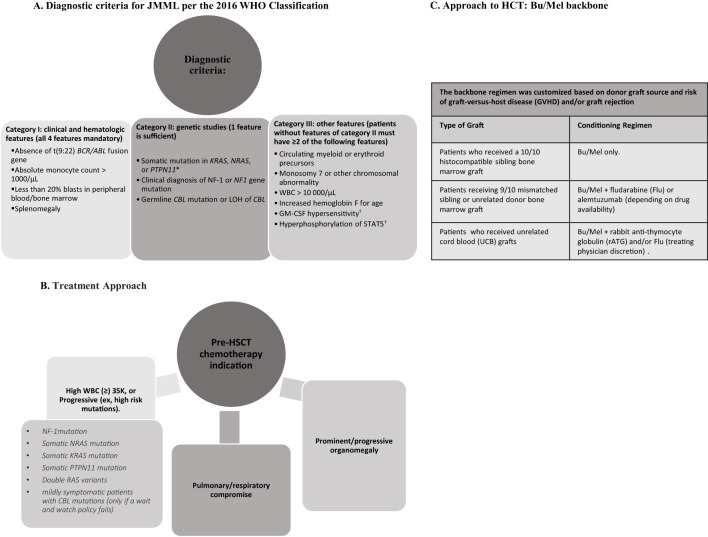 Figure 1
Peer Reviews
No public reviews on file for this paper yet. If you reviewed it on a platform where reviews are public (OpenReview, ICLR, NeurIPS, ICML), you can paste yours below so the community can read it here.
Videos
No videos yet. Explain this paper in a talk, walkthrough, or lecture? Add one.
Taxonomy
TopicsAcute Myeloid Leukemia Research · Chronic Lymphocytic Leukemia Research · Chronic Myeloid Leukemia Treatments