Dynamic RNA binding and unfolding by nonsense-mediated mRNA decay factor UPF2
Jenn-Yeu A. Szeto, Mirella Vivoli Vega, Justine Mailliot, George Orriss, Lingling Sun, Joshua C. Bufton, Kyle T. Powers, Sathish K.N. Yadav, Imre Berger, Christiane Schaffitzel

TL;DR
This paper explores how UPF2, a key protein in RNA decay, binds and unfolds RNA structures, potentially aiding in gene regulation.
Contribution
The study identifies specific RNA-binding domains in UPF2 and demonstrates its RNA annealing and unfolding capabilities.
Findings
UPF2's first and third MIF4G domains are main RNA/DNA-binding modules.
UPF2 unfolds reporter hairpin RNA structures and stabilizes single-stranded RNA.
UPF2 undergoes conformational changes upon RNA binding, suggesting functional remodeling.
Abstract
Nonsense-mediated mRNA decay (NMD) is an mRNA surveillance pathway involved in translational control and gene expression regulation. Core NMD factors up-frameshift proteins UPF1, UPF2, and UPF3B are conserved from yeast to humans and essential to target mRNAs with a premature stop codon for decay. UPF2 binding to UPF1 activates UPF1's ATPase and helicase activities, and UPF2 binding to UPF3B is important for its association with the exon junction complex and efficient NMD. However, UPF2's association with RNA remains largely uncharacterized. Here, we analyze nucleic acid binding, identifying the first and third MIF4G domains of UPF2 as main RNA-/DNA-binding modules. We find that UPF2's MIF4G domain-3 has RNA annealing activity, while full-length UPF2 unfolds our reporter hairpin RNA structure. We show that UPF2 preferentially binds and stabilizes single-stranded RNA (ss-RNA) in a…
Genes, proteins, chemicals, diseases, species, mutations and cell lines named across the full text — each resolved to its canonical identifier and authoritative record.
Click any figure to enlarge with its caption.
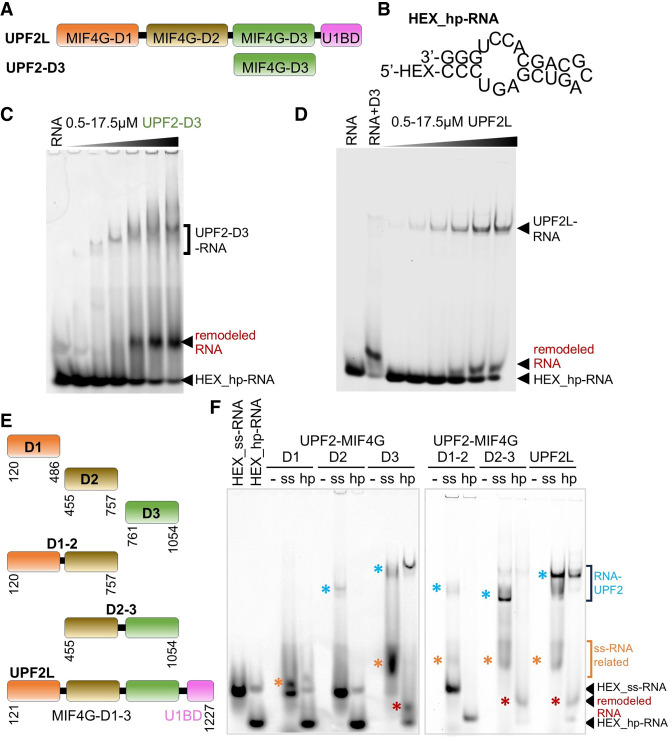 Figure 1
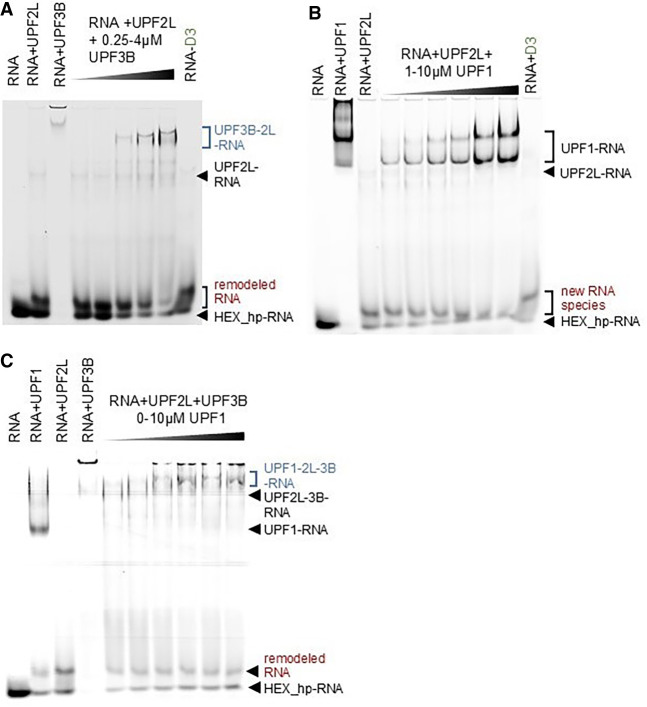 Figure 2
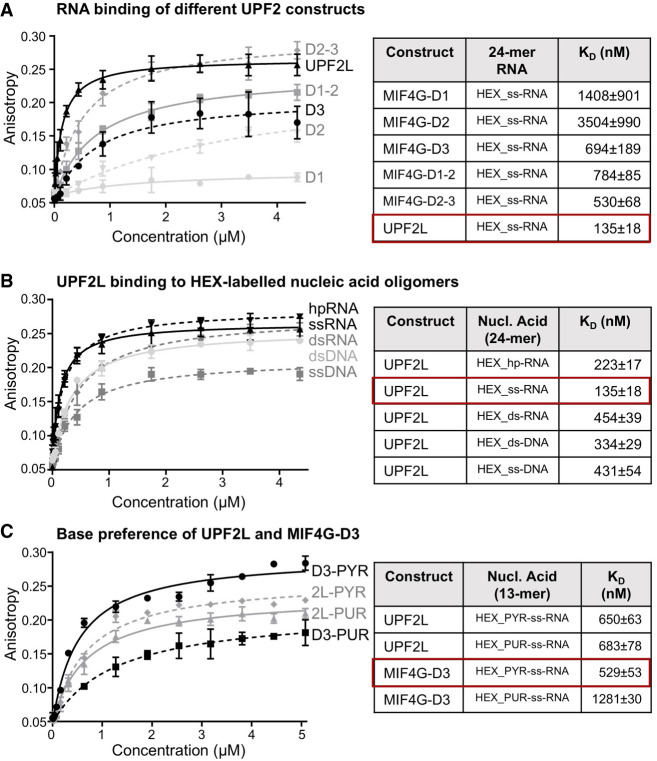 Figure 3
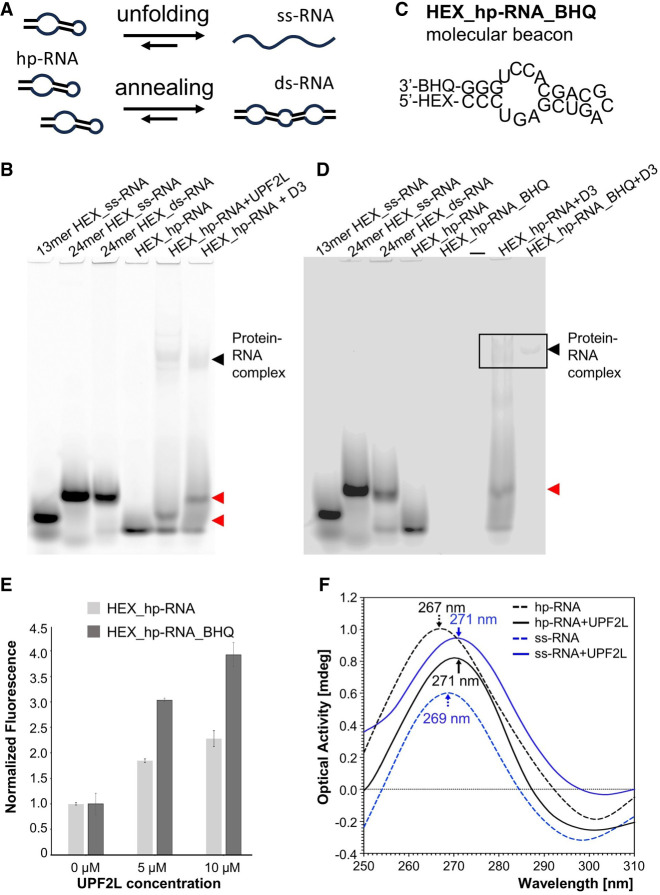 Figure 4
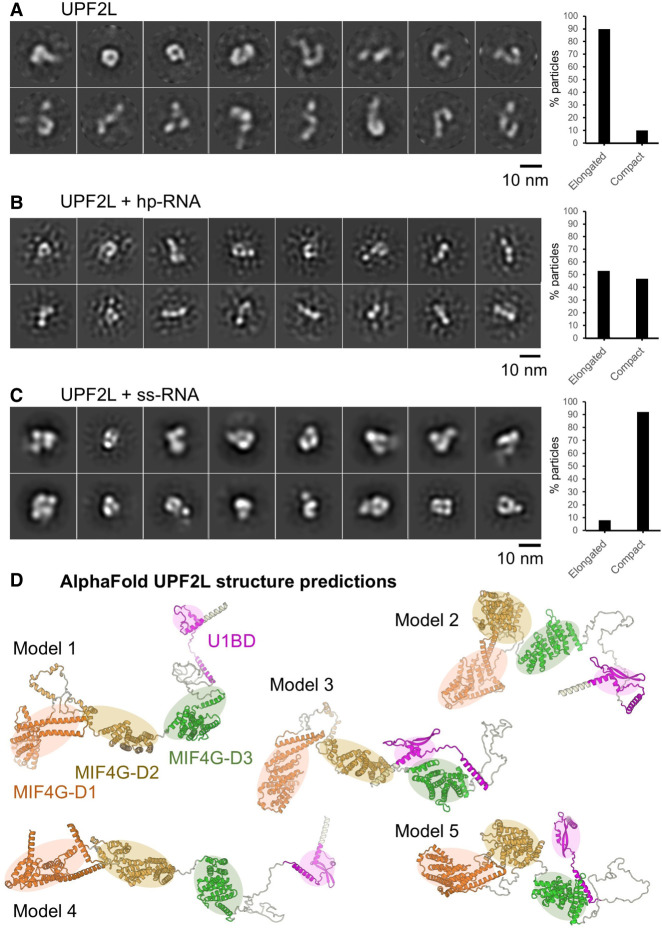 Figure 5
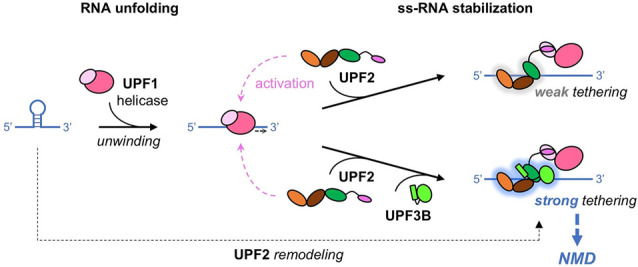 Figure 6
 Figure 7
 Figure 8
Peer Reviews
No public reviews on file for this paper yet. If you reviewed it on a platform where reviews are public (OpenReview, ICLR, NeurIPS, ICML), you can paste yours below so the community can read it here.
Videos
No videos yet. Explain this paper in a talk, walkthrough, or lecture? Add one.
Taxonomy
TopicsRNA Research and Splicing · RNA and protein synthesis mechanisms · RNA modifications and cancer