Association between levels of satisfaction with interpersonal relationships and insomnia symptoms among women working in aged-care services in Japan
Ryuichiro Watanabe, Ai Ikeda, Hadrien Charvat, Setsuko Sato, Yuka Suzuki, Koutatsu Maruyama, Kiyohide Tomooka, Hiroo Wada, Yasunari Koyama, Takeshi Tanigawa

TL;DR
This study explores how satisfaction with interpersonal relationships affects insomnia symptoms in Japanese women working in aged-care services.
Contribution
The study identifies a novel association between low interpersonal relationship satisfaction and increased insomnia symptoms in this specific workforce.
Findings
Low levels of satisfaction with interpersonal relationships were significantly associated with insomnia symptoms.
High work-to-family conflict worsened the relationship between low interpersonal satisfaction and insomnia.
Medium and low satisfaction levels had increased odds of insomnia compared to high satisfaction.
Abstract
The demand for aged-care services in Japan has surged due to the country’s aging population. Furthermore, nationwide survey on the current state of aged-care services revealed that the primary reason for the resignation of women working in these sectors was poor interpersonal relationships. Moreover, given that women working in aged-care services work in shifts around the clock to manage the health and safety of the people in their care, they are at high risk of health-related issues including insomnia symptoms. Thus, we aim to examine the association between levels of satisfaction with interpersonal relationships (LSIR) and insomnia symptoms for women working in aged-care services in Japan, as well as the effect of work–life imbalance on the association between LSIR and insomnia symptoms. In this cross-sectional study, the participants were 472 women aged 18–60 years who worked in…
Genes, proteins, chemicals, diseases, species, mutations and cell lines named across the full text — each resolved to its canonical identifier and authoritative record.
Click any figure to enlarge with its caption.
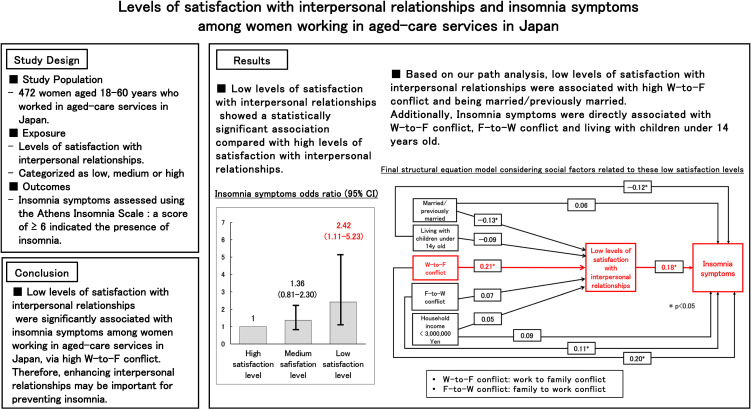 Figure 1
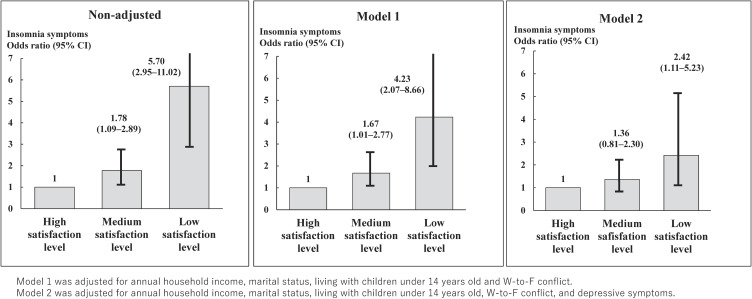 Figure 2
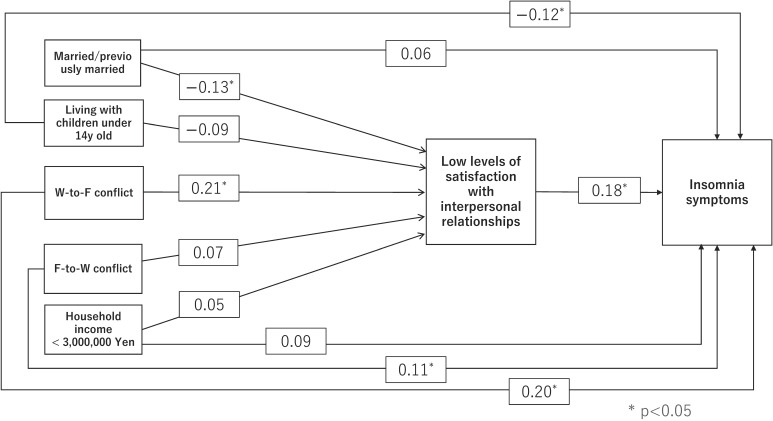 Figure 3
Peer Reviews
No public reviews on file for this paper yet. If you reviewed it on a platform where reviews are public (OpenReview, ICLR, NeurIPS, ICML), you can paste yours below so the community can read it here.
Videos
No videos yet. Explain this paper in a talk, walkthrough, or lecture? Add one.
Taxonomy
TopicsSleep and related disorders · Intergenerational Family Dynamics and Caregiving