Treating Glaucoma in Intellectually Disabled Patients: Novel Criteria for Choosing Surgical Candidates
Mitchell G. Nash, Joseph G. Parrish, David Fleischman

TL;DR
This paper proposes new criteria for deciding which intellectually disabled patients with glaucoma should undergo surgery, addressing a gap in current medical guidance.
Contribution
The paper introduces novel selection criteria for glaucoma surgery in intellectually disabled patients.
Findings
Intellectually disabled patients have higher rates of glaucoma but lack specific surgical guidelines.
A literature review highlights the need for tailored approaches to managing glaucoma in this population.
New criteria are proposed to guide surgical decisions for this vulnerable group.
Abstract
Patients with intellectual disabilities (IDs) have been associated with having a higher frequency of ocular pathologies, including glaucoma. However, despite this association, there is little guidance in the literature pertaining to patient management or outcomes after glaucoma surgery. Literature review of the management of surgical eye conditions in ID patients provides historical considerations in treatment of these patients and educates the community of providers caring for this population. Using these data, we propose a novel set of criteria for selecting which patients with ID and glaucoma should be offered glaucoma surgery.
Genes, proteins, chemicals, diseases, species, mutations and cell lines named across the full text — each resolved to its canonical identifier and authoritative record.
Click any figure to enlarge with its caption.
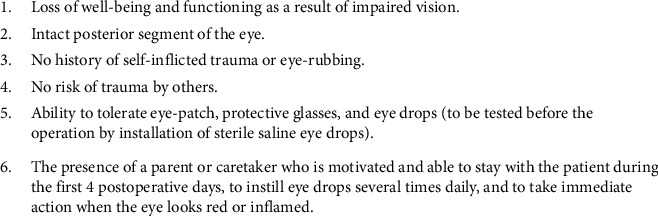 Figure 1
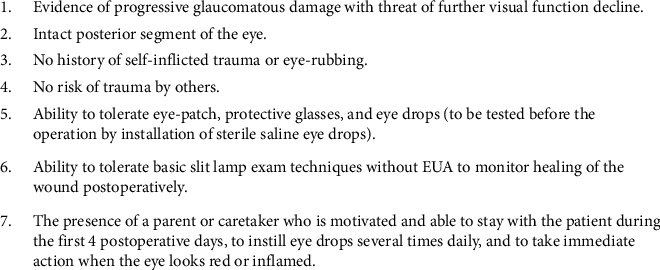 Figure 2
Peer Reviews
No public reviews on file for this paper yet. If you reviewed it on a platform where reviews are public (OpenReview, ICLR, NeurIPS, ICML), you can paste yours below so the community can read it here.
Videos
No videos yet. Explain this paper in a talk, walkthrough, or lecture? Add one.
Taxonomy
TopicsGlaucoma and retinal disorders · Intraocular Surgery and Lenses · Corneal surgery and disorders