[18F]FDG-PET/CT in DLBCL-patients treated with CAR-T cell therapy: potential for defining patient prognosis
Helena A. Peters, Ben-Niklas Bärmann, Emil Novruzov, Daniel Weiss, Matthias Boschheidgen, Vivien Lorena Ivan, Nora Liebers, Johannes Fischer, Eduards Mamlins, Aleksandar Radujkovic, Guido Kobbe, Julian Kirchner, Peter Minko, Kathrin Nachtkamp, Paul Jäger, Christina Antke

TL;DR
This study shows that [18F]FDG-PET/CT scans can help predict outcomes for DLBCL patients undergoing CAR-T cell therapy.
Contribution
The study identifies SUVmax > 9 as a pre-treatment predictor of poor survival and shows post-treatment PET/CT scores can signal early treatment failure.
Findings
Patients with SUVmax > 9 before CAR-T therapy had significantly shorter progression-free and overall survival.
Post-therapy Deauville score > 3 and Lugano classification of progressive disease were linked to increased risk of treatment failure.
Early identification of non-responders could improve treatment strategies in DLBCL patients.
Abstract
The aim of this study is to evaluate the potential of [18F]FDG-PET/CT in terms of prognostic value and treatment monitoring in relapsed / refractory diffuse large B-cell lymphoma (DLBCL)-patients treated with chimeric antigen receptor T-cell (CAR-T) therapy. Forty-eight [18F]FDG-PET/CT scans, acquired at pre-defined time points (t0 – t2) of 18 DLBCL-patients (mean age: 60 ± 12 years) treated with CAR-T cell therapy were retrospectively enrolled. Median time of follow-up was ten months (IQR 6–16) following CAR-T cell infusion. SUVmax, sum of the product of diameters (SPD), Deauville score (DS) and Lugano classification (LC) were evaluated. Clinical parameters (age, sex) were obtained. Survival time analyses for progression-free survival (PFS) and overall survival (OS) were calculated, the latter by using the Kaplan-Meier method and Cox regression including a hazard ratio (HR). P values…
Genes, proteins, chemicals, diseases, species, mutations and cell lines named across the full text — each resolved to its canonical identifier and authoritative record.
Click any figure to enlarge with its caption.
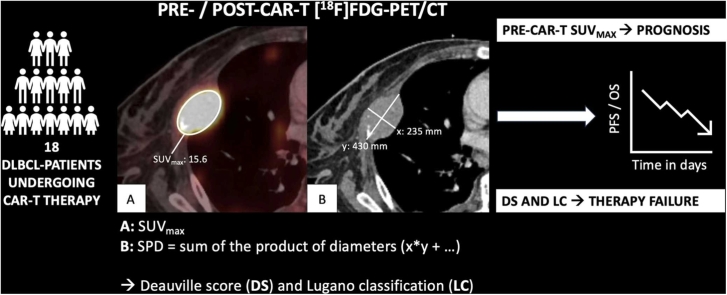 Figure 1
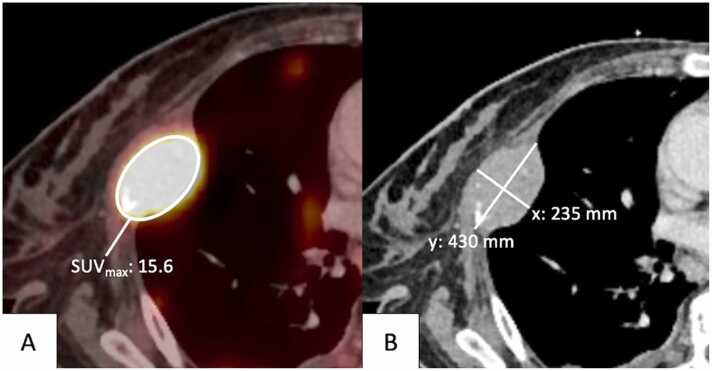 Figure 2
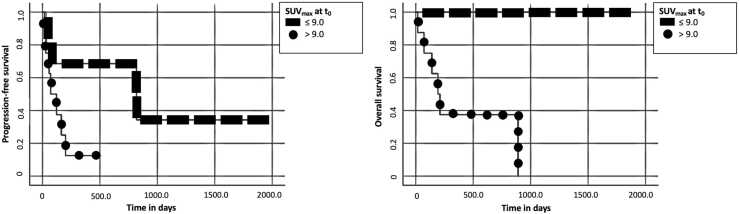 Figure 3
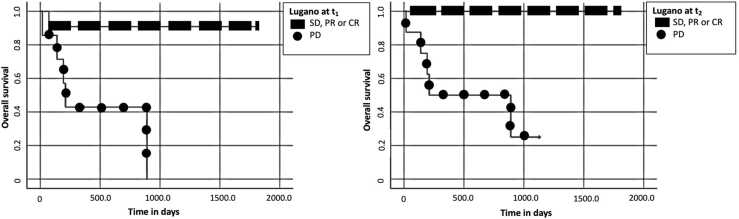 Figure 4
Peer Reviews
No public reviews on file for this paper yet. If you reviewed it on a platform where reviews are public (OpenReview, ICLR, NeurIPS, ICML), you can paste yours below so the community can read it here.
Videos
No videos yet. Explain this paper in a talk, walkthrough, or lecture? Add one.
Taxonomy
TopicsCAR-T cell therapy research · Lymphoma Diagnosis and Treatment