Multidisciplinary stakeholder-informed identification of key characteristics for implementation of workplace genetic testing
Elizabeth Charnysh, Kunal Sanghavi, Kerry A. Ryan, Alyx Vogle, Alexandra Truhlar, Subhamoy Pal, Jonathan M. Reader, J. Scott Roberts, Charles Lee, Anya E.R. Prince, W. Gregory Feero

TL;DR
Experts identified 12 key characteristics to safely implement workplace genetic testing, balancing benefits and risks.
Contribution
A modified Delphi process identified 12 key characteristics for responsible workplace genetic testing implementation.
Findings
Privacy/security, voluntariness, and transparency were deemed important and necessary by most participants.
Stakeholders expressed qualified support for workplace genetic testing if the 12 characteristics are met.
Participants showed varied perspectives, contingent on the implementation of the identified key characteristics.
Abstract
Workplace genetic testing (wGT) is an evolving model for genetic testing where employees are offered consumer genetic testing through employer-sponsored wellness programs. However, the potential harms, benefits, and key characteristics for best implementation practices for wGT have yet to be defined. To address this issue, we conducted a three-round modified Delphi process, including multiple rounds of survey and a virtual deliberative workshop, with purposely chosen wGT stakeholders (employees, employers, ethical, legal, and social implications [ELSI] professionals, genetic testing industry representatives, and healthcare professionals) to share their perspectives. From the modified Delphi process, we identified 12 key characteristics for the implementation of wGT that were perceived to increase the potential for benefit while reducing the risk of potential harms. Most participants…
Genes, proteins, chemicals, diseases, species, mutations and cell lines named across the full text — each resolved to its canonical identifier and authoritative record.
Click any figure to enlarge with its caption.
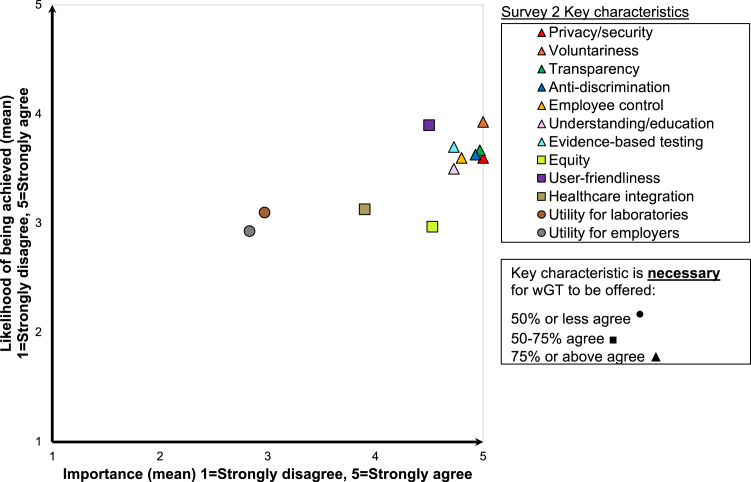 Figure 1
Peer Reviews
No public reviews on file for this paper yet. If you reviewed it on a platform where reviews are public (OpenReview, ICLR, NeurIPS, ICML), you can paste yours below so the community can read it here.
Videos
No videos yet. Explain this paper in a talk, walkthrough, or lecture? Add one.
Taxonomy
TopicsBiotechnology and Related Fields