Arabic Aphasia Research Through a Clinical and Linguistic Lens: A Systematic Review of Current Limitations and Future Directions
Tariq Khwaileh, Eiman Mustafawi, Shereen Elbuy, Noor Numan, Samawiyah Ulde

TL;DR
This paper reviews the limited research on aphasia in Arabic, highlighting gaps in clinical resources and suggesting future directions for better assessment and treatment.
Contribution
The study provides a systematic review of Arabic aphasia research, identifying specific limitations in clinical materials and proposing targeted areas for future development.
Findings
Only 48 studies on Arabic aphasia were identified, with most focusing on linguistic theory rather than clinical applications.
Current assessment materials are translations of other languages and lack cultural and linguistic specificity for Arabic.
There is a lack of comprehensive assessment batteries and controlled psycholinguistic variables in existing resources.
Abstract
Aphasia has been widely investigated for English and other Indo‐European languages such as German, Dutch, Italian and Spanish. It has been reported that published studies on Arabic aphasia only comprised five studies, accounting for only 0.40% of the total literature on aphasia between 2000 and 2009. The present paper is a systematic review of studies that have been published on Arabic aphasia. The main objective of this study is to review the body of aphasia literature on Arabic, to identify strengths and weaknesses in the available clinical resources for Arabic aphasia. Preferred Reporting Items for Systematic Reviews and Meta‐Analyses (PRISMA) guidelines were followed. Five relevant databases were identified and searched using predefined keywords. A 6th source, Google Scholar, was also used to yield grey literature; these sources were screened on Scimago for quality assurance.…
Genes, proteins, chemicals, diseases, species, mutations and cell lines named across the full text — each resolved to its canonical identifier and authoritative record.
Click any figure to enlarge with its caption.
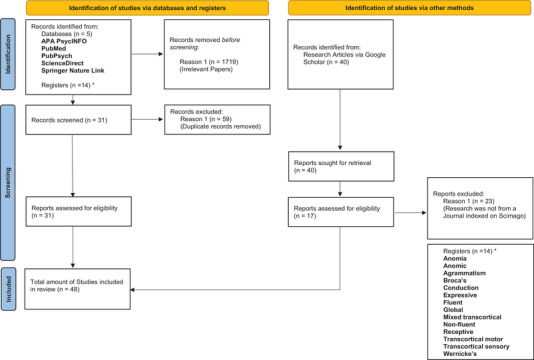 Figure 1
 Figure 2
Peer Reviews
No public reviews on file for this paper yet. If you reviewed it on a platform where reviews are public (OpenReview, ICLR, NeurIPS, ICML), you can paste yours below so the community can read it here.
Videos
No videos yet. Explain this paper in a talk, walkthrough, or lecture? Add one.
Taxonomy
TopicsNeurobiology of Language and Bilingualism · Interpreting and Communication in Healthcare · Second Language Acquisition and Learning