Can serum metabolic signatures inform on the relationship between healthy lifestyle and colon cancer risk?
Komodo Matta, Vivian Viallon, Anastasia Chrysovalantou Chatziioannou, Nivonirina Robinot, Roland Wedekind, Christina C. Dahm, Agnetha Linn Rostgaard-Hansen, Anne Tjønneland, Therese Truong, Chloé Marques, Pauline Frenoy, Rudolf Kaaks, Renée Turzanski Fortner, Matthias B. Schulze

TL;DR
This study explores how a healthy lifestyle reduces colon cancer risk and whether blood metabolites can explain this relationship, finding stronger effects in men and no link after adjusting for lifestyle.
Contribution
The study identifies serum metabolic signatures linked to a healthy lifestyle but finds they do not independently predict colon cancer risk after accounting for lifestyle factors.
Findings
A healthy lifestyle was inversely associated with colon cancer risk (OR 0.79 per SD increase).
The metabolic signature of the healthy lifestyle was moderately correlated with lifestyle factors (r = 0.59).
After adjusting for lifestyle factors, the metabolic signature showed no association with colon cancer risk.
Abstract
Colon cancer is strongly influenced by lifestyle factors. Sociodemographic factors like sex and socioeconomic position (SEP) might modulate the relationship between lifestyle and colon cancer risk. Metabolomics offers potential to uncover biological mechanisms linking lifestyle and colon cancer. Lifestyle and untargeted metabolomic data were available from a nested case–control study within the European Prospective Investigation into Cancer and Nutrition (EPIC), including 1,067 colon cancer cases and 1,067 controls matched on age, sex, study centre, and blood collection time. Serum samples were analyzed using liquid chromatography-mass spectrometry. The Healthy Lifestyle Index (HLI) score was derived from smoking habits, alcohol intake, body mass index (BMI), physical activity, and diet. Penalised regression was applied in controls to derive metabolic signatures for the HLI and the…
Genes, proteins, chemicals, diseases, species, mutations and cell lines named across the full text — each resolved to its canonical identifier and authoritative record.
Click any figure to enlarge with its caption.
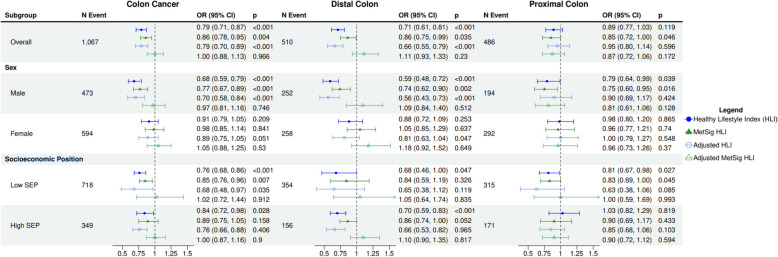 Figure 1
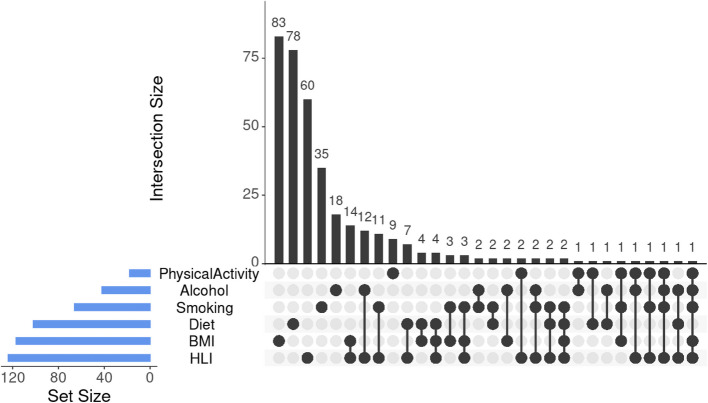 Figure 2
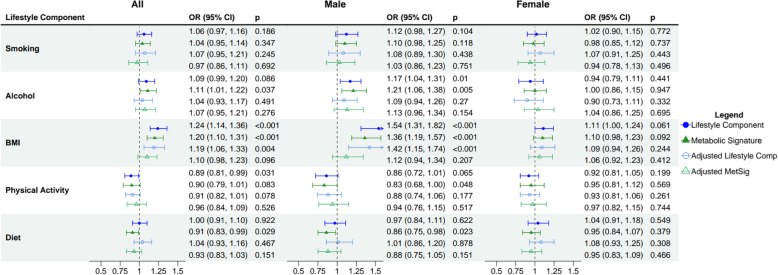 Figure 3
Peer Reviews
No public reviews on file for this paper yet. If you reviewed it on a platform where reviews are public (OpenReview, ICLR, NeurIPS, ICML), you can paste yours below so the community can read it here.
Videos
No videos yet. Explain this paper in a talk, walkthrough, or lecture? Add one.
Taxonomy
TopicsCancer, Lipids, and Metabolism · Nutritional Studies and Diet · Metabolomics and Mass Spectrometry Studies