Distinct benefit frames generate divergent effects of time scarcity mindset on prosocial behavior
Chen Yang

TL;DR
This paper shows how time scarcity affects prosocial behavior differently depending on whether the benefits are for oneself or others.
Contribution
The study introduces benefit frames as a moderator of time scarcity's impact on prosocial behavior.
Findings
Time scarcity inhibits prosocial behavior under others-only benefit frames.
Self-and-other benefit frames reduce the negative effect of time scarcity on prosocial behavior.
Abstract
Previous research has explored how time scarcity mindset influences prosocial behavior; however, the results have been inconsistent. The current research aimed to introduce benefit frames to examine the effect of time scarcity mindset on prosocial behavior. Inspired by the proposal that time scarcity mindset strengthens agentic (i.e., self-oriented) goals while weakening communal (i.e., other-oriented) goals, we assumed that benefit frames would moderate the impact of time scarcity mindset on prosocial behavior. We conducted a survey study (N = 282 participants) and an experimental study (N = 299 participants) to test this assumption. Our results indicated that under an others-benefit frame (i.e., benefits only to others), time scarcity mindset inhibited prosocial behavior, whereas this effect was attenuated under a self-and-other benefit frame (benefits to both oneself and others).…
Genes, proteins, chemicals, diseases, species, mutations and cell lines named across the full text — each resolved to its canonical identifier and authoritative record.
Click any figure to enlarge with its caption.
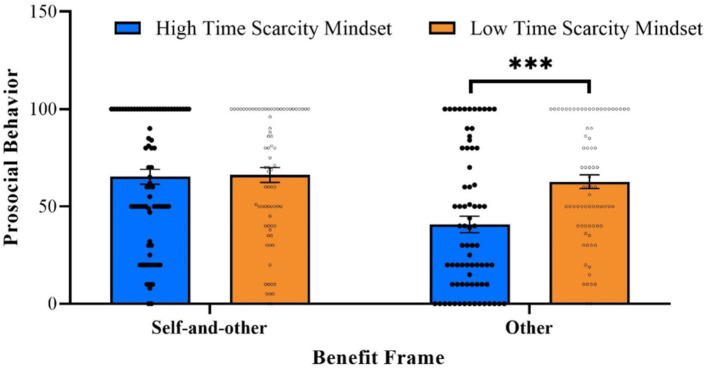 Figure 1
Peer Reviews
No public reviews on file for this paper yet. If you reviewed it on a platform where reviews are public (OpenReview, ICLR, NeurIPS, ICML), you can paste yours below so the community can read it here.
Videos
No videos yet. Explain this paper in a talk, walkthrough, or lecture? Add one.
Taxonomy
TopicsBehavioral Health and Interventions · Psychological and Temporal Perspectives Research · Social and Intergroup Psychology