Atypical Femoral Fracture in Patients With Metastatic Bone Tumors: An Analysis Based on the Japanese Adverse Drug Event Reaction Database (JADER)
Yuka Aimono, Tomiko Sunaga, Ryo Yonezawa, Ayako Tsuboya, Mari Kogo, Shinjiro Tsuge, Akihiro Tamura, Ako Itoh

TL;DR
This study analyzed rare atypical femoral fractures in cancer patients using a national database, finding they occurred more often in women and those on osteoporosis drugs.
Contribution
The study provides population-level insights into atypical femoral fractures in metastatic bone tumor patients treated with denosumab using a large adverse event database.
Findings
5.3% of metastatic bone tumor patients treated with denosumab developed atypical femoral fractures.
Fractures occurred approximately 2.5 years after treatment initiation.
Zoledronic acid showed a significant association with fracture occurrence.
Abstract
Objective Denosumab (DEN)-related atypical femoral fracture (AFF) is a rare entity, and hence not feasible to examine with a single institution-based study. In light of this, we performed a retrospective analysis of the clinical characteristics of patients with metastatic bone tumors treated with DEN and developed AFF. Methods The Japanese Adverse Drug Event Report (JADER) database (2023.8 public version) from the second quarter of 2004 to the second quarter of 2023 was used to investigate the backgrounds of patients with metastatic bone tumors who developed AFF while receiving DEN. The time of AFF onset was defined as the number of days from the start of treatment to the onset of AFF. We also aimed to identify drugs associated with the development of AFF. Cut-off values for signal detection were χ2 ≥4 and number of reports ≥3. Results The JADER database contained 2,012 cases of…
Genes, proteins, chemicals, diseases, species, mutations and cell lines named across the full text — each resolved to its canonical identifier and authoritative record.
Click any figure to enlarge with its caption.
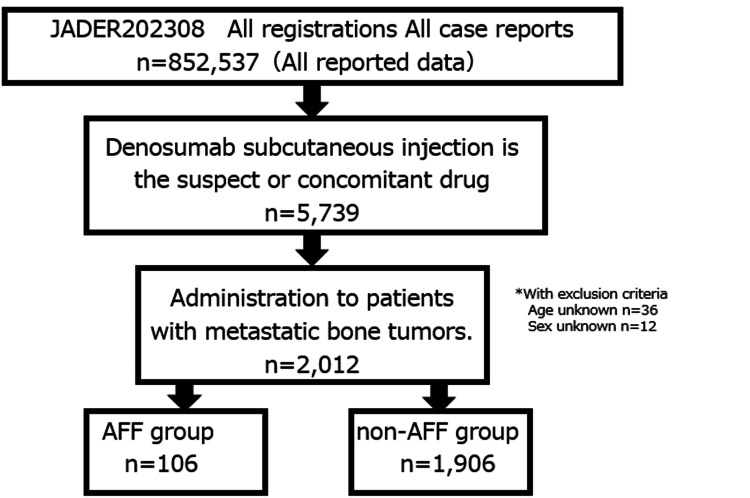 Figure 1
| Variable | AFF (n=106), n (%) | Non-AFF (n=1,906), n (%) | Total (n=2,012), n (%) | |
| Sex | Female/male | 91/15 (85.8/14.2) | 946/960 (49.6/50.4) | 1,037/975 (51.5/48.5) |
| Age | Older than 60 years and elderly/younger than 60 years and adult | 66/40 (62.3/37.7) | 1,481/425 (77.7/22.3) | 1,547/465 (76.9/23.1) |
| Medication for osteoporosis | With/without | 61/45 (57.5/42.5) | 383/1,523 (20.1/79.9) | 444/1,568 (22.1/77.9) |
| Pharmaceutical agent | AFF (n=106), n (%) | Non-AFF (n=1,906), n (%) | Total (n=2,012), n (%) | ROR | 95% CI |
| Zoledronic acid hydrate | 32 (30.2) | 112 (5.9) | 144 (7.2) | 6.93 | (4.39-10.93) |
| Steroids* | 9 (8.5) | 350 (18.4) | 359 (17.8) | 0.41 | (0.21-0.83) |
| PPIs** | 7 (6.6) | 396 (20.8) | 403 (20.0) | 0.27 | (0.17-1.27) |
Peer Reviews
No public reviews on file for this paper yet. If you reviewed it on a platform where reviews are public (OpenReview, ICLR, NeurIPS, ICML), you can paste yours below so the community can read it here.
Videos
No videos yet. Explain this paper in a talk, walkthrough, or lecture? Add one.
Taxonomy
TopicsBone health and treatments · Bone and Joint Diseases · Radiopharmaceutical Chemistry and Applications
Introduction
Bone-modifying agents (BMAs) are used to treat metastatic bone tumors and are also administered to reduce bone loss caused by bone metastases. Although adverse events, such as hypocalcemia and osteonecrosis of the jaw, have been reported, atypical femoral fractures (AFFs) are exceedingly rare. AFF has been associated with the long-term use of bisphosphonates (BPs), but not with denosumab (DEN), an anti-receptor activator of the nuclear factor-κB ligand antibody. The use of BMAs to treat metastatic bone tumors is expected to reduce the frequency of severe skeletal-related events and ameliorate bone pain [1,2].
AFF was reported in 2005 as a characteristic femoral fracture in osteoporotic patients receiving long-term treatment with BPs [3]. In 2013, the American Society for Bone and Mineral Research (ASBMR) published diagnostic criteria for AFF [4]. A few studies have recently reported the use of DEN as a single agent to treat metastatic bone tumors [5,6]. The ASBMR Task Force reported that the risk of developing AFF increased with the duration of treatment with BPs [7]. AFF has been associated with the stronger suppression of bone metabolic turnover and a longer bone healing time than general fractures [8], and when cancer patients develop complete fractures, chemotherapy must also be interrupted due to surgery and rehabilitation. Information on the risk of developing AFF during DEN administration may be obtained in advance, which helps in monitoring for AFF and facilitates its prevention and early detection. Since DEN-related AFF is rare, it is not feasible to analyze with a single institution-based study. Hence, we performed a retrospective analysis of the clinical characteristics of patients with metastatic bone tumors treated with DEN who developed AFF.
Materials and methods
Survey targets
JADER data provided by the Pharmaceuticals and Medical Devices Agency was used as the database to elicit information on adverse drug reactions. Data extraction was performed by a contractor (Intage Healthcare Inc.). JADER is divided into four tables: patient information data, adverse event report drug and concomitant drug data, adverse event data, and data on the course of adverse events. The data eligible for analysis was defined as all reported data, including adverse event reports, from the second quarter of 2004 to the second quarter of 2023 (2023.8 public version). The study period included all reported data (2023.8 public version), including adverse drug reaction reports from the second quarter of 2004 to the second quarter of 2023, for reported cases in which DEN was administered with the suspected or concomitant drug; those with unknown registration data were excluded.
Regarding adverse events in the analysis data, the preferred terms (PT) listed in the ICH International Glossary of Pharmaceutical Terms, Japanese version, and Medical Dictionary for Regulatory Activities, Japanese version (MedDRA/J) ver. 26.0 were used. The AFF group was defined as reports including the term ‘atypical femur fracture (AFF)’ (PT: 10070884), which is the PT listed in MedDRA/J ver. 26.0, while the non-AFF group was defined as all other reports including this term. It is defined as a fracture located along the femoral diaphysis from just distal to the lesser trochanter to just proximal to the supracondylar flare, with at least four of five major features present. These features are as follows: sustained with minimal or no trauma; the fracture line originates at the lateral cortex and is substantially transverse in its orientation (although it may become oblique as it progresses medially across the femur); complete fractures extend through both cortices and may be associated with a medial spike; incomplete fractures involve only the lateral cortex; noncomminuted or minimally-comminuted fractures and localized periosteal or endosteal thickening of the lateral cortex is present at the fracture site. A total of 852,537 reports were registered in JADER, from which data on cases in which DEN was the suspect drug or administered concomitantly with the suspect drug were extracted. A total of 2,012 cases were analyzed, excluding those with no information on age or sex. Of these cases, 106 (5.3%) were in the AFF group and 1,906 (94.7%) were in the non-AFF group (Figure 1).
Flowchart of the dataset used in the analysisAFF: atypical femoral fracture; JADER: The Japanese Adverse Drug Event Report
Survey items
Patient Background
Based on the data analyzed, patient sex and age registered in JADER were investigated as the patient background of the subject reports. Age categories are registered in units of 10 years and terms of adults and older individuals. In the present study, cases were divided into the following two groups: 60+ and elderly, and 20s-50s and adults. In addition, patients with no information on sex or age were excluded.
Time to the Onset of AFF
The number of days until the onset of AFF was investigated, with the first day of treatment being set as day one. Patients with no data on the date of the onset of adverse drug reactions or those with the onset of adverse drug reactions before the start of treatment were excluded.
Extraction of Data on Drugs Associated With AFF
In addition to the 2,012 cases in which DEN was the suspect drug or administered concomitantly with the suspect drug, in patients with metastatic bone tumors, ZOL, steroids, and proton pump inhibitors (PPIs) [9], which have been indicated to increase the risk of AFF, were also included for comparison. In this case, one report of the suspected or concomitant use of DEN was considered. Data were categorized and tabulated for each drug effect.
Statistical Analysis
A 2 × 2 contingency table was created using an imbalance analysis [10], which is used to examine relationships between combinations of medicinal products and adverse events in spontaneous adverse drug reaction report data, and the reporting odds ratio (ROR) and its 95% confidence interval (CI) were calculated. In accordance with reporting [10], cut-off values for signal detection were χ2 ≥4 and number of reports ≥3. SPSS Statistics ver. 27 (IBM Corp., Armonk, NY) was used for statistical analyses.
Results
Subject reports
Patient Background
In the AFF group, 91 (85.8%) women and 61 (57.5%) patients receiving osteoporosis medications had a higher percentage of reports (Table 1).
Time to the Onset of AFF
Of the 106 cases in the AFF-onset group, 36 were included in the study. Breast cancer was the most common primary disease for metastatic bone tumors, accounting for 20 cases (55.6%). The median time to the onset of AFF was 926 [interquartile range (IQR): 534-1,552] days.
Relationship Between AFF and Drugs Other Than DEN
Of the 2,012 cases in which DEN was the suspect drug or administered concomitantly with the suspect drug in patients with metastatic bone tumors, 60 drugs other than DEN were classified as ‘suspect’ for their involvement in AFF. Of these, the ROR and 95% CI of ZOL, steroids, and PPIs are shown in Table 2. The only drug for which a signal was detected was ZOL with ROR of 6.93 (4.39-10.93).
Discussion
There have been no previous reports using JADER regarding AFF caused by DEN. Therefore, we believe the findings of this study provide useful information in terms of starting DEN treatment. The time of the onset of AFF was 2.5 years, and a signal was detected for ZOL after the extraction of drugs associated with AFF. The availability of relevant information on AFF to patients starting treatment with DEN may lead to its early detection.
As shown in Appendix 1, according to the survey of AFF 2021 registered cases compiled in Japan by the Osteoporosis Committee of the Japanese Orthopaedic Association, 600 (92.2%) cases of AFF (n=651) were female [11]. This is consistent with the results of the JADER survey. In addition, in the final summary of the Specific Use Results Survey on the long-term use of DEN (July 2020), all four (0.11%) AFF cases among those analyzed (n=3,506) were female [12]. Furthermore, the suspect drug was DEN, and adverse events were extracted using the FDA Adverse Event Reporting System with AFF. Data were available for 158,894 reports (up to March 2024). Information was missing on sex, age, reason for use, and osteoporosis, which resulted in their exclusion from further analysis in 6,597 cases. Of these, 112 (1.7%) had AFF and 99 (88.4%) were female [13] (Appendix 1). Femoral diaphyseal fracture is more prevalent in females due to the curvature of the femur, suggesting a relationship between the prevalence of AFF and female sex.
Adults 65 years and older are generally more likely to develop adverse events when administered BMAs compared to younger adults. A previous study reported that bone resorption exceeded bone formation, and bone strength decreased with age in both men and women [14]. On the other hand, since AFF appears to be associated with a younger age than non-AFF [15], the development of AFF needs to be considered irrespective of age. According to the findings of the AFF 2021 registry case study, 413 (63.4%) of AFF cases (n=651) were treated with BPs [11]. Shane et al. have reported that 291 (93.9%) of patients with osteoporosis and concurrent AFF were being treated with BPs [4] (Appendix 1). When BPs are used to treat bone metastases, a careful follow-up is required because, as with osteoporosis, AFF may occur.
According to the special drug results survey, the long-term use of DEN entailed 103-575 days [12]. Therefore, data from the JADER registry showed that AFF occurred after the long-term use of DEN. The mechanisms underlying the onset of AFF are considered to involve the suppression of bone metabolic turnover due to the long-term use of BMAs. In clinical practice, the long-term use of DEN to prolong the survival of cancer patients is also assumed to be a factor contributing to the development of AFF. Regarding the duration of BPs to treat osteoporosis, according to the findings of the AFF 2021 registry case survey, the most commonly observed duration of BPs was longer than three years in 308 (74.6%) cases [11] (Appendix 1). In the study by Shane et al., the average duration of treatment with BPs was seven years [16].
Schilcher et al. showed that the risk of AFF increased with the duration of treatment with BPs, with an accelerated increase from four years onwards [17]. Dell et al. have reported a rate of 1.78/100,000 patients with AFF less than two years after the initiation of DEN treatment and 107.5/100,000 patients after more than 10 years of treatment [18]. On the other hand, AFF was previously shown to occur after 1.9 years [19], two to four years [5,6], 3.5 years [20], and 68-103 (mean: 83.3) months [21] of treatment with BPs for bone metastases (Appendix 2). One-year dose intensities for ZOL and DEN to treat bone metastases were approximately 10- and 12-fold higher, respectively, than those for osteoporosis. Therefore, the time to the onset of AFF after treatment for bone metastases is expected to be shorter.
The findings of a recent follow-up study on DEN in patients with osteoporosis showed that bone density continued to increase when DEN was administered continuously for six years. Furthermore, even after two years of treatment and one year of withdrawal, bone density was the same as that after six years of continuous treatment with DEN. Moreover, bone density remained higher after two years of treatment with DEN and two years of withdrawal than before treatment with DEN [22]. Therefore, DEN may be temporarily withdrawn or the dosing interval may be adjusted. However, we recommend its continuous administration for the first two years. The effects of a gradual reduction in BMAs (mainly 12 weeks of ZOL) were examined in breast cancer patients with bone metastases [23]. In the future, it may be necessary to change (extend) the dosing interval of BMAs [24] (Appendix 2).
ZOL was the main treatment before the launch of DEN. Lockwood et al. indicated the importance of considering the potential complications associated with the use of BPs to accurately diagnose and treat AFF promptly, even in cancer patients [25]. The FDA issued guidance in 2010, stating that patients receiving BPs or DEN (particularly those on long-term treatment for three to five years) need to be instructed to report AFF symptoms and that doctors need to regularly check for these symptoms [26]. Kaku et al. examined 529 patients with metastatic bone tumors who were treated with ZOL or DEN at a single center, and five patients (0.9%) who developed AFF had received ZOL [27].
The incidence of AFF caused by DEN in patients with metastatic bone tumors was 0.4% in a retrospective observational study [28]. However, no randomized trials or other studies have been conducted on DEN-related AFF in patients with metastatic bone tumors. Therefore, further investigations are needed on the frequency of AFF in relation to age and dosages, as well as on the establishment of appropriate dosing and withdrawal periods. We suggest a reassessment of the risk of fracture in female patients with a history of osteoporosis medication or ZOL use from two years after the initiation of DEN and periodically thereafter. Furthermore, if thickening of the lateral femoral cortex is observed, regular bone resorption marker measurements and radiographic examinations may help prevent AFF.
This study has two limitations that need to be addressed. There was a reporting bias, and the amount of individual clinical information available was limited. Since it was not possible to confirm a causal relationship, caution needs to be exercised when referring to the present results for the monitoring of adverse events in clinical practice. If the possibility of an adverse event is indicated, a case-control study is considered necessary to test the hypothesis that a relationship exists between the drug and the adverse event.
Conclusions
Although AFF is rare, it significantly impacts the quality of life and the activities of daily living. An explanation of AFF to patients and the monitoring of adverse effects are essential for its prevention. In JADER, the incidence of AFF in patients with metastatic bone tumors receiving DEN was higher in women and patients administered osteoporosis drugs. The time of the onset of AFF was approximately 2.5 years, and a signal was detected for ZOL. Further investigations are needed to identify risk factors for AFF. The clinical characteristics identified in the present study may help contribute to the prevention and early detection of AFF.
The reference list from the paper itself. Each links out to its DOI / PubMed record.
- 1Long-term efficacy and safety of zoledronic acid compared with pamidronate disodium in the treatment of skeletal complications in patients with advanced multiple myeloma or breast carcinoma: a randomized, double-blind, multicenter, comparative trial Cancer Rosen LS Gordon D Kaminski M 173517449820031453489110.1002/cncr.11701 · doi ↗ · pubmed ↗
- 2Denosumab compared with zoledronic acid for the treatment of bone metastases in patients with advanced breast cancer: a randomized, double-blind study J Clin Oncol Stopeck AT Lipton A Body JJ 513251392820102106003310.1200/JCO.2010.29.7101 · doi ↗ · pubmed ↗
- 3Severely suppressed bone turnover: a potential complication of alendronate therapy J Clin Endocrinol Metab Odvina CV Zerwekh JE Rao DS Maalouf N Gottschalk FA Pak CY 129413019020051559869410.1210/jc.2004-0952 · doi ↗ · pubmed ↗
- 4Atypical subtrochanteric and diaphyseal femoral fractures: report of a task force of the American Society for Bone and Mineral Research J Bone Miner Res Shane E Burr D Ebeling PR 226722942520102084267610.1002/jbmr.253 · doi ↗ · pubmed ↗
- 5Atypical femoral fractures mimicking metastatic lesions in 2 patients taking denosumab Acta Orthop Austin DC Torchia MT Klare CM Cantu RV 3513538820172807701510.1080/17453674.2016.1277412 PMC 5434608 · doi ↗ · pubmed ↗
- 6Impending atypical femoral fracture in a patient of breast cancer with bone metastases receiving long-term denosumab Clin Nucl Med Sugihara T Koizumi M Hayakawa K Ito Y Sata N 3653664320182951754810.1097/RLU.0000000000002058 · doi ↗ · pubmed ↗
- 7Managing osteoporosis in patients on long-term bisphosphonate treatment: report of a Task Force of the American Society for Bone and Mineral Research J Bone Miner Res Adler RA El-Hajj Fuleihan G Bauer DC 16353120162635017110.1002/jbmr.2708 PMC 4906542 · doi ↗ · pubmed ↗
- 8Atypical femoral fractures related to bisphosphonate treatment: issues and controversies related to their surgical management Bone Joint J Koh A Guerado E Giannoudis PV 29530299-B 20172824996710.1302/0301-620X.99B 3.BJJ-2016-0276.R 2 · doi ↗ · pubmed ↗