A helping hand: XND1–DOF4.6 interaction modulates Arabidopsis drought tolerance
Leonard Blaschek

Abstract
Genes, proteins, chemicals, diseases, species, mutations and cell lines named across the full text — each resolved to its canonical identifier and authoritative record.
Click any figure to enlarge with its caption.
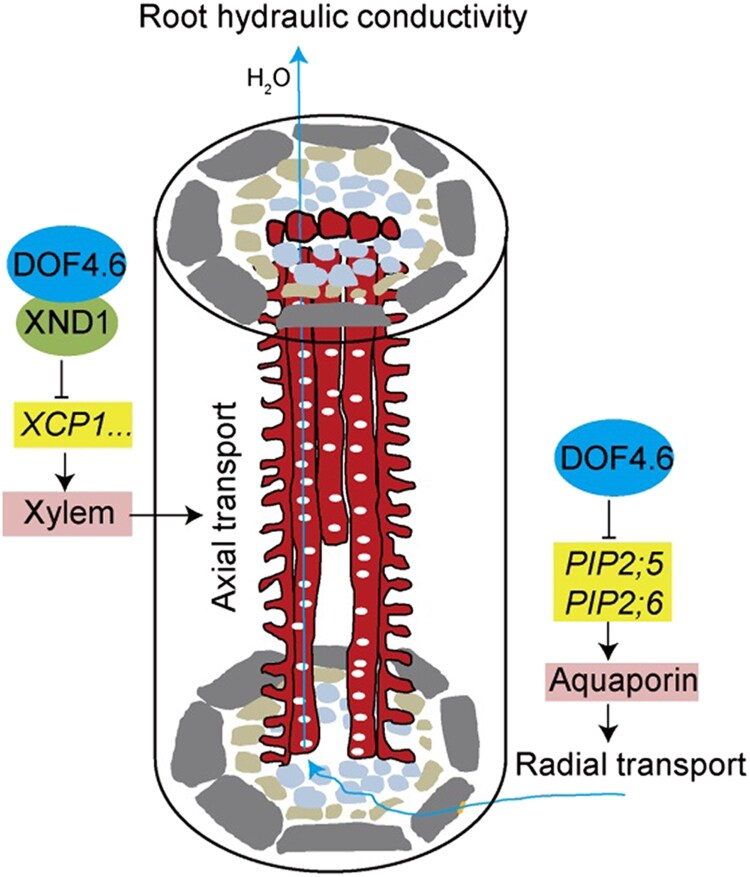 Figure 1
Peer Reviews
No public reviews on file for this paper yet. If you reviewed it on a platform where reviews are public (OpenReview, ICLR, NeurIPS, ICML), you can paste yours below so the community can read it here.
Videos
No videos yet. Explain this paper in a talk, walkthrough, or lecture? Add one.
Taxonomy
TopicsPlant Molecular Biology Research · Photosynthetic Processes and Mechanisms · Plant responses to water stress
Xylem differentiation is strictly regulated. The specialized roles of xylem tracheary elements (TEs) and fibers in long-distance water transport and structural support, respectively, make the precise regulation of their formation pivotal for plant fitness. Xylem differentiation is orchestrated by a group of NAC domain–containing transcription factors (TFs), specifically Vascular NAC-Domain (VND) and NAC Secondary Wall Thickening Promoting Factor (NST) proteins, forming functional homo and hetero dimers. These TFs induce the transcription of genes directing secondary cell wall biosynthesis, lignification, and programmed cell death. Expression of NSTs and VNDs is restricted to future xylem TEs and fibers through cell type– and organ-specific repression by TFs such as WRKY15, WRKY12, and ZFP2 (Wang et al. 2010; Ge et al. 2020; Low et al. 2025). The timeline of differentiation is further fine-tuned post transcriptionally by Xylem NAC Domain 1 (XND1). XND1 heterodimerizes with VNDs and NSTs, attenuating their capacity for transcriptional activation and/or sequestering them into the cytosol (Zhang et al. 2020; Zhong et al. 2021). Loss of XND1 accelerates xylem differentiation, leading to shorter TEs and dwarfed plants without affecting total TE number (Zhong et al. 2021).
Now, Bingli Ding and colleagues (Ding et al. 2025) reveal another piece of the regulatory puzzle surrounding xylem differentiation. They show that DOF4.6, previously identified as a negative regulator of TE formation (Ramachandran et al. 2020), acts in concert with XND1 to fine-tune vascular capacity in roots. The dof4.6 loss-of-function mutant showed accelerated TE differentiation in roots, coinciding with higher root hydraulic conductivity. These phenotypes were nearly identical to those of the xnd1 loss-of-function mutant. Moreover, dof4.6 xnd1 double mutants revealed an epistatic relationship between the 2 genes, suggesting that they act in the same pathway. Accordingly, it turns out that DOF4.6 and XND1 interact with each other directly, as confirmed with GST pull-down, split luciferase, bimolecular fluorescence complementation, and co-immunopurification experiments. This interaction increased the capacity of XND1 to bind to the promoter of XCP1, a protease directing TE programmed cell death at the end of their differentiation. While the effects on TE differentiation were virtually identical between dof4.6 and xnd1 mutants, the former showed a higher resistance to osmotic stress. This suggested additional, XND1-independent functions of DOF4.6 in the regulation of water transport. Indeed, the authors found that expression of aquaporins PIP2;5 and PIP2;6 was negatively regulated by DOF4.6 but not XND1. In addition, the accelerated TE formation and transcriptional changes in dof4.6 mutant plants improved their drought resistance. These results suggest a model in which DOF4.6 and XND1 act in concert to control axial water transport by delineating TE differentiation, while DOF4.6 additionally regulates aquaporins to modulate lateral water transport (Figure).
Previously, XND1 was believed to affect xylem differentiation primarily through post-transcriptional repression of VNDs and NSTs. Ding et al. (2025) show that XND1, in complex with DOF4.6, can also directly repress genes downstream of VNDs, such as XCP1. How exactly the direct transcriptional repression by XND1 and DOF4.6 interacts with NST/VND sequestration by XND1 is still hard to gauge. Additionally, it remains to be shown how these effects vary between organs and developmental stages. The regulatory circuitry of xylem differentiation is dynamic and tissue specific, as highlighted by varying roles of DOF4.6 in shoots compared with roots (Ramachandran et al. 2020) and potentially inverted transcriptional responses of aquaporins in 10-day-old and 21-day-old dof4.6 seedlings (Ding et al. 2025). Lastly, how DOF4.6 might affect the reported positive effect of XND1 on biotic resistance (Tang et al. 2018) is yet to be investigated. The many open questions notwithstanding, the work by Ding and colleagues brings us a step closer to fully appreciating the sophisticated regulatory network underpinning the plant vasculature.
Recent related articles in The Plant Cell:
Liu et al. (2025) profiled the miRNome during TE differentiation in Arabidopsis and identified miRNA coexpression networks functioning at the different stages of TE differentiation. Pfaff et al. (2024) introduced a method to induce tracheary element transdifferentiation of isolated protoplasts that can be used to study patterned secondary cell wall biosynthesis in a tissue-free environment and various mutant backgrounds.
The reference list from the paper itself. Each links out to its DOI / PubMed record.
- 1Ding B, Liang M, Shi Y, Zhang R, Wang J, Huang Y, Yan D, Hou X, Maurel C, Tang N. DOF 4.6 acts in concert with XND 1 on root hydraulics and drought response in Arabidopsis. Plant Cell. 2025:37(4):koaf 083. 10.1093/plcell/koaf 08340262770 PMC 12013818 · doi ↗ · pubmed ↗
- 2Ge S, Han X, Xu X, Shao Y, Zhu Q, Liu Y, Du J, Xu J, Zhang S. WRKY 15 suppresses tracheary element differentiation upstream of VND 7 during xylem formation. Plant Cell. 2020:32(7):2307–2324. 10.1105/tpc.19.0068932327537 PMC 7346572 · doi ↗ · pubmed ↗
- 3Liu C, Li A, Guo Z, Chen N, Wang Y, Tang W, Wu Y, Liu J, Wang Z, Li L, et al Micro RNA analysis reveals 2 modules that antagonistically regulate xylem tracheary element development in Arabidopsis. Plant Cell. 2025:36(1):koaf 011. 10.1093/plcell/koaf 011PMC 1176053839792476 · doi ↗ · pubmed ↗
- 4Low PM, Kong Q, Blaschek L, Ma Z, Lim PK, Yang Y, Quek T, Lim CJR, Singh SK, Crocoll C, et al ZINC FINGER PROTEIN 2 suppresses funiculus lignification to ensure seed loading efficiency in Arabidopsis. Dev Cell. 2025. 10.1016/j.devcel.2025.01.02139999844 · doi ↗ · pubmed ↗
- 5Pfaff SA, Wagner ER, Cosgrove DJ. The structure and interaction of polymers affects secondary cell wall banding patterns in Arabidopsis. Plant Cell. 2024:36(10):4309–4322. 10.1093/plcell/koae 23339163271 PMC 11449099 · doi ↗ · pubmed ↗
- 6Ramachandran V, Tobimatsu Y, Masaomi Y, Sano R, Umezawa T, Demura T, Ohtani M. Plant-specific dof transcription factors VASCULAR-RELATED DOF 1 and VASCULAR-RELATED DOF 2 regulate vascular cell differentiation and lignin biosynthesis in Arabidopsis. Plant Mol Biol. 2020:104(3):263–281. 10.1007/s 11103-020-01040-932740898 · doi ↗ · pubmed ↗
- 7Tang N, Shahzad Z, Lonjon F, Loudet O, Vailleau F, Maurel C. Natural variation at XND 1 impacts root hydraulics and trade-off for stress responses in Arabidopsis. Nat Commun. 2018:9(1):3884. 10.1038/s 41467-018-06430-830250259 PMC 6155316 · doi ↗ · pubmed ↗
- 8Wang H, Avci U, Nakashima J, Hahn MG, Chen F, Dixon RA. Mutation of WRKY transcription factors initiates pith secondary wall formation and increases stem biomass in dicotyledonous plants. Proc Natl Acad Sci U S A. 2010:107(51):22338–22343. 10.1073/pnas.101643610721135241 PMC 3009815 · doi ↗ · pubmed ↗