Cracking the seed code: How nitrate directly breaks ABA signaling for germination
Nitin Uttam Kamble

Abstract
Genes, proteins, chemicals, diseases, species, mutations and cell lines named across the full text — each resolved to its canonical identifier and authoritative record.
Click any figure to enlarge with its caption.
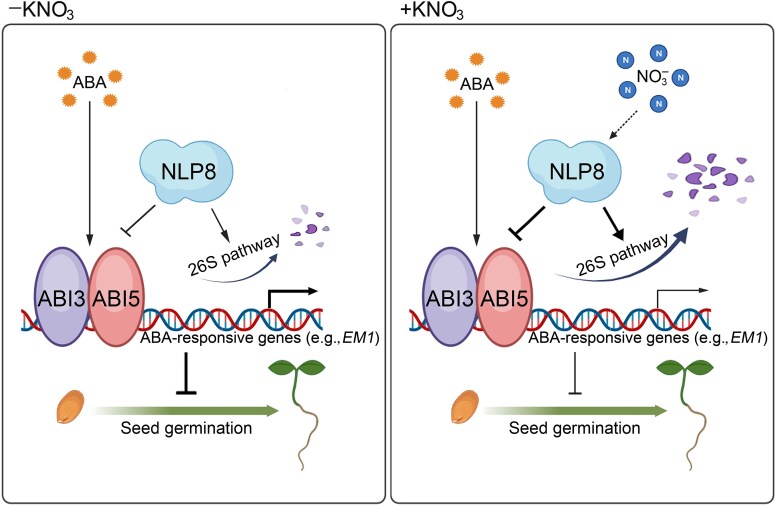 Figure 1
Peer Reviews
No public reviews on file for this paper yet. If you reviewed it on a platform where reviews are public (OpenReview, ICLR, NeurIPS, ICML), you can paste yours below so the community can read it here.
Videos
No videos yet. Explain this paper in a talk, walkthrough, or lecture? Add one.
Taxonomy
TopicsPlant nutrient uptake and metabolism · Seed Germination and Physiology · Legume Nitrogen Fixing Symbiosis
Have you ever wondered how seeds can be stored for years and still give rise to the next generation of life? Extensive research has shown that the plant hormone abscisic acid (ABA) plays a crucial role in maintaining seed dormancy and desiccation tolerance (reviewed by Sajeev et al. 2024). ABA regulates this process through intricate molecular mechanisms involving the ABA receptor complex (PYR/PYL/RCAR), protein phosphatases (PP2Cs), and kinases (SnRK2s), along with ABA signaling pathway transcription factors (TFs) such as ABSCISIC ACID INSENSITIVE 3 (ABI3) and ABI5 (Lopez-Molina et al. 2001).
Interestingly, nitrogen not only determines plant growth and yield potential as a macronutrient but also acts as a key signaling molecule. Plants primarily take up nitrogen from the soil in the form of nitrate (NO_3_^−^), which, upon reduction to nitrite, releases nitric oxide (NO). Both nitrate and NO have been shown to stimulate seed germination. NO functions through PROTEOLYSIS6 (PRT6) to negatively regulate ABI5 transcription and induce ABI5 S-nitrosylation, leading to its degradation and modulation of the ABA response (Gibbs et al. 2014; Albertos et al. 2015). Despite this knowledge, whether nitrate serves as a crucial cue that directly regulates ABA signaling during seed germination remains unknown.
In new work, Zhichong Huang and colleagues (Huang et al. 2025) explore the role of nitrate in ABA-regulated seed germination. Huang et al. first demonstrated that nitrate mitigates the inhibitory effects of ABA during Arabidopsis (A. thaliana) wild-type Columbia seed germination. Seeds germinated on water agar supplemented with ABA and KNO_3_ exhibited better germination and cotyledon greening compared with controls germinated on media containing ABA alone. Using double mutants of NITRATE REDUCTASE1 (NIA1) and NIA2 (nia1_nia2), which are impaired in NO synthesis, along with prt6 (a NO perception mutant), the authors observed an improvement in germination when both ABA and KNO_3_ were present, as opposed to when only ABA was present, demonstrating that nitrate modulates ABA signaling independently of NO signaling.
Huang et al. further studied if nitrate can specifically modulate ABI3 and ABI5 functions as these TFs are well studied in ABA-repressed seed germination. They found that ABI3 and ABI5 transcript levels were lower in seeds germinated on ABA + KNO_3_ compared with those on ABA with or without KCl. In addition, KNO_3_, but not KCl, partially suppressed the ABA hypersensitivity of ABI3 and ABI5 overexpression seeds.
Huang et al. then focused on NIN-LIKE PROTEIN (NLP) TFs known to play key roles in nitrate-mediated gene expression (Figure). Through protein–protein interaction studies, they confirmed that NLP8 physically interacts with ABI3 and ABI5 both in vitro and in vivo. This interaction was responsive to both ABA and nitrate, with strong interaction observed with the phosphorylated form of ABI5. Notably, NLP8 is highly abundant in mature dry and imbibed seeds and is induced by ABA but not by nitrate. Importantly, only NLP8, and not NLP7 or NLP9, could suppress ABA signaling and promote seed germination despite all 3 showing interaction with ABI3 and ABI5, suggesting that nitrate inhibits ABA signaling specifically through NLP8.
Through comprehensive double and triple mutant analyses, the authors demonstrated that NLP8 functions upstream of ABI3 and ABI5 in modulating ABA signaling, as the ABA hypersensitivity of NLP8 mutants required functional ABI3 and ABI5 (Figure). Additional protein DNA interaction studies showed that NLP8 attenuates ABI3 and ABI5 function through protein–protein interactions, thereby modulating the expression of downstream target genes such as LATE EMBRYOGENESIS ABUNDANT1 (EM1) and EM6. Additionally, they found that nitrate and NLP8 promote the degradation of ABI3 and ABI5 via the 26S proteasome pathway, reducing their suppressive effects on seed germination and early seedling establishment (Figure).
In summary, these findings reveal that nitrate attenuates the ABA signaling pathway independently of NO signaling through NLP8. Specifically, NLP8 directly interacts with ABI3 and ABI5 to regulate downstream gene expression. The coordination between the nitrate and ABA signal transduction pathways guarantees that ABA signaling remains regulated at an optimal level under nitrate-sufficient conditions. Nevertheless, the precise mechanisms by which nitrate promotes NLP8 association with and degradation of ABI3/ABI5 via the 26S proteasome pathway remain to be unraveled. Does the increased interaction following nitrate or ABA pretreatment arise from a similar mechanism, and is nitrate binding by NLP8 relevant in the context of nitrate pretreatment? Understanding these processes could have implications for improving seed germination under diverse physiological conditions.
Recent related articles in The Plant Cell
Du et al. (2024) report on negative regulation of ABA signaling by AFP1-mediated degradation of ABI5 through the U-box E3 ubiquitin ligase PUB35. Durand et al. (2024) report on NLP2 as a top-tier transcriptional regulator of the early nitrate response gene regulatory network. Mei et al. (2023) report that Auxin contributes to jasmonate-mediated regulation of abscisic acid signaling during seed germination in Arabidopsis. Shanks et al. (2024) review research that uses systems biology approaches to examine temporal and spatial mechanisms behind nitrogen sensing and signaling in plants. Zhao et al. (2024) report on effect of S-nitrosylation of the transcription factor MYB30 in NO-promoted seed germination in Arabidopsis.
The reference list from the paper itself. Each links out to its DOI / PubMed record.
- 1Albertos P, Romero-Puertas MC, Tatematsu K, Mateos I, Sánchez-Vicente I, Nambara E, Lorenzo O. S-nitrosylation triggers ABI 5 degradation to promote seed germination and seedling growth. Nat Commun. 2015:6(1):8669. 10.1038/ncomms 966926493030 PMC 4639896 · doi ↗ · pubmed ↗
- 2Du C, Liu M, Yan Y, Guo X, Cao X, Jiao Y, Zheng J, Ma Y, Xie Y, Li H, et al The U-box E 3 ubiquitin ligase PUB 35 negatively regulates ABA signaling through AFP 1-mediated degradation of ABI 5. Plant Cell. 2024:36(9):3277–3297. 10.1093/plcell/koae 19438924024 PMC 11371175 · doi ↗ · pubmed ↗
- 3Durand M, Brehaut V, Clement G, Kelemen Z, Macé J, Feil R, Duville G, Launay-Avon A, Roux P-L, Lunn C, et al The Arabidopsis transcription factor NLP 2 regulates early nitrate responses and integrates nitrate assimilation with energy and carbon skeleton supply. Plant Cell. 2024:35(5):1429–1454. 10.1093/plcell/koad 025PMC 1011828036752317 · doi ↗ · pubmed ↗
- 4Gibbs DJ, Md Isa N, Movahedi M, Lozano-Juste J, Mendiondo GM, Berckhan S, Marín-de la Rosa N, Vicente Conde J, Sousa Correia C, Pearce SP, et al Nitric oxide sensing in plants is mediated by proteolytic control of group VII ERF transcription factors. Mol Cell. 2014:53(3):369–379. 10.1016/j.molcel.2013.12.02024462115 PMC 3969242 · doi ↗ · pubmed ↗
- 5Huang Z, Han X, He K, Ye J, Yu C, Xu T, Zhang J, Du J, Fu Q, Hu Y. Nitrate attenuates abscisic acid signaling via NIN-LIKE PROTEIN 8 in Arabidopis seed germination. Plant Cell. 2025:37(3):koaf 046. 10.1093/plcell/koaf 04640123384 PMC 11952927 · doi ↗ · pubmed ↗
- 6Lopez-Molina L, Mongrand S, Chua NH. A postgermination developmental arrest checkpoint is mediated by abscisic acid and requires the ABI 5 transcription factor in Arabidopsis. Proc Natl Acad Sci U S A. 2001:98(8):4782–4787. 10.1073/pnas.08159429811287670 PMC 31911 · doi ↗ · pubmed ↗
- 7Mei S, Zhang M, Ye J, Du J, Jiang Y, Hu Y. Auxin contributes to jasmonate-mediated regulation of abscisic acid signaling during seed germination in Arabidopsis. Plant Cell. 2023:35(3):1110–1133. 10.1093/plcell/koac 36236516412 PMC 10015168 · doi ↗ · pubmed ↗
- 8Sajeev N, Koornneef M, Bentsink L. A commitment for life: decades of unraveling the molecular mechanisms behind seed dormancy and germination. Plant Cell. 2024:36(5):1358–1376. 10.1093/plcell/koad 32838215009 PMC 11062444 · doi ↗ · pubmed ↗