Innovative Biobased Thermoplastic Binders for Sustainable Lithium-Ion Batteries
Daniela de Morais Zanata, Rafael Del Olmo, Mikel Larumbe, Marcela de Paula Ramos, Nery M Aguilar, Irune Villaluenga

TL;DR
This paper introduces a new biobased polymer that can replace a common binder in lithium-ion batteries, offering a sustainable and high-performing alternative.
Contribution
The study develops and evaluates a novel biobased polymer (ISB-25PEG) as a sustainable alternative to PVDF in lithium-ion batteries.
Findings
ISB-25PEG binder shows superior adhesion and cohesion compared to PVDF.
Battery performance with ISB-25PEG is comparable to traditional PVDF binders.
The polymer is a promising sustainable alternative for next-generation batteries.
Abstract
The growing global demand for batteries has driven the search for sustainable materials for energy storage applications. One promising approach to enhance the sustainability of lithium-ion batteries (LIBs) is replacing poly(vinylidene fluoride) (PVDF) with biobased polymers as binders. However, the primary challenge lies in identifying biobased binders that can meet the mechanical and electrochemical performance requirements necessary for high-efficiency batteries. Balancing sustainability with performance remains an obstacle in the development of biobased alternatives. This study explores the potential of novel biobased polymers to replace PVDF as a binder in LFP cathodes. Biobased polymers, synthesized from isosorbide and poly(ethylene glycol) (PEG), were developed, and the results show that cathodes using the ISB-25PEG binder exhibit superior adhesion, cohesion, and battery…
Genes, proteins, chemicals, diseases, species, mutations and cell lines named across the full text — each resolved to its canonical identifier and authoritative record.
Click any figure to enlarge with its caption.
 1
1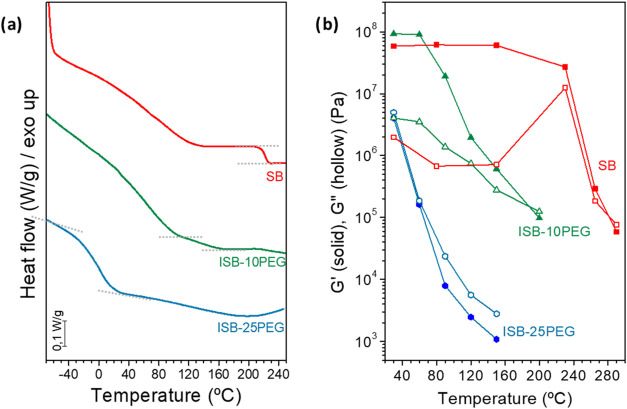 2
2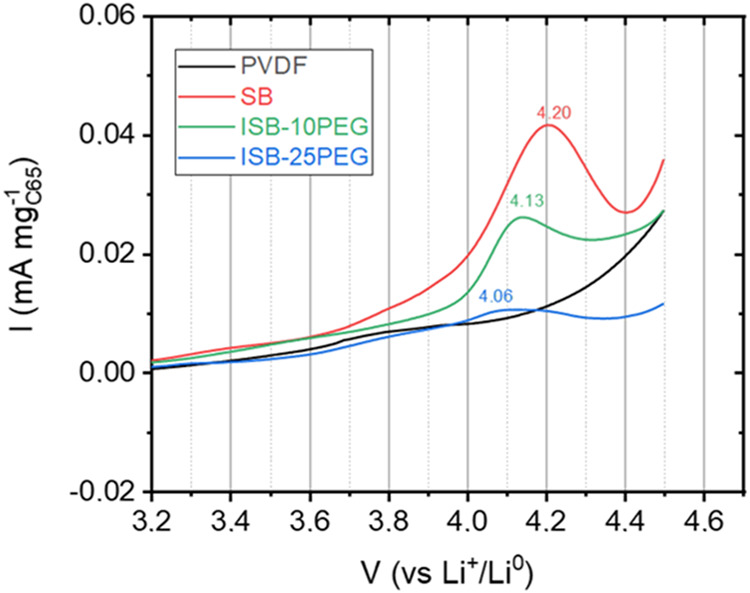 3
3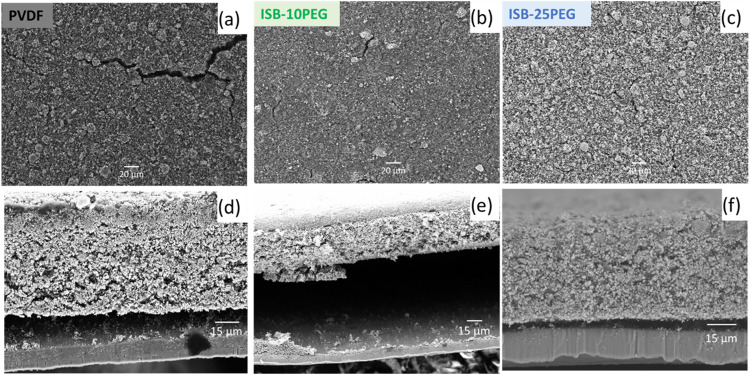 4
4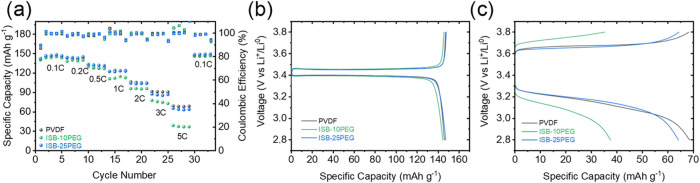 5
5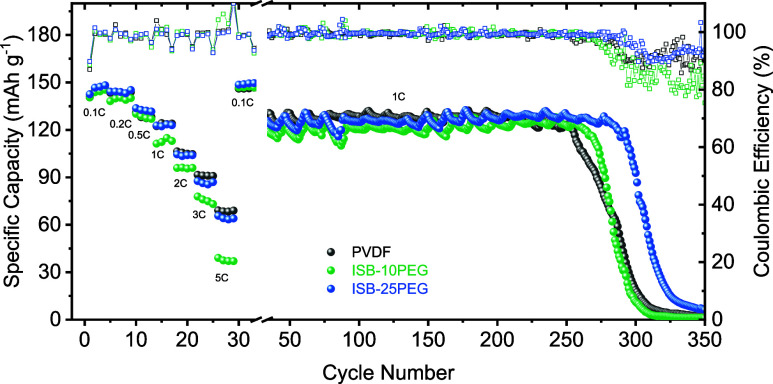 6
6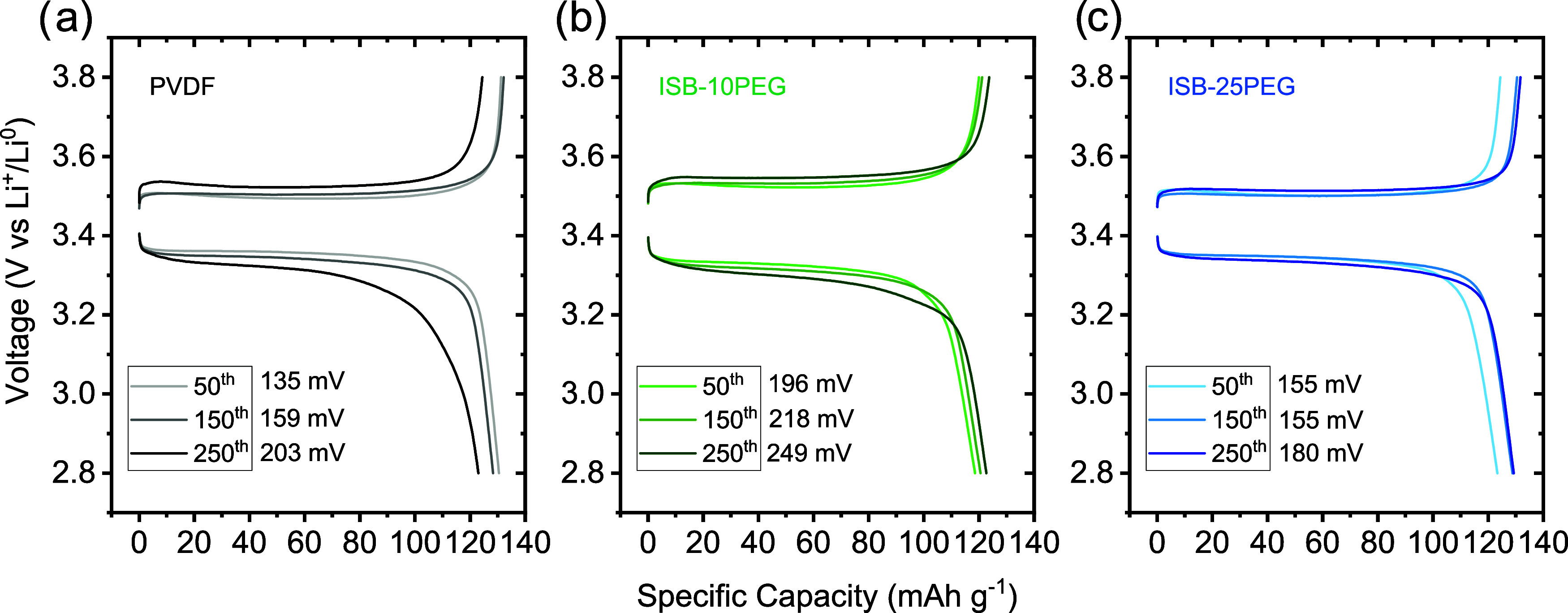 7
7| thickness coated (μm) | solid content (%) | mass loading (mgLFP cm–2, mAh cm–2) | |
|---|---|---|---|
| PVDF | 125 | 43 | 7.0, 1.20 |
| SB | 150 | 49 | 3.9, 0.66 |
| ISB-10PEG | 150 | 49 | 7.8, 1.33 |
| ISB-25PEG | 150 | 49 | 6.5, 1.10 |
| composition (mol %) | composition (wt %) | GPC | DSC | TGA | ||||||
|---|---|---|---|---|---|---|---|---|---|---|
| polymer | ISB | PEG | ISB | PEG |
| residue (%) | ||||
| SB | 100 | 0 | 100 | 0 | 64,500 | 125,300 | 1.94 | 222 | 395 | 24 |
| ISB-10PEG | 92 | 8 | 74 | 26 | 50,200 | 80,600 | 1.60 | 118 | 372 | 21 |
| ISB-25PEG | 75 | 25 | 43 | 57 | 17,600 | 33,400 | 1.90 | 0.5 | 361 | 26 |
- —HORIZON EUROPE Climate, Energy and Mobility10.13039/100018700
- —Eusko Jaurlaritza10.13039/501100003086
- —Eusko Jaurlaritza10.13039/501100003086
- —Agencia Estatal de Investigación10.13039/501100011033
- —Agencia Estatal de Investigación10.13039/501100011033
- —Agencia Estatal de Investigación10.13039/501100011033
- —María de Maeztu Excellence UnitNA
Peer Reviews
No public reviews on file for this paper yet. If you reviewed it on a platform where reviews are public (OpenReview, ICLR, NeurIPS, ICML), you can paste yours below so the community can read it here.
Videos
No videos yet. Explain this paper in a talk, walkthrough, or lecture? Add one.
Taxonomy
TopicsAdvancements in Battery Materials · Extraction and Separation Processes · Recycling and Waste Management Techniques
Introduction
1
The rapid growth in global energy demand encourages the transition from fossil fuels to renewable energy storage technologies.? Lithium-ion batteries (LIBs) are crucial in this transition, owing to their high energy density, long cycle life, and versatility across various applications. ?,? Despite their broad advantages, the sustainability in LIB technologies remains a significant challenge. ?,?
A critical component of LIBs is the binder, which keeps active material particles and conductive agents fixed on the current collector, ensuring the structural integrity by the accommodation of the mechanical stresses and volumetric changes that occur during battery charge and discharge cycles. ?,? This is one of the reasons why poly(vinylidene fluoride) (PVDF) has dominated the binder market in the last few years. ?,? However, the use of fluorine-based polymers has raised concerns, especially due to their negative environmental and health impact.? For such reasons, the European Chemicals Agency (ECHA) proposed the restriction of the large-scale application of per- and polyfluoroalkyl substances (PFAS) in the future.? Therefore, the substitution of PVDF with sustainable binders for LIBs has attracted widespread attention, ?−? ? although finding an environmentally friendly alternative that is low-cost and has excellent thermal and mechanical properties is still a challenge.
In recent years, increasing attention has been directed toward biobased binders, such as polysaccharides, ?,? lignin-based materials,? or cellulose derivatives, ?,? as substitutes for synthetic ones. Carboxymethyl cellulose (CMC) is the most famous biobased binder used in the industry.? Usually, CMC is combined with a rubberizing agent, such as styrene–butadiene rubber, to avoid the cracking and peeling of the electrode layer upon drying, especially if high loadings are used.? Other biobased polymers, such as guar gum, potato starch, and wheat starch, showed high flexibility at high loadings, but they delaminated upon calendaring due to the low inner electrode cohesion.? In summary, the key obstacle for biobased binders is to meet the mechanical and electrochemical performance standards required for high-efficiency LIBs.
This study addresses these challenges by investigating the potential of a novel biobased binder for cathodes in LIBs, composed of isosorbide (ISB) and poly(ethylene glycol) (PEG). Isosorbide, a renewable diol derived from glucose,? has been used as a building block in different polymers ?−? ? ? and offers excellent thermal stability and mechanical strength, while PEG (which can also be biobased?) contributes to flexibility and processability.? The copolymerization of rigid ISB and PEG within a (co)poly(arylene ether sulfone) linear chain resulted in a thermoplastic biobased binder with a tunable T g, and therefore, low processing temperatures. It is important to note that these copolymers are not entirely biobased, as the arylene ether sulfone moiety is derived from petroleum. However, replacing bisphenol A (BPA)commonly used in the large-scale production of polysulfoneswith biobased diols represents a significant environmental advancement. This substitution reduces reliance on fossil fuel-derived materials while maintaining the performance of the polymers. Additionally, bis(4-fluorophenyl) sulfone (DFPS), a key component for the production of the binders developed in this study, is not classified as a PFAS (per- and polyfluoroalkyl substance),? unlike materials such as PVDF, ensuring compliance with current and future European regulations.
Additionally, a comparative analysis was conducted to benchmark the performance of ISB-PEG copolymer-based cathodes against PVDF-based ones. Key performance metrics, including binder adhesion, electrochemical stability, and overall battery efficiency, were assessed under conditions representative of practical battery operation. The cathodes based on ISB-25PEG not only match the performance of PVDF in terms of adhesion and stability but also enable the development of LIBs with improved sustainability. By elucidating the potential of ISB-PEG-based copolymers as a viable and sustainable alternative to PVDF, this study contributes to the development of environmentally friendly LIBs, contributing to future research and innovation in integrating renewable materials into next-generation energy storage devices.
Experimental
Section
2
Materials
2.1
Isosorbide (ISB, 98%, TCI) and 18-crown-6 (99%, Thermo Scientific) were manipulated in a glovebox under an argon flow and used without further purification. Bis(4-fluorophenyl) sulfone (DFPS, 99%, TCI), potassium carbonate (K_2_CO_3_, 99%, Acros Organics), anhydrous dimethyl sulfoxide (DMSO, 99.8%, Thermo Scientific), poly(ethylene glycol) PEG (molecular weight of 1300 g mol^–1^, Sigma-Aldrich), and acetic acid (HPLC grade) were used without further purification. For comparative purposes, poly(vinylidene fluoride) (PVDF Solef 5130, 1000–1100 kg mol^–1^) was employed as the reference binder with 1-methyl-2-pyrrilidone (NMP, Sigma-Aldrich 99%) as the solvent. For the processing of the isosorbide-based electrodes, dimethylformamide (DMF, Acros, 99.5%) was used. To prepare the electrode slurries, conducting carbon (Super C_65_, Timcal) and lithium iron phosphate (LiFePO_4_, Aleees) were used without further treatment. As the liquid electrolyte, a solution of 1 M LiPF_6_ in EC:DEC (1:1, vol %) (LP40, Solvionic, 99.9%) was used as received.
Synthesis of the SB Polymer and ISB-xPEG Copolymers
2.2
The SB polymer was synthesized following a similar procedure described by Park et al.? For ISB-10PEG, ISB (0.5 g, 3.46 mmol), PEG (0.5 g, 0.39 mmol), DFPS (0.98 g, 3.85 mmol), and K_2_CO_3_ (0.66 g, 4.81 mmol) were dried at 40 °C overnight in a dried two-neck glass flask. A Dean–Stark apparatus was coupled to the system, which was previously purged with argon, before the addition of anhydrous DMSO (4 mL). Then, a solution of 18-crown-6 (0.051 g, 0.19 mmol) in anhydrous DMSO (1 mL) was added to a flask via a syringe under an argon atmosphere. The reaction mixture was heated at 155 °C for 24 h, under a mild argon flow. After polymerization, the reaction mixture was diluted with DMF (5 mL), cooled to room temperature, and precipitated into water containing acetic acid (2% v/v). The solid was filtered and reprecipitated in deionized water after dissolving in DMF. The polymer was dried under vacuum at 100 °C overnight. ISB-25PEG was prepared using the same procedure, adjusting the ISB (0.39 g, 2.70 mmol) and PEG (1.5 g, 1.15 mmol) content.
Cathode Processing
2.3
To assess the electrochemical stability of the developed polymers, slurries composed of C_65_ and polymers in a weight ratio of 1:1 were prepared and cast on aluminum foil using an automatic film applicator (NEURTEK Instruments, 40 mm s^–1^). After drying at room temperature, disks of 10 mm in diameter were punched, resulting in 1 mg_C_65_ _ cm^–2^.
The cathode slurries were prepared by dissolving the binder (5 wt %) and by subsequent addition of the active material (90 wt %) and conducting carbon (5 wt %). The mixtures were homogenized using a Speed Mixer (3000 rpm) and cast similarly to C-polymer electrodes. Very similar loadings were achieved by tuning the viscosity and thickness of the coating (see Table). Finally, disks of 10 mm diameter were punched and further dried at 60 °C under high vacuum overnight prior to characterization. The electrodes were evaluated in low (∼0.7 mAh cm^–2^) and high (∼1.2 mAh cm^–2^) loadings.
1: Slurry Key Parameters for Casting and the Resultant Capacity Loading
Characterizations
2.4
SB Polymer and ISB-xPEG Copolymers: Structural,
Thermal, and Mechanical Characterizations
2.4.1
^1^H NMR spectra of the polymers were acquired in DMSO-d 6 (5 mg mL^–1^), using a Bruker Avance 300 MHz spectrometer at 25 °C. The signal of the residual protons of DMSO (δ = 2.50 ppm) was used as the internal reference standard.
Gel permeation chromatography (GPC) was measured in a PL-GPC 50 integrated GPC system (Agilent Technonologies). 0.05 M LiBr (0.05 M) in DMF was used as the mobile phase at a flow rate of 1.0 mL min^–1^. The column was KD-806 M (Shodex) and all of the measurements were performed at 50 °C. The samples were dissolved in the mobile phase at 1 mg mL^–1^. Molecular weights were determined using a calibration curve based on poly(methyl methacrylate) (PMMA) standards.
Differential scanning calorimetry (DSC) analyses were performed on a TA Instrument DSC 25. The following program was used: heating from 40 to 270 °C, 5 min isotherm, cooling from 270 to −70 °C, 5 min isotherm, and heating from −70 to 270 °C. The heating and cooling rates were 20 °C min^–1^. The thermal stability of the whole set of polymers was investigated by thermogravimetric analysis (TGA) (TGA 8000 Pekin Elmer) under a nitrogen flow (40 mL min^–1^), at a heating rate of 10 °C/min, from 40 to 800 °C.
The rheological properties were determined by using a strain-controlled ARES-G2 rotational rheometer (TA Instruments). Samples of 8 mm diameter were analyzed in a parallel plate geometry. All of the experiments were conducted under linear viscoelastic conditions for the studied temperature range.
SB, ISB-xPEG, and PVDF
Binder Performance: Cell Assembly, Electrochemical Characterization, and Morphology of the Cathodes
2.4.2
The lithium metal was cleaned with cyclohexane and a nylon brush inside an Ar glovebox (H_2_O < 0.1 ppm, O_2_ < 0.8 ppm) until a homogeneous and shiny surface was obtained. Disks of 12 mm in diameter were punched for the characterization of the studied polymers. CR2032 coin cells were employed to assemble the different cells using glass fiber (GF) as the separator and 240 μL of LP40. To assess the electrochemical stability of the different polymers, Li||C-polymer cells were used, while Li||LFP cells were employed to evaluate the performance of the polymers as binders for lithium-ion batteries.
The electrochemical stability was evaluated by linear sweep voltammetry at 1 mV s^–1^ from the OCV to 4.5 V vs Li^+^/Li^0^. Galvanostatic charge–discharge was employed to assess the rate capability in the range of 0.1–5C. Subsequently, the cells were cycled at 0.1C for capacity recovery after the stress suffered at high current densities prior to evaluating the long-term stability at 1C. The experiments were carried out at room temperature. The different cathode formulations were launched in duplicated cells.
The surface morphology, internal porosity, and adhesion to the current collector of the electrodes were analyzed using a benchtop Hitachi 3030 scanning electron microscope (SEM). All analyses were performed under low vacuum and at a 15 kV accelerating voltage. All samples were prepared on carbon tape.
Results and Discussion
3
SB Polymer and ISB-xPEG
Copolymers: Structural, Thermal, and Mechanical Characterizations
3.1
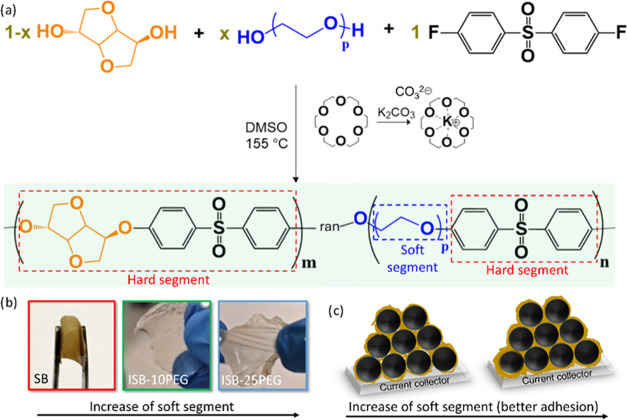
To develop a sustainable and competitive binder, we combine soft and hard segments into a poly(arylene ether sulfone) backbone. The hard segment (composed of isosorbide and aromatic rings from the sulfone moieties) provides structural stability, ensuring electrode integrity during cycling. ?,? In contrast, the soft segment (composed of PEG, with a composition of 10 and 25 mol %) enables the polymer matrix to absorb mechanical strain, allowing expansion during cycling. Isosorbide and PEG were added simultaneously in order to obtain random copoly(arylene ether sulfone) (Figurea). The SB (100% ISB, no PEG; Table) and ISB-10PEG (90 mol % ISB and 10 mol % PEG; Table) membranes are flexible (Figureb), while the ISB-25PEG (75 mol % ISB and 25 mol % PEG; Table) membrane is both flexible and stretchable, showing a synergistic effect between the soft and hard components of the biobased binder. Furthermore, the enhanced flexibility of the polymer is typically associated with the improved adhesion? (Figurec) and cracking resistance, which is fundamental for a binder performance.?
(a) Schematic representation of the synthesis of ISB-xPEG poly(arylene ether sulfone) copolymers. (b) Photographs of the SB, ISB-10PEG, and ISB-25PEG polymer membranes. (c) Schematic representation of the binder adhesion with an increase of the soft segments in the polymer backbone.
2: Nomenclature and Molar and Mass Compositions Determined by 1H NMR Spectroscopy
The SB polymer (SB derived from “superbio”)? and the novel ISB-xPEG copolymers were synthesized by aromatic nucleophilic substitution, catalyzed by K_2_CO_3_ and 18-crown-6 (Figurea). In this reaction, a complex formed between the K^+^ ion and an alkoxide, with 18-crown-6 playing a key role due to its ability to accommodate the K^+^ ion, resulting in the formation of a “naked” alkoxide ion. ?,? This increases the stability of the alkoxide, which is crucial for achieving a high molecular weight and ensuring the success of the reaction. As a result, we obtained a high molecular weight (M w) (125.3 kg mol^–1^) for the SB polymer, surpassing the entanglement threshold value (28 kg mol^–1^) for isosorbide-based polymers.? Additionally, GPC results (Figure S1 and Table) also showed that as the PEG content increases, the M w of the copolymer decreases, with values of 80.6 kg mol^–1^ for ISB-10PEG and 33.4 kg mol^–1^ for ISB-25PEG. This decrease in the molecular weight can be attributed to the greater stability of the secondary alkoxides from isosorbide compared to the primary alkoxides derived from PEG.?
The chemical structure and composition of the copolymers were confirmed by ^1^H NMR (Figure S2 and Table). In all spectra, the presence of signals from aromatic hydrogens (H_h_ and H_g_), isosorbide hydrogens (H_a_, H_b_, H_c_, H_d_, H_e_, and H_f_), and hydrogens from PEG (H_j_) was confirmed. The complete assignment is shown in Figure S2. The main results obtained by ^1^H NMR, GPC, DSC, and TGA are summarized in Table.
Thermal properties are also important parameters that are directly imparted in the binder performance and processability. Poly(arylene ether sulfone) are rigid polymers, which present a high glass transition temperature (T g) and are used as engineering plastics.? However, to enable processing at milder temperatures, PEG, a flexible polyol, was randomly introduced into the copoly(arylene ether sulfone) backbone to decrease its T g. As shown in Figurea, a pronounced decrease in the T g was observed as the PEG content increases. While SB showed a T g of 222 °C, the incorporation of 10 mol % (ISB-10PEG) and 25 mol % (ISB-25PEG) PEG reduces the T g to 118 and 0.5 °C, respectively. The stretchability of ISB-25PEG is related to its subambient T g. As previously mentioned, increasing the PEG content leads to a reduction in the molecular weight (M w) of the copolymer. While both a lower M w and the inclusion of soft segments contribute to the reduction of T g, the incorporation of PEG has a more pronounced effect. On one hand, the decrease in T g due to a lower M w is primarily related to increased chain-end mobility and reduced entanglements. On the other hand, the incorporation of soft PEG segments in the polymer backbone presents a plasticizer effect, lowering the activation energy required for conformational changes in the system.? The plasticizing effect caused by the incorporation of soft segments has a more significant impact on the polymer’s final properties than the reduction in the molecular weight (M w), as illustrated in Figure S3. For instance, the SB polymer with an M w of 8000 g mol^–1^ exhibited a T g of 68 °C (Figure S3), which is notably higher than that of ISB-25PEG, which has an M w of 33,400 g mol^–1^ but a lower T g due to the presence of PEG segments. Interestingly, both copolymers showed a single T g (indicated by the dotted gray lines), suggesting no phase separation (miscibility between both soft and hard segments). Additionally, the PEG backbone did not crystallize in the copolymers, although both the precursor and the PEG-arylene ether sulfone homopolymer are crystalline solids at room temperature (Figure S4). The same was observed for segmented polyurethanes synthesized using macrodiols with a molecular weight < 2 kDa,? where the random copolymer structure prevented macromolecular packing into crystalline lamellae.
(a) DSC 2nd heating curves and (b) storage (G′) and loss (G″) moduli as a function of temperature of the SB polymer (red horizontal bar) and the copolymers ISB-10PEG (green horizontal bar) and ISB-25PEG (blue horizontal bar) at 1 Hz and 0.5% strain.
The thermal degradation stability was evaluated, and the results are shown in Table and Figure S5. The SB polymer showed the highest 5 wt % loss temperatures (T d,5% = 395 °C). As the PEG content increased, the thermal stability decreased, with the degradation temperatures of ISB-10PEG (T d,5% = 372 °C) and ISB-25PEG (T d,5% = 361 °C) being lower. However, these degradation temperatures are still higher than those of most biobased commodity polymers (T d,5% < 316 °C), ?,? though lower than that of PVDF (455 °C).? However, it is important to highlight that these biobased polymers offer more than adequate thermal stability for use as binders in LIBs.
The rheological properties are also influenced by the PEG content, following the same trend as the DSC results shown in Figuresb and S6. The SB copolymer exhibited a solid-like behavior, with the storage modulus (G′) surpassing the loss modulus (G″) across the entire frequency range below its T g. At 230 °C (near its T g), the loss modulus (G″) increased, indicating the transition from a glassy to a viscous state. Above 230 °C, both the storage modulus (G′) and loss modulus (G″) decreased, approaching similar values, with G″ surpassing G′ at lower frequencies, signaling a liquid-like behavior (Figure S6a). For ISB-10PEG, at temperatures below 60 °C, both G′ and G″ were similar to those of the SB polymer. As the temperature increased, both moduli decreased due to the enhanced mobility of the polymer chains. At 200 °C, G″ exceeded G′, and the material could be processed at lower temperatures than the SB polymer (Figuresb and S6b). With a further increase in the PEG content (ISB-25PEG), the rheological properties showed a lower temperature for the transition of the elastomer to the thermoplastic response. Both G′ and G″ decreased gradually with rising temperature due to increased chain mobility, as seen in Figuresb and S6c.
Based on the polymer characterization, the incorporation of PEG into the polymer backbone lowers the T g, enhancing the processability of the binder for lithium-ion batteries. Additionally, the PEG segments possess higher polarity and mobility compared to the isosorbide and arylene ether sulfone segments, which can improve both cohesion and adhesion. Consequently, the SB, ISB-10PEG, and ISB-25PEG polymers were evaluated as binders and compared to those of the commercial PVDF binder. The cathode characterization is discussed in the following sections.
Electrochemical Stability
3.2
To evaluate the electrochemical stability of the studied polymers for its potential role as biobased binders, active material-free electrodes (polymer-C_65_ 50/50 wt %) were tested as working electrodes versus the Li metal, using a 1 M LiPF_6_ in EC:DEC solution (LP40) as the liquid electrolyte. As shown in Figure, the PVDF-based electrode exhibited no degradation peaks across the entire measured voltage range. In contrast, the SB-based electrode displayed a degradation peak at 4.2 V, which shifted to lower voltages with the increasing PEG content (4.13 V for ISB-10PEG and 4.06 V for ISB-25PEG) as expected due to the low electrochemical stability of pure PEG (< 4.0 V).? Consequently, the proposed polymers are suitable for use in sustainable cathode active materials, such as S_8_ and LFP, with operation voltages below 4.0 V.
Linear sweep voltammetry curves of Li|GF, 240 μL of LP40|Polymer:C65 (1:1 wt %) at 1 mV s–1 for PVDF (black horizontal bar), SB (red horizontal bar), ISB-10PEG (green horizontal bar), and ISB-25PEG (blue horizontal bar) polymers.
Application in Li-Ion Batteries
3.2.1
LFP was chosen as the active material to test the performance of the biobased polymers studied as binders in cathodes composed of 90 wt % LFP/5 wt % C_65_/5 wt % polymer with a loading of 1.2 mAh cm^–2^. As shown in Figure S7, SB-based cathodes exhibited significant fissures and began to detach from the current collector at a loading of 0.7 mAh cm^–2^. At a higher loading of 1.2 mAh cm^–2^, the SB binder resulted in poor-quality coatings that detached from the current collector, preventing cell assembly and testing. Consequently, only the cathodes based on ISB-10PEG and ISB-25PEG binders were compared to a reference cathode using a PVDF binder. As shown in Figurea–c, SEM images show the particle distribution and integrity of the cathodes. However, the PVDF-based cathodes displayed some cracks, which diminished as the PEG content in the biobased binders increased, with the ISB-25PEG binder demonstrating a homogeneous and robust coating. Additionally, cross-sectional images revealed poor adhesion for the ISB-10PEG and PVDF-based cathodes (Figured,e), while the ISB-25PEG-based cathode exhibited significantly better adhesion and integrity with the current collector (Figuref). These results clearly demonstrate that incorporating PEG into the biobased polymer backbone enhances both particle cohesion within the cathodes and adhesion to the current collector. This improvement can be attributed to the increased polarity and mobility of the ISB-xPEG binders, which strengthens intermolecular interactions and adhesion with both the LFP particles and the current collector. ?,?
Top-view (upper) and cross-sectional (bottom) SEM images of fresh cathodes (1.2 mAh cm–2) based on (a, d) PVDF, (b, e) ISB-10PEG, and (c, f) ISB-25PEG.
The cathodes were cycled in a ramp capability test at different C-rates (0.1 to 5C), as shown in Figurea–c. Notably, the ISB-25PEG cathode achieved the highest Coulombic efficiency in the first cycle (see Figure S8) at 0.1C (89.8%), outperforming both the ISB-10PEG (88.6%)- and PVDF-based (87.0%) cathodes. After the first cycle of stabilization, the Coulombic efficiency for all three cathodes remained close to 100%, indicating good reversibility and efficient cycling, reaching very similar capacities at a low C-rate (< 1C). However, at higher C-rates (> 1C), a significant capacity drop was observed for all of the cathodes, with the ISB-10PEG-based cathode exhibiting the lowest specific capacity across all C-rates. This trend was pronounced at 5C, where the ISB-10PEG-based cathode capacity dropped to 37 mAh g^–1^, while the ISB-25PEG- and PVDF-based cathodes maintained capacities of 64 and 69 mAh g^–1^, respectively. To understand the significant drop for the ISB-10PEG-based cathode at 5C, electrochemical impedance spectroscopy was used (Figure S9) after rate capability measurements. As a result, the PVDF-based cathode presented the lowest cell resistance (23.3 Ω), followed by ISB-25PEG (31.6 Ω) and finally ISB-10PEG (42.6 Ω). These results match with the capacities observed at high C-rates since lower resistances ease a faster lithium-ion insertion. Additionally, the recovery of all cathodes at 0.1C after high current density stress suggests that the cathodes were not significantly damaged during high-rate cycling.
(a) Rate capability of cathodes (1.2 mAh cm–2) and voltage profiles of the cells at (b) 0.1C and (c) 5C rates at room temperature.
After successful C-rate capability with no capacity drop at 0.1C in the last step, the cells were cycled for long-term stability at 1C to assess their cyclability (Figure). The results showed that all cathodes retained 80% of their initial capacity at 1C after different cycle numbers: the PVDF-based cathode reached this retention after 232 cycles, the ISB-10PEG-based cathode after 241 cycles, and the ISB-25PEG-based cathode after 263 cycles, demonstrating a significant cycle life improvement for the biobased binders. Voltage profiles (Figure) further revealed that the PVDF-based cathode experienced a 50% increase in the overpotential between the 50th and 250th cycles, while the ISB-10PEG- and ISB-25PEG-based cathodes showed much smoother increases in the overpotential with rises of 27 and 16%, respectively. These results are consistent with the SEM observations of coating quality and microstructure.
Long-term cycling of cells using different binders: PVDF (black horizontal bar), ISB-10PEG (green horizontal bar), and ISB-25PEG (blue horizontal bar) at the 1C rate (1.2 mAh cm–2).
Voltage profiles of the 50th, 150th, and 250th cycles for (a) PVDF-, (b) ISB-10PEG-, and (c) ISB-25PEG-based cathodes at the 1C rate.
Conclusions
4
Recognizing that the primary challenge in developing a biobased binder lies in obtaining materials with mechanical properties comparable to PVDFthe most widely used binder, which raises environmental concerns due to its fluorinated naturethis work focuses on preparing a poly(arylene ether sulfone) containing isosorbide and PEG segments. The incorporation of soft (PEG) segments in the hard isosorbide-based poly(arylene ether sulfone) directly influenced the thermal and mechanical properties of the polymer. All of the polymers were thermoplastic, with the T g decreasing from 222 °C (SB polymer) to 118 (ISB-10PEG) and 0.5 °C (ISB-25PEG), thereby enhancing the polymer’s processability. The ISB-25PEG membrane is both flexible and stretchable, showing a synergistic effect between the soft and hard components of the biobased binder.
This synergy was also observed in the LFP cathodes, where the ISB-25PEG-based cathode showed improved mechanical properties compared to the PVDF-based one due to the increased polarity and flexibility imparted by soft PEG segments. This resulted in improved particle cohesion within the cathodes, better adhesion to the current collector, and a more uniform cathode microstructure. At both 0.1 and 5C rates, the specific capacities of ISB-25PEG- and PVDF-based cathodes presented were comparable (ISB-25PEG: 146.2 mAh g^–1^ and PVDF: 144.2 mAh g^–1^ at 0.1C; ISB-25PEG: 64 mAh g^–1^ and PVDF: 69 mAh g^–1^ at 5C). Notably, the ISB-25PEG-based cathode exhibits a superior capacity retention at 1C, highlighting a significant improvement in the cycle life, thanks to this biobased binder. These findings contribute to the environmental goals of the battery industry and support the transition toward more sustainable technologies. The promising results lay the foundation for further research and development with the possibility of scaling this technology to broader industrial applications.
Supplementary Material
The reference list from the paper itself. Each links out to its DOI / PubMed record.
- 1Holechek J. L.Geli H. M. E.Sawalhah M. N.Valdez R.A Global Assessment: Can Renewable Energy Replace Fossil Fuels by 2050?Sustainability 2022148479210.3390/su 14084792 · doi ↗
- 2Xu J.Cai X.Cai S.Shao Y.Hu C.Lu S.Ding S.High-Energy Lithium-Ion Batteries: Recent Progress and a Promising Future in Applications Energy Environ. Mater.202365 e 1245010.1002/eem 2.12450 · doi ↗
- 3Khan F. M. N. U.Rasul M. G.Sayem A. S. M.Mandal N. K.Design and Optimization of Lithium-Ion Battery as an Efficient Energy Storage Device for Electric Vehicles: A Comprehensive Review J. Energy Storage 202371202210803310.1016/j.est.2023.108033 · doi ↗
- 4Costa C. M.Barbosa J. C.Gonçalves R.Castro H.Campo F. J. D.Lanceros-Méndez S.Recycling and Environmental Issues of Lithium-Ion Batteries: Advances, Challenges and Opportunities Energy Storage Mater.20213743346510.1016/j.ensm.2021.02.032 · doi ↗
- 5Dou W.Zheng M.Zhang W.Liu T.Wang F.Wan G.Liu Y.Tao X.Review on the Binders for Sustainable High-Energy-Density Lithium Ion Batteries: Status, Solutions, and Prospects Adv. Funct. Mater.20233345230516110.1002/adfm.202305161 · doi ↗
- 6Rahani E. K.Shenoy V. B.Role of Plastic Deformation of Binder on Stress Evolution during Charging and Discharging in Lithium-Ion Battery Negative Electrodes J. Electrochem. Soc.20131608 A 115310.1149/2.046308 jes · doi ↗
- 7Jäckel N.Dargel V.Shpigel N.Sigalov S.Levi M. D.Daikhin L.Aurbach D.Presser V.In Situ Multi-Length Scale Approach to Understand the Mechanics of Soft and Rigid Binder in Composite Lithium Ion Battery Electrodes J. Power Sources 201737116216610.1016/j.jpowsour.2017.10.048 · doi ↗
- 8Hu X.An A. K. J.Chopra S. S.Life Cycle Assessment of the Polyvinylidene Fluoride Polymer with Applications in Various Emerging Technologies ACS Sustainable Chem. Eng.202210185708571810.1021/acssuschemeng.1c 05350 · doi ↗