Palmoplantar keratoderma in a middle-aged male
Manisha Siriwardene, Frank Isaacs

Abstract
Genes, proteins, chemicals, diseases, species, mutations and cell lines named across the full text — each resolved to its canonical identifier and authoritative record.
Click any figure to enlarge with its caption.
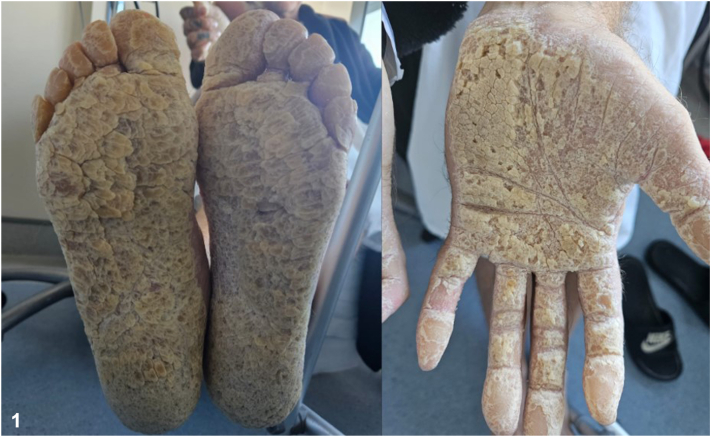 Figure 1
Peer Reviews
No public reviews on file for this paper yet. If you reviewed it on a platform where reviews are public (OpenReview, ICLR, NeurIPS, ICML), you can paste yours below so the community can read it here.
Videos
No videos yet. Explain this paper in a talk, walkthrough, or lecture? Add one.
Taxonomy
TopicsSkin and Cellular Biology Research · Dermatological and Skeletal Disorders
Clinical presentation
A 50-year-old male presented with thick, diffuse plaques over the palms and soles of the feet and a congenital form of sensorineural hearing loss (Fig 1). He was unable to work and required a full-time carer for activities of daily living due to limited dexterity and pain associated with fine movements of the hands and feet. There was a strong family history of palmoplantar keratoderma with a biological father, brother, daughter, 2 nephews and a paternal grandmother also being affected. On examination, there was evidence of honeycomb pattern of hyperkeratosis over the palms and soles of the feet and a “starfish”-shaped hyperkeratosis over the knuckles causing digital constricting bands. There were no ocular defects.Fig 1. Figure 1 Clinical photograph demonstrating diffuse thickened plaques over the palms and soles of the feet.
Question 1: What is the most likely diagnosis?
- A.Olmsted syndrome
- B.Vohwinkel syndrome
- C.Huriez syndrome
- D.Punctate keratoderma
- E.Hereditary painful callosities
Answers:
- A.Olmsted syndrome—Incorrect. Olmsted syndrome is not associated with sensorineural hearing loss.
- B.Vohwinkel syndrome—Correct. The classical presentation of Vohwinkel syndrome includes a honeycomb pattern of hyperkeratosis over the palms and soles of the feet, sensorineural hearing impairment and a “starfish”-shaped hyperkeratosis typically over the knuckles which may cause digital constricting bands.1
- C.Huriez syndrome—Incorrect. This condition presents with the triad of congenital sclero-atrophy, hypoplastic nails, and palmoplantar keratoderma.
- D.Punctate keratoderma—Incorrect. This condition presents with small round bumps along the palms and soles as opposed to thick, diffuse plaques.
- E.Hereditary painful callosities—Incorrect. This condition presents with keratotic lesions over pressure points over the palms and soles; a pattern not demonstrated here.
Question 2: Which of the following is not a common complication of this syndrome?
- A.Peridontitis
- B.Psychologic distress
- C.Secondary skin infections
- D.Pseudoainhum (digital constricting bands)
- E.Sensorineural hearing loss
Answers:
- A.Peridontitis—Correct. Peridontits is not a complication of Vohwinkel syndrome; however, it may be found in Papillon-Lefevre syndrome.
- B.Psychologic distress—Incorrect. Patients with Vohwinkel syndrome often report psychological distress due to increased morbidity and pain associated with their condition.2
- C.Secondary skin infections—Incorrect. Vohwinkel syndrome may be complicated by secondary skin infections due to breaks in the skin.2
- D.Pseudoainhum (digital constricting bands)—Incorrect. Hyperkeratosis in Vohwinkel syndrome may cause constricting bands (known as pseudoainhum) which can result in autoamputation of the digits.3
- E.Sensorineural hearing loss—Incorrect. This is a common complication found in the classical variant of Vohwinkel syndrome.2
Question 3: A mutation in which of genes and correlating protein is associated with this syndrome?
- A.Gap junction protein beta 2 (GJB2 gene); connexin 26 protein2
- B.Gap junction protein beta 2 (GJB2 gene); protein C
- C.TRPV3 gene; connexin 26 protein
- D.p53 gene; p53 tumour suppressor protein
- E.Fibulin-5 gene; elastin
Answers:
- A.Gap junction protein beta 2 (GJB2 gene); connexin 26 protein—Correct. A mutation in the GJB2 gene which encodes connexin 26 is associated with Vohwinkel syndrome.2^,^4
- B.Gap junction protein beta 2 (GJB2 gene); protein C—Incorrect. The GJB2 gene does not encode for protein C.
- C.TRPV3 gene; connexin 26 protein—Incorrect. The TRPV3 is associated with Olmsted syndrome and does not encode connexin 26.
- D.p53 gene; p53 tumour suppressor protein—Incorrect. The p53 gene mutation is not associated with Vohwinkel syndrome.
- E.Fibulin-5 gene; elastin—Incorrect. The fibulin -5 gene which encodes for elastin is associated with a form of Cutis Laxa, not Vohwinkel syndrome.
Conflicts of interest
None disclosed.
The reference list from the paper itself. Each links out to its DOI / PubMed record.
- 1Solis R.R.Diven D.G.Trizna Z.Vohwinkel's syndrome in three generations J Am Acad Dermatol 4420013763781117442010.1067/mjd.2001.106348 · doi ↗ · pubmed ↗
- 2Saleh D.Saleh H.M.Tanner L.S.Vohwinkel syndrome Stat Pearls 2024 Stat Pearls Publishing
- 3Bassetto F.Tiengo C.Sferrazza R.Vohwinkel syndrome: treatment of pseudo-ainhum Int J Dermatol 49201079822046561910.1111/j.1365-4632.2009.04267.x · doi ↗ · pubmed ↗
- 4Choudhary N.Ahar R.De A.Vohwinkel's syndrome: a rare disorder of keratinization Indian J Dermatol 5920146192548440410.4103/0019-5154.143547 PMC 4248511 · doi ↗ · pubmed ↗