The complete mitochondrial genome of Phlugiolopsis damingshanis (Orthoptera: Tettigoniidae: Meconematinae)
Yuqing Yao, Tinging Yu, Xun Bian, Bin Zhang

TL;DR
This paper reports the full mitochondrial genome of a grasshopper species from China, showing its genetic structure and composition.
Contribution
The study provides the first complete mitochondrial genome of Phlugiolopsis damingshanis and confirms its gene content similarity to another species.
Findings
The mitochondrial genome is 16,988 bp long and has a high AT content of 70%.
It contains 13 protein-coding genes, 22 tRNA genes, and 2 rRNA genes.
The gene content matches that of Phlugiolopsis tuberculata.
Abstract
We present the complete mitochondrial genome of Phlugiolopsis damingshanis based on the specimen from Wuming, China. The mitogenome is 16,988 bp in length and is AT rich (70%). It consists of 13 protein-coding, 22 transfer RNA, and 2 ribosomal RNA genes and is identical in gene content to Phlugiolopsis tuberculata.
Genes, proteins, chemicals, diseases, species, mutations and cell lines named across the full text — each resolved to its canonical identifier and authoritative record.
Click any figure to enlarge with its caption.
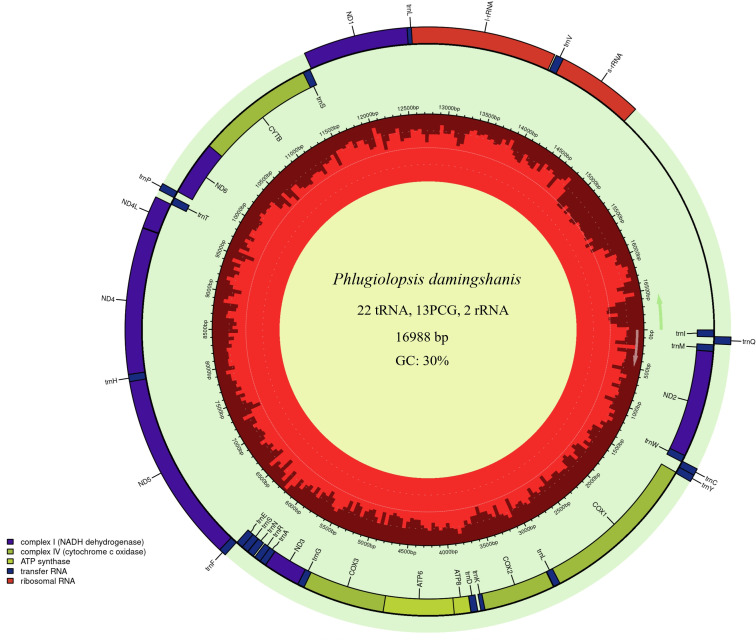 Fig 1
Fig 1| Gene | Type | Minimum nucleotide position | Maximum nucleotide position | Length | Start codon | Stop Codon | Direction |
|---|---|---|---|---|---|---|---|
| tRNA-Ile | tRNA | 1 | 67 | 67 | – | – | Forward |
| tRNA-Gln | tRNA | 64 | 133 | 70 | – | – | Reverse |
| tRNA-Met | tRNA | 141 | 205 | 65 | – | – | Forward |
| ND2 | CDS | 206 | 1234 | 1,029 | ATT | TAA | Forward |
| tRNA-Trp | tRNA | 1232 | 1298 | 67 | – | – | Forward |
| tRNA-Cys | tRNA | 1290 | 1354 | 65 | – | – | Reverse |
| tRNA-Tyr | tRNA | 1354 | 1418 | 65 | – | – | Reverse |
| COX1 | CDS | 1411 | 2955 | 1,545 | ATT | TAA | Forward |
| tRNA-Leu | tRNA | 2950 | 3015 | 66 | – | – | Forward |
| COX2 | CDS | 3020 | 3704 | 685 | ATG | T | Forward |
| tRNA-Lys | tRNA | 3704 | 3774 | 71 | – | – | Forward |
| tRNA-Asp | tRNA | 3773 | 3839 | 67 | – | – | Forward |
| ATP8 | CDS | 3840 | 4004 | 165 | ATT | TAA | Forward |
| ATP6 | CDS | 3998 | 4675 | 678 | ATG | TAA | Forward |
| COX3 | CDS | 4675 | 5461 | 787 | ATG | T | Forward |
| tRNA-Gly | tRNA | 5461 | 5526 | 66 | – | – | Forward |
| ND3 | CDS | 5527 | 5880 | 354 | ATT | TAA | Forward |
| tRNA-Arg | tRNA | 5882 | 5946 | 65 | – | – | Forward |
| tRNA-Ala | tRNA | 5945 | 6008 | 64 | – | – | Forward |
| tRNA-Asn | tRNA | 6024 | 6091 | 68 | – | – | Forward |
| tRNA-Ser | tRNA | 6093 | 6160 | 68 | – | – | Forward |
| tRNA-Glu | tRNA | 6160 | 6227 | 68 | – | – | Forward |
| tRNA-Phe | tRNA | 6230 | 6296 | 67 | – | – | Reverse |
| ND5 | CDS | 6297 | 8028 | 1732 | ATT | T | Reverse |
| tRNA-His | tRNA | 8028 | 8093 | 66 | – | – | Reverse |
| ND4 | CDS | 8094 | 9420 | 1,327 | ATT | T | Reverse |
| ND4L | CDS | 9426 | 9722 | 297 | ATG | TAA | Reverse |
| tRNA-Thr | tRNA | 9724 | 9792 | 69 | – | – | Forward |
| tRNA-Pro | tRNA | 9791 | 9856 | 66 | – | – | Reverse |
| ND6 | CDS | 9858 | 10385 | 528 | ATA | TAA | Forward |
| CYTB | CDS | 10385 | 11521 | 1,137 | ATG | TAG | Forward |
| tRNA-Ser | tRNA | 11519 | 11588 | 70 | – | – | Forward |
| ND1 | CDS | 11605 | 12553 | 949 | TTG | T | Reverse |
| tRNA-Leu | tRNA | 12553 | 12617 | 65 | – | – | Reverse |
| 16S rRNA | rRNA | 12592 | 13908 | 1,317 | – | – | Reverse |
| tRNA-Val | tRNA | 13923 | 13994 | 72 | – | – | Reverse |
| 12S rRNA | rRNA | 13993 | 14781 | 789 | – | – | Reverse |
Peer Reviews
No public reviews on file for this paper yet. If you reviewed it on a platform where reviews are public (OpenReview, ICLR, NeurIPS, ICML), you can paste yours below so the community can read it here.
Videos
No videos yet. Explain this paper in a talk, walkthrough, or lecture? Add one.
Taxonomy
TopicsOrthoptera Research and Taxonomy · Genomics and Phylogenetic Studies · Genetic diversity and population structure
ANNOUNCEMENT
Meconematinae, commonly known as quiet cricket, produce ultrasonic sound. The genus Phlugiolopsis Zeuner, 1940, belongs to the brachypterous group of the tribe Meconematini (1), which was established by Zeuner (2). Phlugiolopsis is mainly found in south China (1, 3–6). This region has a subtropical and tropical climate with high humidity, and the soft cuticle of these insects is adapted to such conditions (7). Up to now, the genetic information on species remains limited. Phlugiolopsis damingshanis Bian, Shi & Chang, 2012, is a miniature species originally described from specimens from Wuming, Guangxi, China (8). To enrich molecular data and contribute to the phylogeny of Phlugiolopsis, the complete mitochondrial genome of P. damingshanis was assembled and annotated.
The specimen of P. damingshanis analyzed here was collected from Damingshan in Guangxi, China (23.5005 N, 108.436742 W, 1200 m). The voucher specimen is deposited at Guangxi Normal University. The DNA was extracted from the hind femur using the TIANamp Genomic DNA Kit (TIANGEN). The 150 bp paired-end library was constructed with the MGIEasy Kit (MGI) and sequenced on an Illumina NovaSeq 6000 (Illumina Inc.). The raw data were processed using fastp v.0.20.0 (9), by trimming adapters and primers, filtering reads with phred quality <Q5, and filtering reads with N base number >3. The sequencing generated 8,225,010 reads that were filtered. Sequencing was performed by Beijing Berry Genomics Co., Ltd. The sequenced mitogenome data were assembled by NOVOPlasty 4.3.3 (10), yielding an N50 of 16,988 and GC content of 30%. The mitochondrial genome sequence of Phlugiolopsis tuberculata (GenBank accession number: NC_068779) was identified as the most closely related reference sequence using BLAST. The start position of the mitochondrial genome was adjusted to correspond with Phlugiolopsis tuberculata. The annotation was performed on the MITOS website (11). Gene start and stop positions were confirmed by comparison to seven complete mitochondrial genomes of Phlugiolopsis in GenBank and using standard, universally accepted initiation and termination codons as defined in the invertebrate mitochondrial genetic code (12, 13). Nucleotide identities were calculated by BLAST search using the default settings.
The complete circular mitochondrial genome of P. damingshanis is 16,988 bp in length. The genome contains 37 genes including 13 protein-coding, 22 tRNA, and 2 rRNA (Fig. 1). Six of the protein-coding genes initiate with ATT (ATP8, COX1, ND2, ND3, ND4, and ND5), five with ATG (ATP6, COX2, COX3, ND4L, and CYTB), one with ATA (ND6) and TTG (ND1) (Table 1). Seven of the protein-coding genes terminate with TAA (ATP6, ATP8, COX1, ND2, ND3, ND4L, ND6),and the T termination codon is found in the rest of five genes except CYTB (TAG) (T stop codon is completed by the addition of 3´ A residues to the mRNA, as is common in animal mitochondrial genomes [14, 15]). The entire mitochondrial genome sequence of P. damingshanis is 94.13% similar to the genome of Phlugiolopsis tuberculata.
The genome was annotated using the MITOS website and mapped with the Chloroplot online site (16). The innermost ring displays the GC content in red color and the direction of transcription, as indicated by the arrows. The final ring displays the genes. Genes transcribed clockwise are on the inside, while counterclockwise transcriptions are positioned on the outside. The color coding corresponds to genes of different groups as listed in the key in the bottom left. PCG, protein-coding genes.
The reference list from the paper itself. Each links out to its DOI / PubMed record.
- 1Zheng M, Su J, Shi F. 2024. Five new species of the genus Phlugiolopsis Zeuner, 1940 (Tettigoniidae: meconematinae) from China. Eur J Taxon 935. doi:10.5852/ejt.2024.935.2541 · doi ↗
- 2Zeuner FE. 1940. Phlugiolopsis henryi ng, n. sp., a new Tettigoniid, and other Saltatoria (Orthop.) from the Royal Botanic Gardens, Kew. J Soc British Ent 2:76–84.
- 3Zheng M, Duan Y, Liu Q, Chang Y. 2023. A supplement of the genus Phlugiolopsis Zeuner, 1940 (Tettigoniidae: meconematinae) from Yunnan, China. Zootaxa 5306:385–391. doi:10.11646/zootaxa.5306.3.637518515 · doi ↗ · pubmed ↗
- 4Pan Y, Bian X. 2024. Four new species of the genus Phlugiolopsis (Orthoptera: tettigoniidae: meconematinae) from Guangxi, China. Zootaxa 5443:287–297. doi:10.11646/zootaxa.5443.2.1139646678 · doi ↗ · pubmed ↗
- 5Pan Y, Bian X. 2024. New additions of the genus Phlugiolopsis (Orthoptera: tettigoniidae: meconematinae) from China. Zootaxa 5433:339–355. doi:10.11646/zootaxa.5433.3.339646767 · doi ↗ · pubmed ↗
- 6Zheng M, Shi F. 2024. Contribution to the genus Phlugiolopsis (Tettigoniidae: meconematinae) from China. Zootaxa 5443:151–160. doi:10.11646/zootaxa.5443.2.139646688 · doi ↗ · pubmed ↗
- 7Bian X, Shi F. 2018. New taxa of the genus Phlugiolopsis (Orthoptera: tettigoniidae: meconematinae) from Yunnan, China, with comments on the importance to taxonomy of the left tegmen. Zootaxa 4532:341–366. doi:10.11646/zootaxa.4532.3.230647353 · doi ↗ · pubmed ↗
- 8Bian XUN, Shi F-M, Chang Y-L. 2012. Supplement for the genus Phlugiolopsis zeuner, 1940 (Orthoptera: tettigoniidae: meconematinae) from China. Zootaxa 3411:55–62. doi:10.11646/zootaxa.3411.1.226191577 · doi ↗ · pubmed ↗