Coding-complete genome sequence of a measles virus genotype B3 isolate from Rabat, Morocco, in 2024
Safae Elkochri, Idrissa Diawara, Zineb Rhazzar, El Mehdi Belouad, Youssef El kadiri, Maryam Benlamari, Taha Chouati, Boutaina Elgharbaoui, Narjisse Ahmadi, Amine Idriss Lahlou, Nadia Touil, Khalid Ennibi, Boutayeb Saber, Lahcen Belyamani, Elmostafa El Fahime

TL;DR
This paper reports the full genome sequence of a measles virus from Morocco and shows it is closely related to a U.S. isolate.
Contribution
The paper provides a new coding-complete genome sequence of a measles virus isolate from Morocco and identifies its lineage.
Findings
The genome sequence of a measles virus isolate from Rabat, Morocco, was determined.
The isolate belongs to lineage B3 and is closely related to a U.S. isolate.
Abstract
We determined the coding-complete genome sequence of a measles virus that was isolated in Rabat from a Moroccan patient on 23 March 2024. Phylogenetic analysis showed that this virus, named MVi/Rabat.MAR/29.24, belongs to lineage B3 and is closely related to a USA isolate.
Genes, proteins, chemicals, diseases, species, mutations and cell lines named across the full text — each resolved to its canonical identifier and authoritative record.
Click any figure to enlarge with its caption.
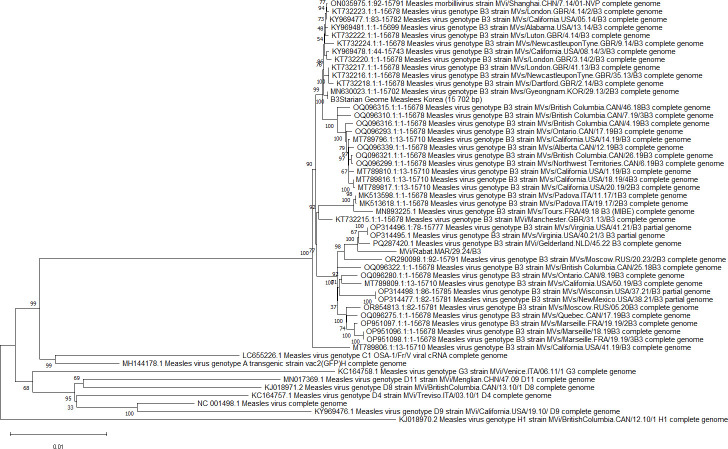 Fig 1
Fig 1| Primer name | Sequence (5′ to 3′) | Amplicon size (bp) | Reference |
|---|---|---|---|
| UTR5-F |
| 541 | This study |
| MVR-1R |
| This study | |
| AF1-2 |
| 1,098 | Namuwulya et al. ( |
| AR1-2 |
| This study | |
| MVR-2F |
| 877 | This study |
| MVR-2R |
| This study | |
| BF2_5 |
| 604 | Namuwulya et al. ( |
| AR1_4 |
| Namuwulya et al. ( | |
| MVR-3F |
| 954 | This study |
| MVR-3R |
| This study | |
| MVR-4F |
| 985 | This study |
| MVR-4R |
| This study | |
| AF3_10 |
| 579 | Namuwulya et al. ( |
| BR2_8 |
| Namuwulya et al. ( | |
| MVR-5F |
| 1,047 | This study |
| MVR-5R |
| This study | |
| MVR-6F |
| 1,002 | This study |
| MVR-6R |
| This study | |
| BR4-13 |
| 1,046 | This study |
| BF4_13 |
| Namuwulya et al. ( | |
| MVR-7F |
| 1,149 | This study |
| MVR-7R |
| This study | |
| AF5_17 |
| 1,099 | Namuwulya et al. ( |
| AR5-17 |
| This study | |
| MVR-8 F |
| 1,078 | This study |
| MVR-8R |
| This study | |
| BF6_21 |
| 766 | Namuwulya et al. ( |
| AR5_20 |
| Namuwulya et al. ( | |
| MVR-9F |
| 818 | This study |
| MVR-9R |
| This study | |
| MVR-10F |
| 816 | This study |
| MVR-10R |
| This study | |
| AF7_26 |
| 534 | Namuwulya et al. ( |
| BR6_23 |
| Namuwulya et al. ( | |
| MVR-11F |
| 1,217 | This study |
| MVR-11R |
| This study | |
| BF8-29 |
| 844 | Namuwulya et al. ( |
| AR7-28 |
| Namuwulya et al. ( | |
| BF8-31 |
| 1,370 | This study |
| BR8_31 |
| Namuwulya et al. ( | |
| UTR3-F |
| 476 | This study |
| UTR3-R |
| This study |
- —Mohammed VI Fondation for Health and Science
Peer Reviews
No public reviews on file for this paper yet. If you reviewed it on a platform where reviews are public (OpenReview, ICLR, NeurIPS, ICML), you can paste yours below so the community can read it here.
Videos
No videos yet. Explain this paper in a talk, walkthrough, or lecture? Add one.
Taxonomy
TopicsVirology and Viral Diseases · SARS-CoV-2 and COVID-19 Research · Immune responses and vaccinations
ANNOUNCEMENT
The Ministry of Health and Social Protection issued a warning on March 2024, regarding the surge of measles cases nationwide (1). This disease is caused by the measles virus (MV), the prototype of the Morbillivirus genus and Paramyxoviridae family (2). The MV is an enveloped and single -stranded, negative sense RNA virus. The WHO currently recognizes eight clades, designated A–H and 24 genotypes (or subtypes) (3). MV genomes are generally composed of 15,894 nt and encode six structural proteins (N, P, M, F, H, and L) and two nonstructural proteins (V, C)
We performed genome analysis of a circulating MV virus to help trace the spread of MV during the recent epidemics.
MV virus was isolated from a nasopharyngeal swab of a 32-year-old female admitted with fever, cough, and a red blotchy rash without serious complications at the Military Training Hospital, Rabat, on 23 March 2024.
The virus was isolated in Vero.DogSLAM as described previously (1). RNA was extracted from infected cells using the NucleoSpin RNA Virus Isolation Kit (Macherey-Nagel, Germany) and quantified using NanoDrop Spectrophotometer (Thermo Fisher Scientific, USA). cDNA was prepared with 200 ng of RNA and random hexamer using the RevertAid RT Kit (Thermo Fisher Scientific, USA).
Published (4) and custom-designed primers covering the whole MV reference genomes (NC_001498.1 or MN630023.1) were used with MyFi Mix (Meridains Bioscience) for PCR amplification at Tm 55°C (Table 1). Twenty-one amplicons were sequenced in both directions (42 reads in total) on an Applied Biosystems. We used defaults parameters of Unipro Ugene version 50.5 (5) to assemble the nucleotide sequences aligned with the RefSeq (NC_001498.1).
The assembled genome consists of 15,896 nucleotides, and has an identity match of 99.50% and 99.44%, respectively, with the MVs/Virginia.USA/40.21/3[B3] (Gi: OP314495.1) and MVi/Gelderland.NLD/45.22[B3] (Gi:PQ287420.1) (Fig. 1).
A phylogenetic tree representing the coding-complete genome sequence of the Measles strain MVi/Rabat.MAR/29.24/[B3] along with 51 other RefSeq genomes selected from different regions at the nucleotide level. The evolutionary history was inferred using the neighbor-joining method to generate the tree. The percentage of replicate trees in which the associated taxa clustered together during the bootstrap test (500 replicates) is indicated next to the branches. The tree is drawn to scale, with branch lengths in the same units as the evolutionary distances used to infer the phylogenetic tree. These evolutionary distances were computed using the maximum composite likelihood method and are expressed in the number of base substitutions per site. This analysis involved 51 nucleotide sequences, and all ambiguous positions were removed.
Our strain is classified as a B3 genotype as per the WHO genotyping approach (6) with 99.50% similarity to MVs/Virginia.USA/40.21/3[B3] strain.
The reference list from the paper itself. Each links out to its DOI / PubMed record.
- 1Elbenaissi Y, Zniber N, Elkochri S, Aadi Y, Roufik I, Regad A, Elqatni M, Tagajdid M, Elannaz H, Laraqui A, Elmchichi B, Touil N, Ennibi K, Lahlou Amine I, Abi R. 2024. Resurgence of measles in Morocco in 2024 experience of the Mohamed V military hospital. Open J Clin Med Case Rep 10. doi:10.52768/2379-1039/2278 · doi ↗
- 2Bellini W-J, Rota J-S, Rota P-A. 1994. Virology of measles virus. J Infect Dis 170 Suppl 1:S 15–23. doi:10.1093/infdis/170.supplement_1.s 157930749 · doi ↗ · pubmed ↗
- 3WHO. 2015. Genetic diversity of wildtype MV and the global measles nucleotide surveillance database (Mea NS). Wkly Epidemiol Rec 30:373–380.26211016 · pubmed ↗
- 4Namuwulya P, Bukenya H, Tushabe P, Tweyongyere R, Bwogi J, Cotten M, Phan MVT. 2022. Near-complete genome sequences of measles virus strains from 10 years of Uganda country-wide surveillance. Microbiol Resour Announc 11:e 00606-22. doi:10.1128/mra.00606-2235876572 PMC 9387275 · doi ↗ · pubmed ↗
- 5Okonechnikov K, Golosova O, Fursov M, the UGENE team. 2012. Unipro UGENE: a unified bioinformatics toolkit. Bioinformatics 28:1166–1167. doi:10.1093/bioinformatics/bts 09122368248 · doi ↗ · pubmed ↗
- 6WHO. 2001. Nomenclature for describing the genetic characteristics of wild-type measles viruses (update): part I. Wkly Epidemiol Rec 76:242–247.11515240 · pubmed ↗