Complete genome sequences of two shipworm endosymbiont strains, Teredinibacter turnerae SR01903 and SR02026
Mark T. Gasser, Ron Flatau, Marvin A. Altamia, Claire Marie Filone, Daniel L. Distel

TL;DR
This paper provides the full genome sequences of two shipworm endosymbiont strains, which can help in understanding their role in symbiosis.
Contribution
The paper presents complete genome sequences of two new Teredinibacter turnerae strains using Oxford Nanopore sequencing.
Findings
The genome sequences of SR01903 and SR02026 were obtained from shipworm gills.
These sequences will support comparative genomics and symbiosis model development.
Abstract
We present the complete genome sequences of two strains of Teredinibacter turnerae, SR01903 and SR02026, shipworm endosymbionts isolated from the gills of Lyrodus pedicellatus and Teredo bartschi, respectively, and derived from Oxford Nanopore sequencing. These sequences will aid in the comparative genomics of shipworm endosymbionts and symbiosis model development.
Genes, proteins, chemicals, diseases, species, mutations and cell lines named across the full text — each resolved to its canonical identifier and authoritative record.
Click any figure to enlarge with its caption.
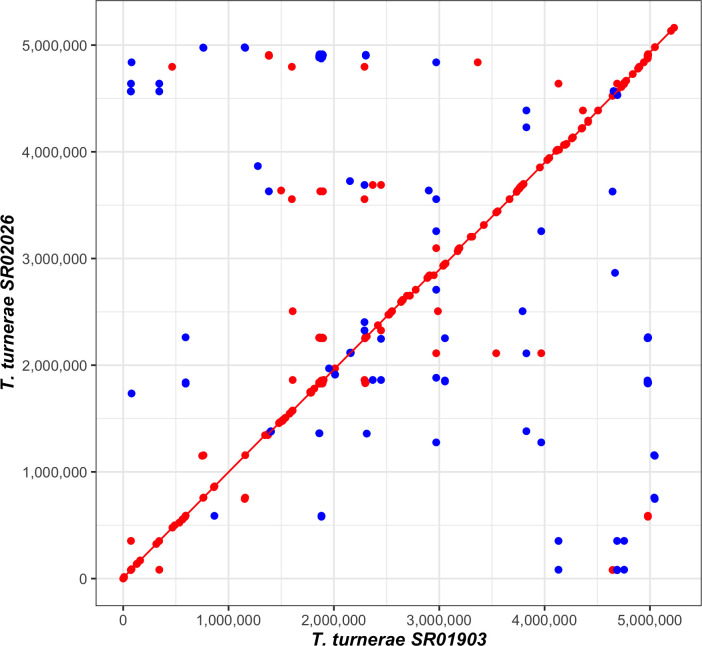 Fig 1
Fig 1| Strain | SR01903 | SR02026 |
|---|---|---|
| Host |
|
|
| Reads | 77,041 | 253,198 |
| Bases (M) | 289.9 | 306.2 |
| Read N50 | 11,088 | 2,331 |
| Assembly (bp) | 5,229,132 | 5,163,139 |
| Coverage | 52× | 44× |
| GC content (%) | 50.9 | 50.9 |
| Genes | 4,207 | 4,142 |
| CDS | 4,152 | 4,086 |
|
|
|
- —NOAA Ocean Explorationhttp://dx.doi.org/10.13039/100018611
- —National Institutes of Healthhttp://dx.doi.org/10.13039/100000002
- —Gordon and Betty Moore Foundationhttp://dx.doi.org/10.13039/100000936
- —National Science Foundationhttp://dx.doi.org/10.13039/501100008982
- —Applied Physics Laboratory, Johns Hopkins Universityhttp://dx.doi.org/10.13039/100012314
Peer Reviews
No public reviews on file for this paper yet. If you reviewed it on a platform where reviews are public (OpenReview, ICLR, NeurIPS, ICML), you can paste yours below so the community can read it here.
Videos
No videos yet. Explain this paper in a talk, walkthrough, or lecture? Add one.
Taxonomy
TopicsInsect symbiosis and bacterial influences · Genomics and Phylogenetic Studies · Parasite Biology and Host Interactions
ANNOUNCEMENT
Teredinibacter species (class: Gammaproteobacteria, family: Cellvibrionaceae) are cultivable intracellular endosymbionts of xylotrophic (wood-eating), bivalve wood-borers (Teredinidae) commonly called shipworms (1–4). Shipworm symbionts secrete lignocellulolytic enzymes that aid shipworm hosts in wood digestion (5, 6), have been the focus of research targeting novel enzyme and drug discovery (6–11), and are key to developing shipworm symbiotic systems as models for symbiosis research. To advance these studies, we present the complete genomes of two strains of Teredinibacter turnerae, the most commonly occurring shipworm symbiont species. Wood containing live specimens of Lyrodus pedicellatus and Teredo bartschi was collected from the Indian River Lagoon, Merit Island, FL (N 28.40605 W 80.66034) on 24 January 2020 and subsequently maintained in laboratory culture as in reference 12. Strain SR01903 was isolated from the gill of a single specimen of L. pedicellatus immediately after collection from the wild. Strain SR02026 was isolated from the gill of a fourth-generation lab-reared specimen of T. bartschi. Bacterial isolations were performed as in O'Connor et al*.* (5). Briefly, gills were removed by dissection and homogenized in 1.0 mL of shipworm basal medium (SBM) (13) in an autoclave sterilized glass dounce homogenizer. Homogenates were streaked onto culture plates containing 1.0% Bacto agar prepared in SBM at pH 8.0 supplemented with 0.2% w/v powdered cellulose (Sigmacell Type 101; Sigma-Aldrich) and 0.025% w/v NH_4_Cl. Plates were then incubated at 30°C. When individual colonies appeared, a single colony was picked, re-streaked, and regrown. This process was repeated until clonal isolates were achieved. Genomic DNA was extracted from the resulting clonal isolates, as in O'Connor et al*.* (5), using the Qiagen DNeasy Blood and Tissue Kit following the manufacturer’s recommended protocol for cultured cells with the exception that DNA was eluted with two 75 µL volumes of AE buffer preheated to 56°C. DNA quality and length were assessed on Tapestation (Agilent Technologies, US). Nanopore (Oxford Nanopore Technologies, UK) sequencing was performed using the Q20+ Chemistry Ligation Sequencing Kit (SQK-LSK112) and sequenced on a MinION (Mk1B) instrument with an R10.4 (FLO-MIN112) flow cell. Bases were called using Guppy v6.4.6 with the high-accuracy algorithm and the default read quality filtering. Adapters were trimmed from reads using Porechop v0.2.4 (https://github.com/rrwick/Porechop) and filtered to remove reads less than 1 Kb using Filtlong v0.2.1 (https://github.com/rrwick/Filtlong). De novo assembly was performed with Flye v2.9.2 (https://github.com/fenderglass/Flye) (14), followed by contig correction and consensus generation with Racon v1.5.0 (https://github.com/lbcb-sci/racon) and Medaka v1.8.0 (https://github.com/nanoporetech/medaka). Assemblies were then circularized and rotated to start at dnaA predicted by prodigal v2.6.3 (15) with Circlator v1.5.5 (https://github.com/sanger-pathogens/circlator) (16). All software were run using default settings unless otherwise noted. Chromosomal assemblies were produced for both strains and annotated using the NCBI Prokaryotic Genome Annotation Pipeline (Table 1) (17). The primary sequences were 98.67% identical based on the calculated average nucleotide identity (18) and highly syntenic (Fig. 1) (19). Both strains are greater than 98% identical to T. turnerae T7901 (1), confirming their taxonomic identity.
Synteny plot comparing the genome sequences of SR01903 and SR02026. A MUMmer3 plot was generated with NUCmer v3.1 (18) using NUCmer to assess synteny and completion. Minimum exact matches of 20 bp are represented as a dot with lines representing match lengths > 20 bp. Forward matches are displayed in red, while reverse matches are shown in blue.
The reference list from the paper itself. Each links out to its DOI / PubMed record.
- 1Yang JC, Madupu R, Durkin AS, Ekborg NA, Pedamallu CS, Hostetler JB, Radune D, Toms BS, Henrissat B, Coutinho PM, et al.. 2009. The complete genome of Teredinibacter turnerae T 7901: an intracellular endosymbiont of marine wood-boring bivalves (shipworms). P Lo S One 4:e 6085. doi:10.1371/journal.pone.000608519568419 PMC 2699552 · doi ↗ · pubmed ↗
- 2Altamia MA, Shipway JR, Stein D, Betcher MA, Fung JM, Jospin G, Eisen J, Haygood MG, Distel DL. 2020. Teredinibacter waterburyi sp. nov., a marine, cellulolytic endosymbiotic bacterium isolated from the gills of the wood-boring mollusc Bankia setacea (Bivalvia: Teredinidae) and emended description of the genus Teredinibacter. Int J Syst Evol Microbiol 70:2388–2394. doi:10.1099/ijsem.0.00404932100688 PMC 7395619 · doi ↗ · pubmed ↗
- 3Altamia MA, Shipway JR, Stein D, Betcher MA, Fung JM, Jospin G, Eisen J, Haygood MG, Distel DL. 2021. Teredinibacter haidensis sp. nov., Teredinibacter purpureus sp. nov. and Teredinibacter franksiae sp. nov., marine, cellulolytic endosymbiotic bacteria isolated from the gills of the wood-boring mollusc Bankia setacea (Bivalvia: Teredinidae) and emended description of the genus Teredinibacter. Int J Syst Evol Microbiol 71:004627. doi:10.1099/ijsem.0.00462733439117 PMC 8346767 · doi ↗ · pubmed ↗
- 4Distel DL, Morrill W, Mac Laren-Toussaint N, Franks D, Waterbury J. 2002. Teredinibacter turnerae gen. nov., sp. nov., a dinitrogen-fixing, cellulolytic, endosymbiotic gamma-proteobacterium isolated from the gills of wood-boring molluscs (Bivalvia: Teredinidae). Int J Syst Evol Microbiol 52:2261–2269. doi:10.1099/00207713-52-6-226112508896 · doi ↗ · pubmed ↗
- 5O’Connor RM, Fung JM, Sharp KH, Benner JS, Mc Clung C, Cushing S, Lamkin ER, Fomenkov AI, Henrissat B, Londer YY, Scholz MB, Posfai J, Malfatti S, Tringe SG, Woyke T, Malmstrom RR, Coleman-Derr D, Altamia MA, Dedrick S, Kaluziak ST, Haygood MG, Distel DL. 2014. Gill bacteria enable a novel digestive strategy in a wood-feeding mollusk. Proc Natl Acad Sci USA 111:E 5096–E 5104. doi:10.1073/pnas.141311011125385629 PMC 4250168 · doi ↗ · pubmed ↗
- 6Sabbadin F, Pesante G, Elias L, Besser K, Li Y, Steele-King C, Stark M, Rathbone DA, Dowle AA, Bates R, Shipway JR, Cragg SM, Bruce NC, Mc Queen-Mason SJ. 2018. Uncovering the molecular mechanisms of lignocellulose digestion in shipworms. Biotechnol Biofuels 11:59. doi:10.1186/s 13068-018-1058-329527236 PMC 5840672 · doi ↗ · pubmed ↗
- 7Fowler CA, Sabbadin F, Ciano L, Hemsworth GR, Elias L, Bruce N, Mc Queen-Mason S, Davies GJ, Walton PH. 2019. Discovery, activity and characterisation of an AA 10 lytic polysaccharide oxygenase from the shipworm symbiont Teredinibacter turnerae. Biotechnol Biofuels 12:232. doi:10.1186/s 13068-019-1573-x 31583018 PMC 6767633 · doi ↗ · pubmed ↗
- 8Fowler C.A, Hemsworth GR, Cuskin F, Hart S, Turkenburg J, Gilbert HJ, Walton PH, Davies GJ. 2018. Structure and function of a glycoside hydrolase family 8 endoxylanase from Teredinibacter turnerae. Acta Crystallogr D Struct Biol 74:946–955. doi:10.1107/S 205979831800973730289404 PMC 6173055 · doi ↗ · pubmed ↗