Complete genome sequence of Streptococcus suis isolated from an aborted bovine fetus and placenta in British Columbia, Canada
Kazal Ghosh, Anatoliy Trokhymchuk, Stephen Raverty

TL;DR
This paper reports the full genome sequence of a Streptococcus suis strain found in an aborted cow fetus and placenta in Canada.
Contribution
The study provides the complete genome sequence of a newly isolated Streptococcus suis strain from bovine abortion cases.
Findings
The genome includes a 2,340,488 bp circular chromosome.
Five circular plasmids with sizes ranging from 2,832 to 5,796 bp were identified.
Abstract
We present the complete genome of Streptococcus suis KKAHC02 isolated from an aborted bovine fetus and placenta in British Columbia, Canada. The genome consists of a circular chromosome of 2,340,488 bp long and five circular plasmids of 5,796, 4,273, 3,973, 3,964, and 2,832 bp, respectively.
Genes, proteins, chemicals, diseases, species, mutations and cell lines named across the full text — each resolved to its canonical identifier and authoritative record.
Click any figure to enlarge with its caption.
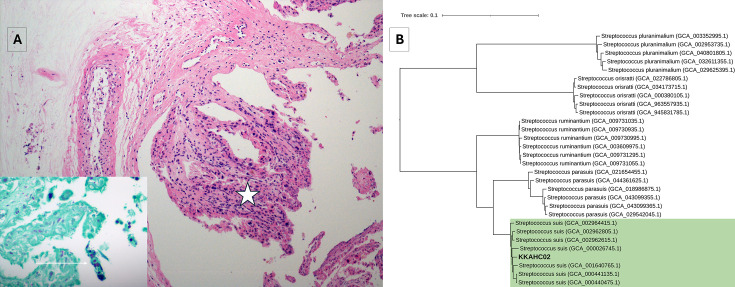 Fig 1
Fig 1| Parameters | Genomic features |
|---|---|
| Genome | Size (bp) and GenBank accession number |
| Chromosome | 2,340,488 ( |
| Plasmids | |
| pKKAHC01 | 5,796 ( |
| pKKAHC02 | 4,273 ( |
| pKKAHC03 | 3,973 ( |
| pKKAHC04 | 3,964 ( |
| pKKAHC05 | 2,832 ( |
| GC content (%) | 41.27 |
| Illumina statistics | |
| Read length | 149 |
| Number of reads (paired, 2×) | 837,511 |
| Mean depth | 53× |
| ONT statistics | |
| | 5,637 |
| Mean read length (bp) | 3,182 |
| Number of reads | 91,297 |
| Total bases | 290,575,824 |
| Coverage | 126× |
| Annotation details | |
| CDSs | 2,285 |
| rRNAs | 12 |
| tRNAs | 57 |
| ncRNAs | 4 |
| Pseudogenes | 100 |
| CRISPR arrays | 1 |
Peer Reviews
No public reviews on file for this paper yet. If you reviewed it on a platform where reviews are public (OpenReview, ICLR, NeurIPS, ICML), you can paste yours below so the community can read it here.
Videos
No videos yet. Explain this paper in a talk, walkthrough, or lecture? Add one.
Taxonomy
TopicsStreptococcal Infections and Treatments · Plant Pathogenic Bacteria Studies · Infections and bacterial resistance
ANNOUNCEMENT
Streptococcus suis is a recognized pathogen of swine with clinical manifestations, including meningitis, septicemia, and endocarditis (1). While its impact on pigs is well documented, its role in other species, especially cattle and humans, is less well understood but is gaining prominence due to its zoonotic potential (2–4). Herein, we present the complete genome of an S. suis isolate recovered in 2021 from the fetus and placenta aborted by a 5-year-old cow in the province of British Columbia (BC).
Histopathology revealed multifocal placentitis with numerous intralesional gram-positive cocci (Fig. 1A). Tissues submitted for routine bacteriology were plated onto Blood and MacConkey agar (Oxoid) and incubated aerobically at 35°C with 5% CO_2_ for 18–24 hours. Colonies were identified by MALDI-TOF MS (Bruker). Heavy growth of S. suis with moderate Escherichia coli was recovered from the placenta and fetal lung. The histopathology and microbiology findings suggested *S. suis-*associated abortion. To our knowledge, this is one of the first reported cases of S. suis in BC’s dairy cattle.
(A) Placentitis with expansion of chorioallantoic villi (star). The inset is a Gram stain; there are numerous gram-positive cocci and diplococci (arrow) with scattered gram-negative bacilli. (B) Midpoint-rooted maximum likelihood phylogenetic tree of S. suis KKAHC02 and some selected S. suis, S. suis-like, and Streptococcus pluranimalium genomes obtained from NCBI GenBank. The tree was obtained with GToTree using the Firmicutes predefined gene set of 119 single-copy genes and default parameters, and the tree was viewed by iTOL.
Bacterial DNA was extracted from pure colonies using the MasterPure Complete DNA and RNA Purification Kit (LGC) for Oxford Nanopore Technologies (ONT) sequencing and the Qiagen DNeasy Blood and Tissue Kit (Qiagen) for Illumina sequencing according to the respective manufacturer’s instructions. DNA concentration and purity were measured with a NanoDrop spectrophotometer (Thermo Fisher Scientific) and quantified with a Qubit 1× dsDNA BR Assay. Nanopore DNA library was prepared with a Native Barcoding Kit (Oxford Nanopore Technologies), loaded onto a flow cell (version 9.4.1), and sequenced for up to 12 hours on a GridION Mk1. ONT reads were basecalled using Guppy (version 5.0). Illumina library preparation followed the DNA Preparation Kit protocol. PhiX control was spiked in at 2% for quality control, and sequencing was performed using the MiniSeq High Output Reagent Kit, with 318 cycles of paired-end 150 bp reads on the Illumina MiniSeq System.
Nanopore reads were demultiplexed, and adaptors were removed using Porechop (version 0.2.4). Sequencing quality was assessed with NanoPlot (version 1.42.0) (5), and low-quality reads were filtered using Chopper (version 0.7.0) (5), selecting reads with a minimum length of 2,000 bp and a q-score of 30. Illumina reads were quality checked using FastQC (version 0.12.1). The KKAHC02 genome was hybrid-assembled with both Nanopore and Illumina reads, circularized, and rotated to DnaA using Unicycler (version 0.5.1) (6). Genome quality was assessed with Quast (version 5.2.0) (7), and completeness was checked using BUSCO (version 5.6.1) (8). Genome annotation was done using PGAP (version 6.9) (9). Chromosomes and contigs matching a plasmid were detected using PlasFlow (10). Default parameters were used except where otherwise noted.
The assembled genome consists of a complete single circular chromosome and five circular plasmids (Table 1). BUSCO analysis indicated 98.4% genome completeness. GC content and annotation details are provided in Table 1. Furthermore, we constructed a phylogenetic tree of KKAHC02 and some selected S. suis, S. suis-like (Streptococcus ruminantium, Streptococcus orisratti, and Streptococcus parasuis), and S. pluranimalium genomes with GToTree (11) using the Firmicutes predefined gene set of 119 single-copy genes. The isolate from this study clustered with S. suis genomes (Fig. 1B).
The reference list from the paper itself. Each links out to its DOI / PubMed record.
- 1Staats JJ, Feder I, Okwumabua O, Chengappa MM. 1997. Streptococcus suis: past and present. Vet Res Commun 21:381–407. doi:10.1023/a:10058703177579266659 · doi ↗ · pubmed ↗
- 2Núñez JM, Marcotullio M, Rojas A, Acuña L, Cáceres M, Mochi S. 2013. First case of meningitis by Streptococcus suis in the norwest area of Argentina. Rev Chilena Infectol 30:554–556. doi:10.4067/S 0716-1018201300050001424248172 · doi ↗ · pubmed ↗
- 3Okwumabua O, Williamson CHD, Pearson TR, Sahl JW. 2020. Draft genome sequence of a Streptococcus suis isolate from a case of cattle meningitis. Microbiol Resour Announc 9:00153–20. doi:10.1128/MRA.00153-20PMC 720648232381604 · doi ↗ · pubmed ↗
- 4Zhu Y, Zhu F, Bo L, Fang Y, Shan X. 2021. A rare case of meningitis and septicemia caused by Streptococcus suis in a woman without a history of live pig contact or eating raw pork. Braz J Microbiol 52:2007–2012. doi:10.1007/s 42770-021-00619-834559387 PMC 8460845 · doi ↗ · pubmed ↗
- 5De Coster W, Rademakers R. 2023. Nano Pack 2: population-scale evaluation of long-read sequencing data. Bioinformatics 39:btad 311. doi:10.1093/bioinformatics/btad 31137171891 PMC 10196664 · doi ↗ · pubmed ↗
- 6Wick RR, Judd LM, Gorrie CL, Holt KE. 2017. Unicycler: resolving bacterial genome assemblies from short and long sequencing reads. PLOS Comput Biol 13:e 1005595. doi:10.1371/journal.pcbi.100559528594827 PMC 5481147 · doi ↗ · pubmed ↗
- 7Mikheenko A, Prjibelski A, Saveliev V, Antipov D, Gurevich A. 2018. Versatile genome assembly evaluation with QUAST-LG. Bioinformatics 34:i 142–i 150. doi:10.1093/bioinformatics/bty 26629949969 PMC 6022658 · doi ↗ · pubmed ↗
- 8Manni M, Berkeley MR, Seppey M, Simão FA, Zdobnov EM. 2021. BUSCO update: novel and streamlined workflows along with broader and deeper phylogenetic coverage for scoring of eukaryotic, prokaryotic, and viral genomes. Mol Biol Evol 38:4647–4654. doi:10.1093/molbev/msab 19934320186 PMC 8476166 · doi ↗ · pubmed ↗