Draft genome sequences of two Stenotrophomonas sp. isolates obtained from the venom of the tarantula Stichoplastoris elusinus (Araneae: Theraphosidae)
Juan Carlos Cambronero-Heinrichs, Daniela Wicki-Emmenegger, Noelia Rechnitzer, Carlos Víquez, Max Chavarría

TL;DR
This paper reports the genome sequences of two bacteria found in the venom of a tarantula, showing they have antibiotic resistance genes important to human and animal health.
Contribution
The discovery of antibiotic resistance genes in Stenotrophomonas sp. from tarantula venom is novel and relevant to health.
Findings
Two Stenotrophomonas sp. isolates were sequenced from tarantula venom.
The isolates are closely related to Stenotrophomonas muris.
Multiple antibiotic resistance genes were identified in the genomes.
Abstract
Genome sequences of two Stenotrophomonas sp. strains are reported. Isolates were obtained from the venom of the tarantula Stichoplastoris elusinus (Araneae: Theraphosidae) and are closely related to the recently described Stenotrophomonas muris. The announcement highlights the presence of multiple antibiotic resistance genes and their relevance to veterinary and human health.
Genes, proteins, chemicals, diseases, species, mutations and cell lines named across the full text — each resolved to its canonical identifier and authoritative record.
Click any figure to enlarge with its caption.
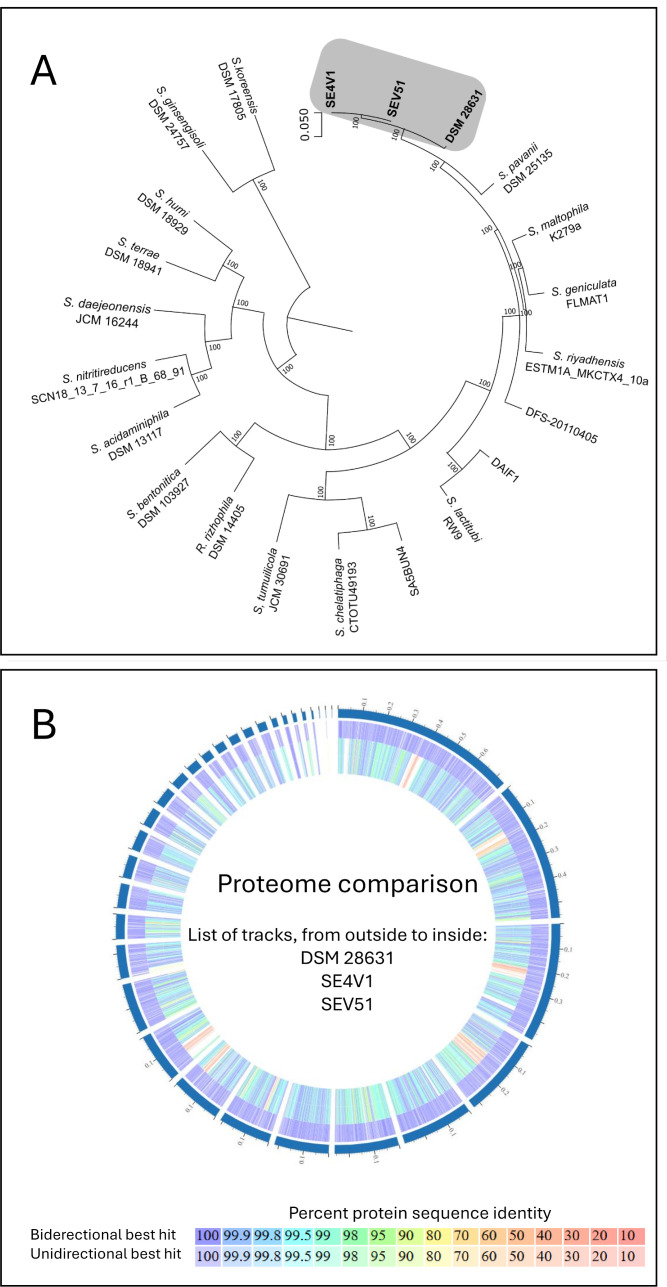 Fig 1
Fig 1| BioSample accession no |
|
|
| Assembly accession no. |
|
|
| No. of raw reads | 12,279,814 | 11,871,790 |
| Genome size (bp) | 4,641,908 | 4,501,221 |
| No. of contigs | 32 | 28 |
| No. of predicted genes | 4,317 | 4,178 |
| G + C content (%) | 66.85 | 66.97 |
| N50 (bp) | 499,905 | 329,043 |
| Coverage (1×) (%) | 100.0 | 100.0 |
| No. of tRNA | 70 | 68 |
| No. of rRNA | 2 | 2 |
- —CeNAT scholarship, Centro Nacional de Alta Tecnologia (CeNAT-CONARE)
Peer Reviews
No public reviews on file for this paper yet. If you reviewed it on a platform where reviews are public (OpenReview, ICLR, NeurIPS, ICML), you can paste yours below so the community can read it here.
Videos
No videos yet. Explain this paper in a talk, walkthrough, or lecture? Add one.
Taxonomy
TopicsVenomous Animal Envenomation and Studies · Genomics and Phylogenetic Studies · Biochemical and Structural Characterization
ANNOUNCEMENT
Venomous animals have evolved toxins that target vital systems of prey (1). Following envenomation, complications like wound infections may arise, either from secondary sources or direct bacterial inoculation during bites (2, 3). Recent studies suggested that venoms are not sterile but host viable bacteria resistant to toxins (2). Bacteria of the genus Stenotrophomonas have been consistently found in the venom of Theraphosidae tarantulas from Costa Rica and India (2, 4, 5). Although it is unclear whether these bacteria are true associates of the venom, as they are also abundant in the tarantula gut (4, 5), their presence warrants further study. Here, we report genome sequences of two Stenotrophomonas sp. isolates from the venom of Stichoplastoris elusinus (Araneae: Theraphosidae) from Alajuela, Costa Rica (4).
Venom was extracted via electric shocks and plated on lysogeny broth agar (Sigma-Aldrich, USA) for bacterial isolation (4). Isolates stored in 20% glycerol at –80°C were cultured in lysogeny broth (150 mL) (6) and incubated overnight (180 rpm, 30°C). Genomic DNA was extracted using the cetyltrimethylammonium bromide protocol (7), and its quality and quantity were assessed by gel electrophoresis, a NanoDrop ND-2000 spectrophotometer, and a Qubit 4 fluorometer (Thermo Fisher Scientific, USA). A paired-end library was prepared with the Illumina Nextera XT kit (Illumina, USA) and sequenced on a NovaSeq PE150 system by Novogene Ltd. (Singapore). Raw data quality was evaluated using FastQC v0.11.9 (8), with low-quality reads and adapter sequences filtered via Trimmomatic v0.36 (9). Reads were assembled using SPADES v5.2.0 (10) and polished with Pilon v1.24 (11). Contigs smaller than 200 bp were removed manually. Assembly quality was assessed with QUAST v5.2.0 (12), and genome annotation was performed using the NCBI annotation service (13). The default parameters were used for all software. Genome assembly statistics and annotation features are detailed in Table 1.
The phylogenomic analysis conducted on PATRIC identified Stenotrophomonas sp. DSM 28631 as the closest relative to both strains (Fig. 1A) (13). Comparative analysis using OrthoANIu (14, 15) revealed similarity values > 98.9% between DSM 28631 and our isolates. PATRIC’s proteome comparison (16) further highlights the distinction between the isolates under study and the reference genome (Fig. 1B). DSM 28631 is the type strain of Stenotrophomonas muris, a species recently described in the gut microbiota of mice and found in plant microbiota, rhizosphere, and wastewater (17). It was recently identified as a virulent human pathogen (18). However, according to the List of Prokaryotic Names, S. muris is a preferred but not formally correct name (19); we therefore maintained the designation as Stenotrophomonas sp. Virulence factors analysis reveals multiple genes in both strains associated with type IV pili but no flagella genes (20). Both strains carry several antibiotic resistance genes, including aminoglycoside phosphotransferases, and multiple efflux pumps (16). The presence of these strains in tarantula venom should be highlighted due to their relevance to veterinary and human health.
Phylogenomic analysis and proteome comparison of Stenotrophomonas sp. strains under study and the reference genome DSM 28631. (A) Phylogenomic tree constructed using 100 genes, showing the isolates SE4V1 and SEV51 (bold) obtained from the venom of the tarantula Stichoplastoris elusinus (Araneae: Theraphosidae), along with other strains from the genus Stenotrophomonas. Only reference genomes, apart from the strains under study, were included. The closest relative for both sequenced isolates in this study is DSM 28631 (bold), which corresponds to the reference genome of Stenotrophomonas muris, a recently described species. Numbers above the branches indicate posterior probabilities, and the scale bar represents the number of substitutions per unit of evolutionary distance. (B) Proteome comparison obtained by PATRIC’s tool (16) between both strains under study and the reference genome DSM 28631.
The reference list from the paper itself. Each links out to its DOI / PubMed record.
- 1Calvete JJ, Sanz L, Angulo Y, Lomonte B, Gutiérrez JM. 2009. Venoms, venomics, antivenomics. FEBS Lett 583:1736–1743. doi:10.1016/j.febslet.2009.03.02919303875 · doi ↗ · pubmed ↗
- 2Esmaeilishirazifard E, Usher L, Trim C, Denise H, Sangal V, Tyson GH, Barlow A, Redway KF, Taylor JD, Kremyda-Vlachou M, Davies S, Loftus TD, Lock MMG, Wright K, Dalby A, Snyder LAS, Wuster W, Trim S, Moschos SA. 2022. Bacterial adaptation to venom in snakes and arachnida. Microbiol Spectr 10:e 0240821. doi:10.1128/spectrum.02408-2135604233 PMC 9248900 · doi ↗ · pubmed ↗
- 3Bonilla-Aldana DK, Bonilla-Aldana JL, Ulloque-Badaracco JR, Al-Kassab-Córdova A, Hernandez-Bustamante EA, Alarcon-Braga EA, Siddiq A, Benites-Zapata VA, Rodriguez-Morales AJ, Luna C, Suarez JA. 2024. Snakebite-associated infections: a systematic review and meta-analysis. Am J Trop Med Hyg 110:874–886. doi:10.4269/ajtmh.23-027838507793 PMC 11066359 · doi ↗ · pubmed ↗
- 4Viquez C, Rojas-Gätjens D, Mesén-Porras E, Avendaño R, Sasa M, Lomonte B, Chavarría M. 2024. Venom-microbiomics of eight species of Neotropical spiders from the Theraphosidae family. J Appl Microbiol 135:lxae 113. doi:10.1093/jambio/lxae 11338692848 · doi ↗ · pubmed ↗
- 5Zhao L, Zhang S, Xiao R, Zhang C, Lyu Z, Zhang F. 2024. Diversity and functionality of bacteria associated with different tissues of spider Heteropoda venatoria revealed through integration of high-throughput sequencing and culturomics approaches. Microb Ecol 87:67. doi:10.1007/s 00248-024-02383-238703220 PMC 11069485 · doi ↗ · pubmed ↗
- 6Bertani G. 2004. Lysogeny at mid-twentieth century: P 1, P 2, and other experimental systems. J Bacteriol 186:595–600. doi:10.1128/JB.186.3.595-600.200414729683 PMC 321500 · doi ↗ · pubmed ↗
- 7Anderson KL, Lebepe-Mazur S. 2003. Comparison of rapid methods for the extraction of bacterial DNA from colonic and caecal lumen contents of the pig. J Appl Microbiol 94:988–993. doi:10.1046/j.1365-2672.2003.01917.x 12752806 · doi ↗ · pubmed ↗
- 8Andrews S. 2010. Fast QC: a quality control tool for high throughput sequence data. Babraham Inst. Available from: https://www.bioinformatics.babraham.ac.uk/projects/fastqc. Retrieved 10 Nov 2024.