Complete genome sequence of Campylobacter sp. GTC17093 isolated from human skin infection
Jun Yonetamari, Masahiro Hayashi, Yoshinori Muto, Kaori Tanaka

TL;DR
This paper presents the full genome sequence of a new Campylobacter species found in a human skin infection.
Contribution
The study provides the complete genome sequence of a newly identified Campylobacter species from a human source.
Findings
The genome consists of a 1,660,156 bp circular chromosome.
The species was isolated from a human skin infection, indicating its potential clinical relevance.
Abstract
Campylobacter, a microaerophilic, Gram-negative spirillum, has been isolated from both animal and human specimens; however, most identified species are of animal origin. Here, we report the complete genome sequence of a new Campylobacter species, consisting of a 1,660,156 bp circular chromosome, isolated from a human skin infection.
Genes, proteins, chemicals, diseases, species, mutations and cell lines named across the full text — each resolved to its canonical identifier and authoritative record.
Click any figure to enlarge with its caption.
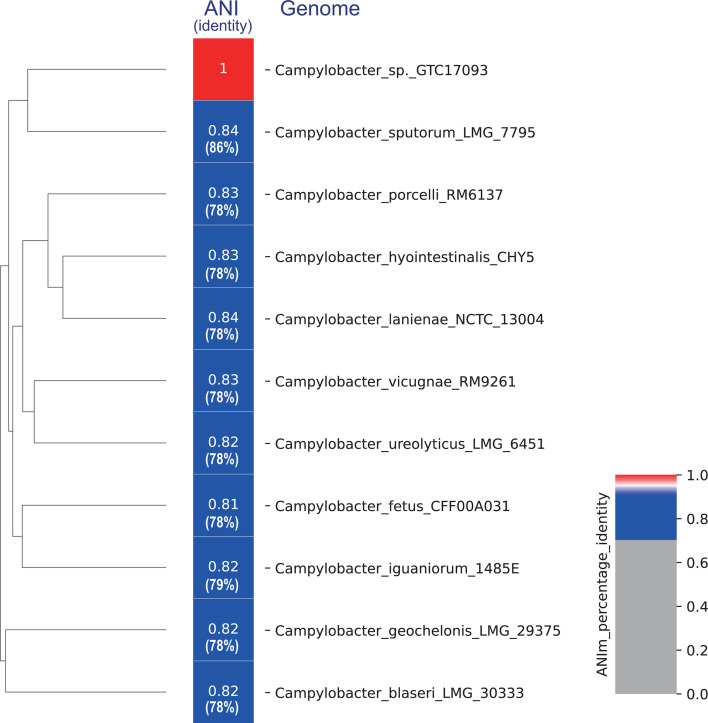 Fig 1
Fig 1| Strain name | ||
|---|---|---|
| Parameter | ||
| GTC17093 | ||
| Illumina sequencing | ||
| No. of reads | 1,921,262 | |
| Size (kb) | 284,813 | |
| Avg coverage (x) | 172 | |
| DRA accession no. |
| |
| ONT sequencing | ||
| No. of reads | 170,285 | |
| Size (kb) | 1,243,671 | |
| Avg read length (bp) | 10,808 | |
| Avg coverage (x) | 749 | |
| N50 | 13,944 | |
| DRA accession no. |
| |
| Assembly | ||
| Estimated genome completeness (%) | 100.0 | |
| Estimated genome contamination (%) | 0.0 | |
| Genome structure | one chromosome | |
| DDBJ/GenBank accession no. |
| |
| Genome size (bp) | 1,660,156 | |
| GC content (%) | 30.4 | |
| No. of coding sequences | 1,665 | |
| Number of rRNAs | 9 | |
| Number of tRNAs | 46 | |
| Number of CRISPRs | 1 | |
Peer Reviews
No public reviews on file for this paper yet. If you reviewed it on a platform where reviews are public (OpenReview, ICLR, NeurIPS, ICML), you can paste yours below so the community can read it here.
Videos
No videos yet. Explain this paper in a talk, walkthrough, or lecture? Add one.
Taxonomy
TopicsSalmonella and Campylobacter epidemiology · Bacteriophages and microbial interactions · Plant Pathogenic Bacteria Studies
ANNOUNCEMENT
Campylobacter species are Gram-negative, curved, or spiral-shaped bacteria, with a single polar flagellum at one or both ends or no flagellum (1). Campylobacter jejuni and Campylobacter coli are the most studied species, while the epidemiology and clinical roles of less common species remain poorly understood (2, 3). The strain GTC17093 used in this study was submitted for genetic analysis by a hospital located in Aichi, Japan. It was isolated from an epidermal cyst on the right chest of an adult patient during incision and drainage. This research was performed in accordance with the Declaration of Helsinki.
The sample was cultured anaerobically on Brucella HK agar plates (Kyokuto Pharmaceutical Industrial, Tokyo, Japan) with 5% sheep blood and incubated at 37°C for 48 h. The strain was subcultured three times under the same conditions. Genomic DNA was extracted from the pellet using Quick Taq HS DyeMix (TOYOBO Co., Ltd., Osaka, Japan) for all genome analyses.
The genome was sequenced using Oxford Nanopore Technologies long-read sequencing and Illumina short-read sequencing (4–6). For long-read sequencing, a library was prepared using the SQK-LSK-110 ligation kit (Oxford Nanopore Technologies [ONT]) without shearing, and small fragments were removed using a Short Read Eliminator XS (Circulomics, Baltimore, USA). Sequencing was performed on a GridION X5 (7) with a FLO-MIN106 flow cell (ONT). Guppy v.7.0.9 (super accuracy mode) was used for base calling, and reads were filtered using NanoFilt v.2.7.1 (8) with “-l 1000 -q 10 –headcrop 50.” For short-read sequencing, a library was prepared using an Illumina DNA Prep (M) Tagmentation Kit, and 2 × 151 bp paired-end sequencing was performed on a NovaSeq 6000 platform (Illumina, USA). Reads were processed using fastp v.0.20.1 (6) with “-q 30 -n 20 -t 1 -T 1.” Read quality was checked using Fastp and NanoPlot v.1.32.1 (8). Sequences were assembled using Unicycler v.0.4.8 (9) with default settings. The assembly was rotated to start with the dnaA gene, and Blobtools v.1.0 (10) was used to confirm data integrity. Average nucleotide identity (ANI) analysis was conducted using PyANI v.0.2.12 (ANIm algorithm) (11).
Genomic data are summarized in Table 1. Genome completeness and contamination were assessed using CheckM (v1.2.2), confirming 100.0% completeness and 0.0% contamination. The DDBJ Fast Annotation and Submission Tool (12) predicted 1,665 coding sequences, nine ribosomal RNAs, 46 transfer RNAs, and one CRISPR. Analysis of the 16S rRNA gene obtained from the genome sequence showed that Campylobacter sputorum LMG 7795 was the closest strain, with 98.1% identity. However, species identification with the genome sequence using GTDB-tK (v.2.3.2) was unsuccessful. BLASTN analysis of the complete genome sequence revealed that GTC17093 is most closely related to several Campylobacter species with ANI values between 81% and 84% (Fig. 1). The highest ANI value (84.0%) was observed with Campylobacter sputorum LMG 7795 (GenBank accession number: GCA008245005.1). However, the strain could not be decisively classified at the species level.
ANI heatmap, generated using PyANI (v.0.2.12) employing the ANIm algorithm, for GTC17093 genome and top 10 closest genomes identified via BLASTN analysis of the whole-genome sequence. The ANIm values are presented in the heat map; sequence identity values obtained via BLASTN analysis are indicated in the brackets.
The reference list from the paper itself. Each links out to its DOI / PubMed record.
- 1Kaakoush NO, Castaño-Rodríguez N, Mitchell HM, Man SM. 2015. Global epidemiology of Campylobacter infection. Clin Microbiol Rev 28:687–720. doi:10.1128/CMR.00006-1526062576 PMC 4462680 · doi ↗ · pubmed ↗
- 2Iraola G, Pérez R, Naya H, Paolicchi F, Pastor E, Valenzuela S, Calleros L, Velilla A, Hernández M, Morsella C. 2014. Genomic evidence for the emergence and evolution of pathogenicity and niche preferences in the genus Campylobacter. Genome Biol Evol 6:2392–2405. doi:10.1093/gbe/evu 19525193310 PMC 4202331 · doi ↗ · pubmed ↗
- 3Liu F, Ma R, Wang Y, Zhang L. 2018. The clinical importance of Campylobacter concisus and other human hosted Campylobacter species. Front Cell Infect Microbiol 8:243. doi:10.3389/fcimb.2018.0024330087857 PMC 6066527 · doi ↗ · pubmed ↗
- 4Sydenham TV, Overballe-Petersen S, Hasman H, Wexler H, Kemp M, Justesen US. 2019. Complete hybrid genome assembly of clinical multidrug-resistant Bacteroides fragilis isolates enables comprehensive identification of antimicrobial-resistance genes and plasmids. Microb Genom 5:e 000312. doi:10.1099/mgen.0.00031231697231 PMC 6927303 · doi ↗ · pubmed ↗
- 5Vu H, Muto Y, Hayashi M, Noguchi H, Tanaka K, Yamamoto Y. 2022. Complete genome sequences of three phocaeicola vulgatus strains isolated from a healthy Japanese individual. Microbiol Resour Announc 11:e 0112421. doi:10.1128/mra.01124-2135112912 PMC 8812301 · doi ↗ · pubmed ↗
- 6Hayashi M, Yonetamari J, Muto Y, Tanaka K. 2024. Complete genome sequence of Peptostreptococcus porci isolated from porcine endocarditis in Japan . Microbiol Resour Announc 13:e 0020124. doi:10.1128/mra.00201-2438842319 PMC 11256772 · doi ↗ · pubmed ↗
- 7European Food Safety Authority and European Centre for Disease Prevention and Control (EFSA and ECDC). 2018. The European Union summary report on trends and sources of zoonoses, zoonotic agents and food-borne outbreaks in 2017. EFSA J 10.2903/j.efsa.2018.5500 PMC 700954032625785 · doi ↗ · pubmed ↗
- 8De Coster W, D’Hert S, Schultz DT, Cruts M, Van Broeckhoven C. 2018. Nano Pack: visualizing and processing long-read sequencing data. Bioinformatics 34:2666–2669. doi:10.1093/bioinformatics/bty 14929547981 PMC 6061794 · doi ↗ · pubmed ↗